Best AM5 CPU for Gaming in 2026 (Top Ryzen Picks Compared)
What is the best AM5 CPU for gaming in 2026?
The Ryzen 7 9800X3D. It tops every major benchmark, delivers the smoothest frame times in CPU-intensive titles, and sits at a price most serious builders can justify. Tom’s Hardware, PCGamesN, GamersNexus, and Club386 all land on the same conclusion.
But the 9800X3D is not the right pick for everyone. Budget builders, content creators who also game, and 4K players each have a different answer. This guide covers every tier of the AM5 lineup with real benchmark data so you can match the chip to your actual setup.

Why AM5 Still Makes Sense in 2026
AM5 launched in late 2022 and AMD has confirmed platform support through at least 2027, with strong indications it will extend beyond that. Zen 6 CPUs, expected in late 2026, will drop into existing AM5 motherboards with a BIOS update. That means an AM5 board you buy today stays relevant for the next CPU generation.
DDR5 memory, which AM5 requires, has dropped significantly in price since launch. A 32GB DDR5-6000 CL30 kit now costs between $80 and $120, which makes the platform cost comparable to older alternatives. For gaming specifically, DDR5-6000 is the sweet spot. Going higher produces diminishing returns in FPS.
If you are debating whether to build AM5 in 2026, the answer is yes. The platform is mature, BIOS support is universal, and you have a clear upgrade path already visible on the roadmap.
Why Is the Ryzen 7 9800X3D the Best AM5 CPU for Gaming?
The Ryzen 7 9800X3D is the best Ryzen AM5 gaming processor available in 2026. If you are searching for the top Ryzen AM5 gaming processor across every budget tier, this guide covers them all. It combines Zen 5 architecture with AMD’s second-generation 3D V-Cache technology, stacking 96MB of L3 cache directly on top of the chiplets. That cache dramatically reduces the number of times the CPU has to reach out to slower system memory during gameplay, which shows up as higher average FPS and significantly better 1% lows.
GamersNexus testing put the 9800X3D at the top of their gaming benchmark suite. Independent testing across 14 games showed an average 35 percent improvement over standard processors in CPU-limited scenarios. The 16 percent improvement in 1% lows compared to the previous generation means noticeably smoother gameplay in demanding open-world titles and competitive shooters.
At 120W TDP, it runs cooler than you might expect. A quality 240mm AIO or a high-end tower air cooler like the Noctua NH-D15 handles it without issue. Exotic cooling is not required.
The 9800X3D tops out at around 5.5 GHz all-core stable. It does not respond meaningfully to traditional overclocking because the 3D V-Cache limits voltage headroom, but it does benefit from memory tuning. Running DDR5-6000 CL30 with EXPO enabled in BIOS extracts the best performance.
Best for: 1080p and 1440p high refresh rate gaming. This is the Ryzen AM5 gaming processor most builders should default to in 2026, competitive shooters, CPU-intensive open-world games, anyone who wants the best gaming performance without a flagship price tag.
Not ideal for: 4K-only players where the GPU bottlenecks before the CPU matters, pure content creators who need multicore more than gaming performance.
Why Choose the Ryzen 7 7800X3D?
The Ryzen 7 7800X3D launched on the previous generation of Zen architecture but still belongs in the conversation for 2026 builds. It uses the first-generation 3D V-Cache design with 96MB of L3 cache on an 8-core Zen 4 base.
In most gaming scenarios, the 7800X3D delivers 95 percent of the 9800X3D’s gaming performance at roughly $100 less. That gap narrows further at 1440p and disappears almost entirely at 4K. For a player gaming at 1440p on a 144Hz monitor, the real-world difference between these two chips is measured in single-digit frame rates.
The platform is fully mature. BIOS support is comprehensive, any DDR5 memory kit works reliably, and cooler compatibility is well-documented. There are no early-adopter surprises left to discover.
Best for: Budget-conscious builders who want X3D performance, 1440p gaming at 144Hz, anyone stepping up from an older platform without paying flagship prices.
Not ideal for: Builders who want the latest Zen 5 efficiency improvements or those who plan to add content creation workloads later.
Why Is the Ryzen 5 9600X the Best Budget AM5 CPU?
The Ryzen 5 9600X is the performance-per-dollar leader in the AM5 lineup. At under $200, it delivers Zen 5 architecture, a 5.4 GHz boost clock, and a 65W TDP that barely stresses any cooler on the market.
Paired with a capable GPU like the RTX 4070 Super or RX 7800 XT, the 9600X delivers frame rates within 6 to 8 percent of the 9800X3D at 1440p. At 4K, the deficit disappears entirely because the GPU becomes the bottleneck before the CPU ever becomes relevant.
The 65W power draw means it runs cool and quiet. A $40 to $60 tower air cooler is all it needs. The money saved over the 9800X3D can go toward a better GPU, which produces a larger real-world impact on most gaming scenarios than closing that 6 to 8 percent CPU gap.
Best for: Budget builders, first-time AM5 buyers, 1440p gaming on a tight budget, anyone who wants a future upgrade path without paying for the top chip now.
Not ideal for: Competitive players at 1080p who want maximum FPS, heavy multitasking alongside gaming.
Why Choose the Ryzen 9 9950X3D?
The Ryzen 9 9950X3D is a 16-core, 32-thread chip with 128MB of L3 cache and a 5.7 GHz max boost clock. It launched in March 2025 at $700 and targets users who cannot separate their gaming machine from their workstation.
In Blender’s BMW benchmark, the 9950X3D rendered in 28.3 seconds. The 9800X3D took 48.9 seconds on the same test. That 42 percent advantage in multithreaded rendering is the reason the 9950X3D exists. For a creator who streams, edits video, and games on the same machine, this chip eliminates the compromise.
For pure gaming, the 9950X3D performs within 1 percent of the 9800X3D in most titles. GamersNexus testing confirmed this. The extra cores deliver no meaningful FPS advantage in games, but they cost you nothing in gaming performance either. You pay the premium entirely for the productivity workloads.
Best for: Streamers, video editors, 3D artists, and developers who also game on the same machine. Anyone whose workload genuinely scales with core count.
Not ideal for: Pure gamers. The 9950X3D costs twice the 9800X3D for identical gaming performance. Spend the difference on a better GPU or monitor.
How Do the Best AM5 CPUs Compare?
| CPU | Cores | Boost Clock | TDP | L3 Cache | Best Use Case | Approx Price |
| Ryzen 7 9800X3D | 8 | 5.5 GHz | 120W | 96MB | Best overall gaming | ~$450 |
| Ryzen 7 7800X3D | 8 | 5.0 GHz | 120W | 96MB | Best value gaming | ~$350 |
| Ryzen 5 9600X | 6 | 5.4 GHz | 65W | 32MB | Best budget gaming | ~$186 |
| Ryzen 9 9950X3D | 16 | 5.7 GHz | 170W | 128MB | Gaming plus creation | ~$700 |
| Ryzen 7 9700X | 8 | 5.5 GHz | 65W | 32MB | Gaming plus multitasking | ~$280 |
| Ryzen 5 7600X | 6 | 5.3 GHz | 105W | 32MB | Entry-level budget | ~$160 |
Still deciding between platforms? Read our AMD vs Intel comparison to see how Ryzen AM5 processors stack up against Intel’s latest Core CPUs for gaming, productivity, and overall value.
How Resolution Changes the Right Pick
Resolution is the most important factor most buyers ignore when choosing a gaming CPU.
At 1080p high refresh rate, the CPU matters most. Games running at 200 to 300 FPS on a 240Hz monitor push the CPU hard. The 9800X3D’s cache advantage shows up most clearly here, with double-digit FPS leads over non-X3D chips in titles like CS2, Valorant, and Rainbow Six Siege.
At 1440p 144Hz, the 7800X3D and 9800X3D are very close. The 9600X also performs well here, staying within 6 to 8 percent of the flagship. This is the resolution where value considerations matter most, because the 9600X leaves enough performance on the table that a better GPU matters more than a better CPU.
At 4K, the GPU becomes the bottleneck in almost every scenario. A Ryzen 5 9600X and a Ryzen 7 9800X3D deliver nearly identical frame rates when paired with the same GPU at 4K. Spending $450 on a CPU for a 4K gaming rig is the wrong allocation of budget compared to spending that money on the GPU.
| Resolution | Best CPU Pick | Why |
| 1080p 144Hz and above | Ryzen 7 9800X3D | Cache advantage shows most at high frame rates |
| 1440p 144Hz | Ryzen 7 7800X3D | 95% of the performance at lower cost |
| 1440p 240Hz | Ryzen 7 9800X3D | Extra headroom justifies the premium |
| 4K 60Hz or 120Hz | Ryzen 5 9600X | GPU bottlenecks before CPU matters |
What to Buy Alongside Your AM5 CPU
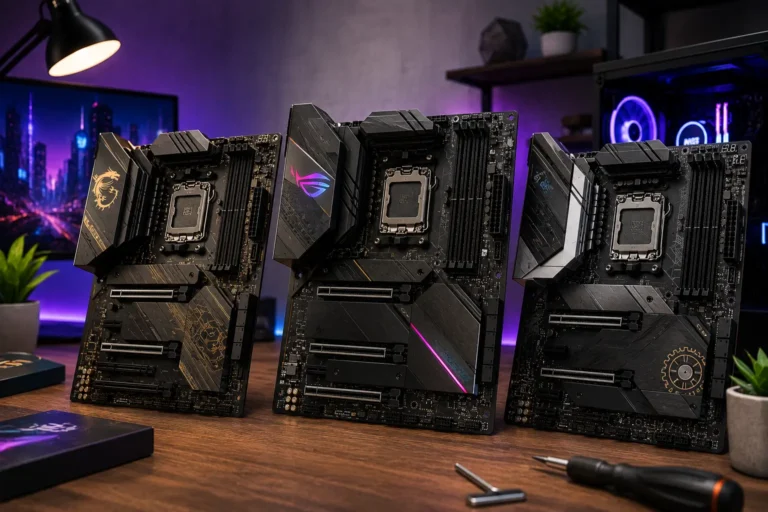
Motherboard: B650 chipset motherboards give you PCIe 5.0 for the GPU and cost less than X670 boards. X670E is only worth considering if you need PCIe 5.0 on both the GPU and NVMe SSD simultaneously. For most gaming builds, B650 is the right chipset. Budget around $150 to $250.
Memory: DDR5-6000 CL30 is the sweet spot for AM5 gaming. Going higher than 6000MHz produces returns too small to measure in most games. Budget around $80 to $120 for a 32GB kit. Enable EXPO in BIOS after first boot.
Cooler: The Ryzen 5 9600X runs fine on a $40 to $60 air cooler. The Ryzen 7 9800X3D and 7800X3D benefit from a 240mm AIO or a premium tower cooler like the Noctua NH-D15. The 9950X3D is the only chip in this lineup that benefits from a 360mm AIO.
PSU: 650W covers any 6-core AM5 build. 750W handles an 8-core CPU paired with an RTX 4070 Ti or RX 7900 XT. Budget 850W or higher if you plan to pair the 9950X3D with a top-tier GPU.
Need help choosing the right board? Our Best AM5 Motherboard guide compares the top B650 and X670 options for gaming, overclocking, and future upgrades.
Frequently Asked Questions
Conclusion
The best AM5 CPU for gaming in 2026 is the Ryzen 7 9800X3D for most builders. It leads every gaming benchmark, runs cool on a mid-range cooler, and sits at a price that serious gaming builds can accommodate.
The Ryzen 7 7800X3D is the value pick that makes sense if the 9800X3D premium feels hard to justify for your specific resolution and refresh rate. The Ryzen 5 9600X is the right answer for budget builders and 4K players where GPU performance dominates the equation.
Match the chip to your resolution, your GPU, and your workload. That combination decides your frame rates far more than chasing the most expensive processor on the list.