Is 16GB RAM Good for Gaming in 2026? (Honest Answer)
You bought a PC with 16GB RAM, or you are about to, and you want a straight answer before you find out the hard way mid-session.
Here it is: yes, 16GB RAM is good for gaming in 2026, but it comes with a condition it did not carry two years ago. It went from the comfortable sweet spot to the working minimum. Most games still run. You just have less breathing room than before when everything else is open too.
Many people searching is 16gb ram good for gaming expect a simple yes or no. The real answer depends on what games you play, how many apps stay open, and whether your sticks are running in dual channel. All three matter.
This guide gives you the real numbers, a game-by-game breakdown, and a clear answer on whether you need to upgrade right now.
What RAM Actually Does in Gaming
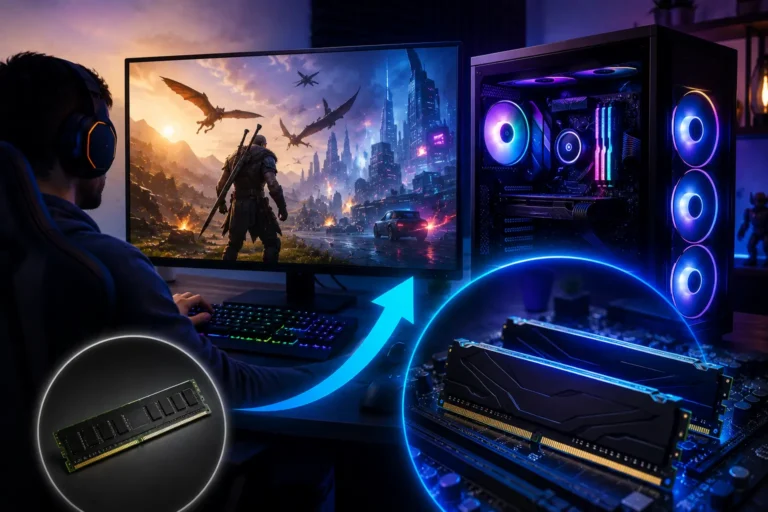
RAM is where your game stages its data while it runs. Textures, map geometry, NPC states, and audio all load from your SSD into RAM so your CPU and GPU can grab them instantly. When RAM fills up, the system spills back to the SSD and that is where stutters come from.
Your GPU controls frame rate. RAM controls smoothness, specifically 1% lows, asset loading times, and traversal stutter in open-world games. A game can average 90 FPS on 16GB and still hitch every time you cross into a new area because assets are swapping in and out constantly. Average FPS hides this. Frame pacing reveals it.
Is 16GB RAM Good for Gaming in 2026?
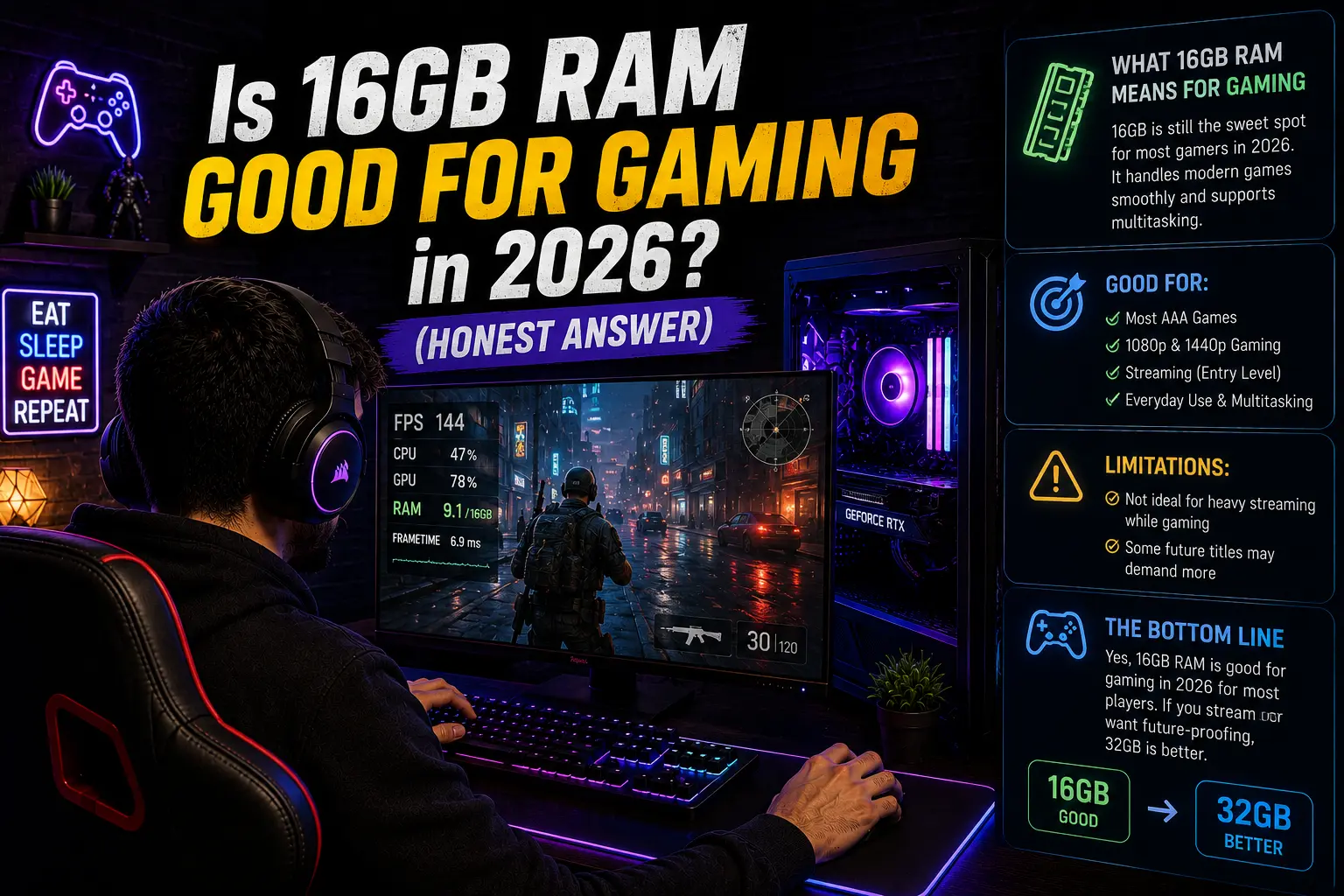
Yes, with one condition: 16GB needs to be your main workload, not one of five things competing for memory at once.
Real-world 2026 benchmark data from Tech2Geek and NoobFeed’s multi-title RAM analysis confirms that 16GB and 32GB ram deliver nearly identical performance in most titles when the game runs without heavy background load. The gap appears when everything else is open too.
Here is what a typical 2026 gaming session actually uses before the game even launches:
RAM Usage Before the Game Loads
| Process | RAM Used |
|---|---|
| Windows 11 | 4 to 6 GB |
| Chrome with 6 to 10 tabs | 1.4 to 2 GB |
| Discord with voice chat | 0.5 to 0.8 GB |
| Steam or Epic Games launcher | 0.3 to 0.5 GB |
| RGB software (Razer, Corsair) | 0.3 to 0.5 GB per app |
| Total before game loads | 7 to 10 GB |
| Headroom left for the game | 6 to 9 GB |
Modern AAA titles expect 10 to 14 GB free. The math is tight.
16GB RAM Gaming Performance by Game Type
Not every game stresses RAM the same way. Here is what real 2026 benchmark data shows across different categories.
Competitive multiplayer titles like Valorant, CS2, and League of Legends use 3 to 5 GB during active play. 16GB RAM gaming performance here is identical to 32GB. You have plenty of headroom even with Discord and Chrome running. If competitive gaming is your main use case, 16GB is genuinely enough and upgrading will not change your FPS or consistency.
Mid-tier AAA titles like Black Myth: Wukong, Doom: The Dark Ages, and Marvel Rivals sit below 14 GB peak usage in testing. 16GB handles these comfortably at 1080p and 1440p. Benchmarks show no meaningful performance difference between 16GB and 32GB for these games without heavy background apps.
Demanding open-world games like Cyberpunk 2077 at Ultra settings push system RAM to around 15 GB in intensive scenes. 16GB runs it but sits right at the edge. Space Marine 2 needs 16GB as its true minimum since dropping below causes textures to render at degraded resolution regardless of in-game settings.
The heaviest 2026 releases already exceed 16GB in peak usage, causing erratic frame times and traversal stutter that 32GB completely eliminates. This is where 16GB RAM gaming performance starts to crack.
If you want to explore more info visit techpedian
16GB RAM Gaming Performance by Title
| Game Category | Typical RAM Use | 16GB Result | 32GB Improvement |
|---|---|---|---|
| Competitive (Valorant, CS2) | 3 to 5 GB | Excellent | None |
| Optimized mid-tier AAA | 6 to 10 GB | Excellent | None |
| AAA at 1080p (Cyberpunk, Doom) | 12 to 15 GB | Good, tight | Minor |
| Open-world AAA at 1440p ultra | 14 to 18 GB | Borderline | Noticeable |
| Heaviest 2026 titles | 18 to 22 GB | Stutters | Significant |
Dual Channel Matters More Than Capacity
This is the detail most buyers miss entirely. Two sticks of 8GB outperform one stick of 16GB in almost every gaming benchmark. Dual channel doubles memory bandwidth by running both sticks simultaneously. The difference in 1% lows and traversal smoothness can reach 10 to 20% depending on the game and CPU.
If you currently have a single 16GB stick and your motherboard has a second slot, adding an identical stick costs very little and delivers one of the best performance-per-dollar upgrades available. Check your motherboard manual for the correct dual-channel slot pairing before buying.
Single vs Dual Channel Impact on Gaming
| Configuration | Bandwidth | Gaming Impact |
|---|---|---|
| 1x 16GB single channel | Baseline | Reduced 1% lows, more stutter |
| 2x 8GB dual channel | Up to 2x | Noticeably smoother frame pacing |
| 2x 16GB dual channel 32GB | Up to 2x | Best all-round stability |
| 1x 32GB single channel | Baseline | Worse than 2x16GB in practice |
16GB vs 32GB RAM Gaming: Which One Do You Actually Need?
When comparing 16gb vs 32gb ram gaming performance, the biggest jump in PC history was 8GB to 16GB. That upgrade eliminated crashes and let modern games run at all. The jump from 16GB to 32GB is smaller and more situational.
In most titles, average FPS difference is under 5% and often zero. The difference shows up in specific real-world scenarios:
Stay on 16GB if you mainly play competitive games, you close background apps before sessions, games currently run smooth with no stutter, and budget is the priority.
Upgrade to 32GB if you notice open-world stuttering despite a capable GPU, you game and stream on the same PC, you keep Chrome and Discord open while playing, or you are building a new system and want it to last through 2027 without RAM being the bottleneck.
A quality 2x16GB DDR4-3600 kit costs $40 to $60 in 2026. It is one of the cheapest meaningful upgrades on an existing platform.