
What Is PvE in Gaming? (Meaning & Examples)

Every multiplayer game eventually gives you a choice: fight other players or fight the game itself. If you keep seeing the letters PvE and wondering what they mean, you are in the right place.
If you’re wondering what is PvE in gaming, the short answer is simple. PvE stands for “Player versus Environment.” It describes any gameplay where you face challenges created by the game itself — computer-controlled enemies, traps, bosses, and hazards — instead of competing against other real players.
In a PvE mode, the game sets the difficulty. You learn the mechanics, build your character, and beat encounters that the developers designed. Whether you play alone or team up with friends, nobody on the other side is a human opponent.
Key Takeaways
- PvE means “Player versus Environment” — you play against the game, not other people.
- PvE content includes quests, dungeons, raids, open-world events, horde modes, and boss fights.
- PvE can be played solo, with friends in co-op, or with AI companions.
- The term grew popular in MMORPGs but now applies to almost every video game genre.
- Many games include both PvE and PvP modes side by side.
What Does PvE Stand For?
PvE stands for “Player versus Environment.” It is a term for gameplay where your opponents are part of the game’s world rather than real people. The “environment” includes everything the developers built to challenge you: AI-controlled monsters, boss fights, traps, puzzles, and even the world itself.
In PvE, you fight computer-controlled enemies, often called NPCs (Non-Player Characters). This can mean clearing a dungeon full of goblins in an RPG or defeating a raid boss with a group of friends. The challenge always comes from the game’s systems, not another human.
The term is most strongly associated with MMORPGs, where players needed a way to distinguish questing and dungeon runs from fighting each other. Today the label applies far beyond that — story-driven single-player games, co-op shooters, and survival games can all be described as PvE.
You may also see PvM (Player versus Monster). It means the same thing as PvE. The RuneScape community, for example, commonly says PvM instead of PvE.
PvE vs PvP: What’s the Difference?
PvE and PvP are the two basic ways to play a multiplayer game, and the difference comes down to one question: who is your opponent? In PvE, you play against the game — enemies follow patterns you can learn and beat. In PvP, you play against other real players, who think, adapt, and surprise you.
PvE encounters are designed. Developers build each boss fight or mission with an intended solution, so with enough preparation, you can always win. PvP encounters are unpredictable, because every opponent brings different skill and strategy.
This is also why the pace feels different. PvE lets you slow down, learn a fight, look up strategies, and retry as many times as you want. PvP demands faster reactions and constant adaptation, since the next opponent is always different.
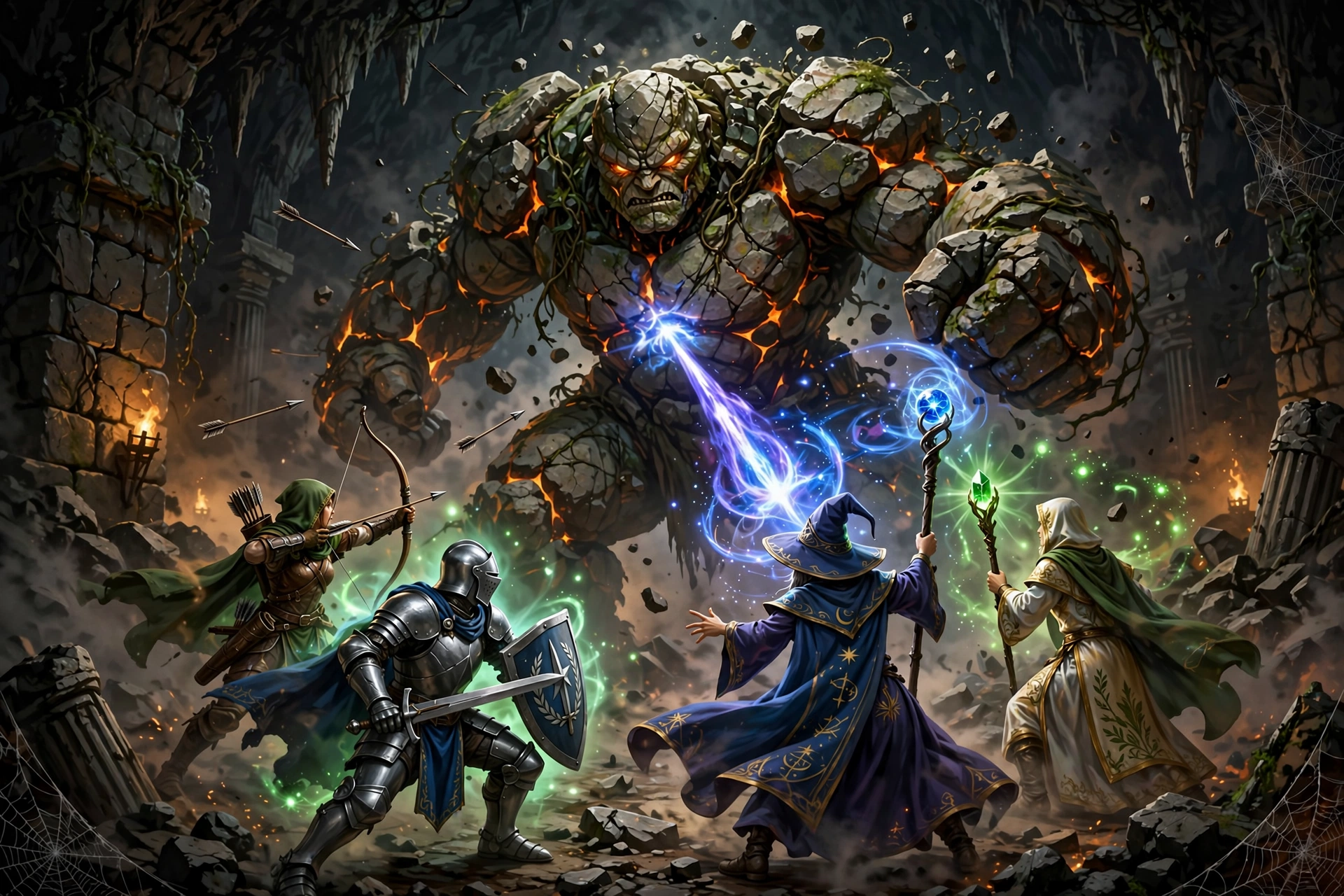
Common Types of PvE Content
PvE is not one single activity. Here are the most common types you will run into:
Quests and Story Missions
The main missions that move a game’s story forward — follow the objective, fight what shows up, and unlock the next part of the story.
Dungeons
Enclosed areas designed for group play, filled with enemies and a boss at the end. Dungeons are a core PvE activity in MMORPGs like World of Warcraft and Final Fantasy XIV, and the concept appears in action RPGs too.
Raids
Longer, harder versions of dungeons that require teamwork and strategy. Raids are often the most challenging PvE content in a game, with multi-stage boss fights that punish mistakes.
Open-World Events
Challenges that appear in the game world, which nearby players can join together. These pop up on timers or triggers and are a relaxed way to experience PvE with whoever happens to be around.
Horde and Survival Modes
Waves of enemies that get harder over time. You and your allies fight to survive as long as possible. Gears of War’s Horde mode and Call of Duty Zombies are well-known examples.
Examples of PvE Games
Almost every game includes some PvE. These are well-known for doing it well:
- World of Warcraft — quests, dungeons, and raids are the backbone of its PvE experience. Players can pick settings that keep PvP out of the way entirely.
- Destiny 2 — strikes, raids, and the open world are PvE, while the Crucible is a separate PvP mode.
- Monster Hunter: World — team up with other hunters to take down giant monsters in pure co-op PvE.
- Elden Ring — a story-driven action RPG built around boss fights against computer-controlled enemies.
- Diablo IV — dungeon crawling and loot hunting against AI enemies, solo or with friends.
- Helldivers 2 — squads of players complete objectives against alien and robot armies in co-op PvE missions.
- Minecraft (Survival mode) — gather resources, build shelter, and survive hostile mobs. Classic PvE with no required story.
Why Do Players Like PvE?
PvE attracts a huge audience, and the reasons are straightforward:
- No pressure from other players. You never have to worry about a more skilled opponent ruining your session.
- Play at your own pace. Take your time, explore, retry a boss fifty times, or look up a strategy guide — nobody is waiting on you.
- Cooperation instead of competition. PvE is where co-op play shines. Friends work together toward a shared goal.
- Story and world-building. PvE modes usually carry the game’s story. If you play for the plot and the world, PvE is where you will spend most of your time.
- Beginner-friendly. AI enemies follow patterns you can learn, making PvE a gentler way to learn a game’s mechanics.
FAQs About PvE
Is PvE only for online games?
No. The term became popular in online games, but it applies to any game where you face computer-controlled challenges. A single-player story game is entirely PvE — “versus environment” simply means you are up against the game itself, not other players.
Can a game have both PvE and PvP?
Yes, and most multiplayer games do. Developers usually keep them as separate modes: you queue for a PvE dungeon or a PvP arena depending on what you want. Some games also have mixed modes where players fight AI enemies while other players can interfere.
Is PvE easier than PvP?
Not necessarily. PvE is more predictable — enemies follow patterns, so with practice you can always win. But top-level raid bosses and high-difficulty missions can be brutally hard. PvP is less predictable but sometimes more casual, depending on your matchmaking.
What is a PvE server in World of Warcraft?
In World of Warcraft, a PvE server (now called a “Normal” realm) is one where open-world combat between players is off by default. You can quest and explore without being attacked by players from the opposing faction.
Conclusion
PvE — Player versus Environment — is simply you against the game. Whether you are clearing a dungeon with friends or soloing a story campaign, PvE is where most players spend the majority of their gaming hours.
Want to keep learning gaming terms? Check out our guide on what AFK means in gaming, or find out what “proc” means — a term you’ll see constantly in RPG loot and ability descriptions.