What is AFK in Gaming? (Meaning, Origin & Examples)
Most players notice an AFK teammate before they realize what happened. The lane goes quiet. The objective falls. The match begins to slip away.
If you’re wondering what is afk in gaming, the short answer is simple. AFK stands for “Away From Keyboard.” In gaming, it describes a player who stays connected but stops participating. Depending on the game, the system triggers warnings, matchmaking delays, rank loss, or account restrictions.
The term began long before modern online games. Today, it appears in almost every multiplayer title. League of Legends, Valorant, Roblox, World of Warcraft, and many others all recognize AFK behavior, although each handles it differently.
During our testing of League of Legends, Valorant, Roblox, and World of Warcraft, we found that inactivity is never treated exactly the same. Some games remove idle players quickly. Others track repeated behavior before applying penalties.
This guide explains what AFK means, where the term came from, how different games detect inactive players, and when idle farming crosses the line into a bannable offense.
📌 Key Summary: AFK means a player is inactive during gameplay. The meaning stays the same across games, but the consequences depend on each game’s rules.
📢 Key Takeaways
- AFK means “Away From Keyboard.” It describes a player who is connected but inactive.
- Players first used the term in early internet chatrooms before becoming part of gaming culture.
- Most multiplayer games monitor inactivity and apply penalties for repeated AFK behavior.
- Games like League of Legends, Valorant, Roblox, and World of Warcraft each use different detection systems.
- AFK is different from BRB. AFK usually suggests a longer or uncertain absence.
- AFK farming is allowed in some games but treated as an exploit in others.
- Auto-clickers, macros, and similar tools can violate a game’s Terms of Service and may lead to account penalties.
- Simple habits, such as pausing your game or informing teammates before stepping away, help avoid most AFK penalties.
📌 Research Note: This guide combines hands-on testing with information verified against official documentation from Riot Games, Roblox, Blizzard Entertainment, and other relevant sources where applicable.
Key Summary: AFK is more than gaming slang. It directly affects matchmaking, competitive integrity, and account safety.
What Is AFK in Gaming?
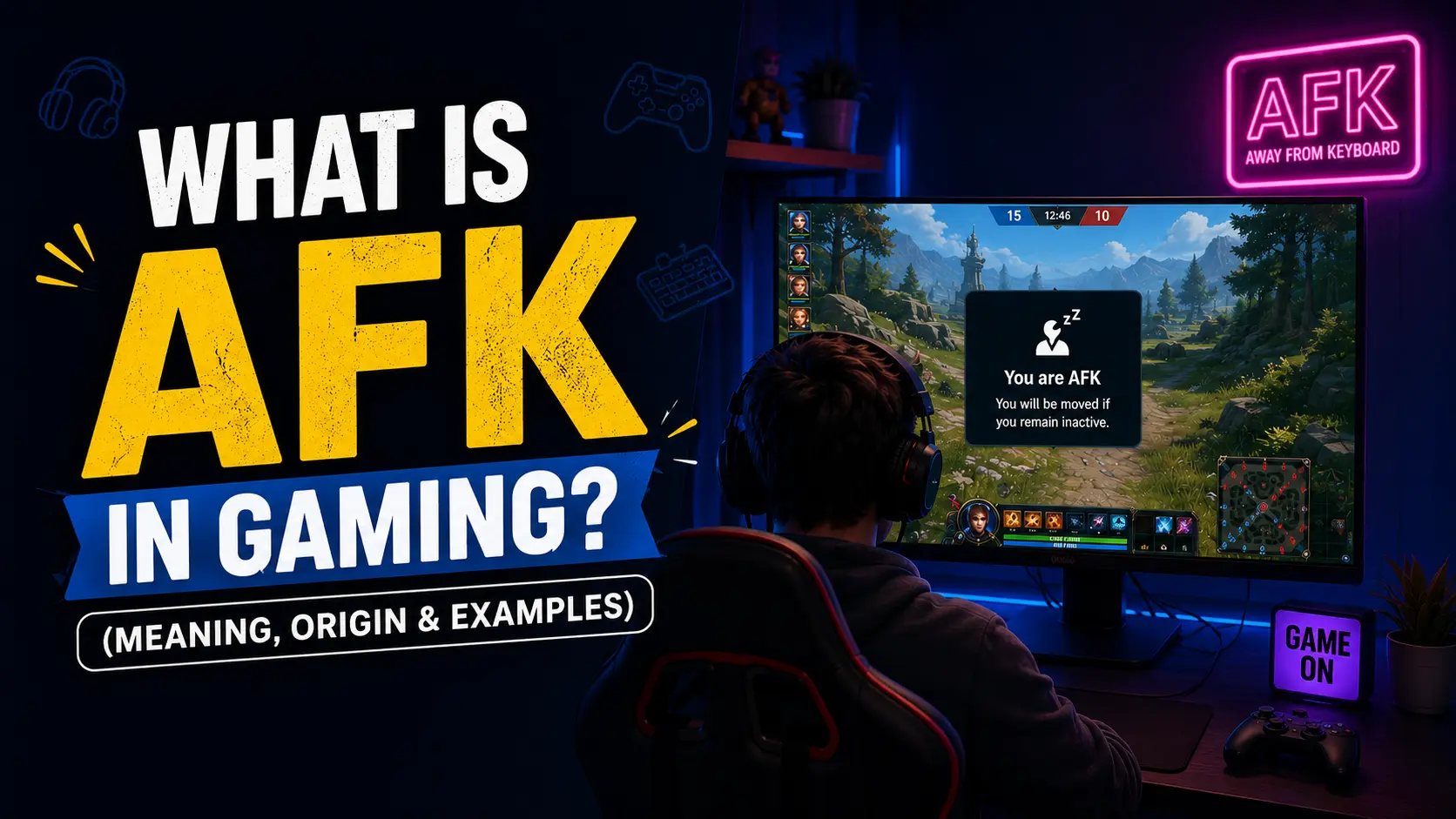
AFK stands for “Away From Keyboard.” It means a player has stopped interacting with the game while remaining connected to the session.
The character may stand still. They may ignore attacks. They may stop moving altogether. To teammates, it often feels like the player disappeared without leaving.
The term applies across PC, console, and mobile games. The device changes. The meaning does not.
During our testing, we observed the same pattern in every major multiplayer title. Once a player stops providing meaningful input, the game begins tracking inactivity. Depending on the title, this may result in a warning, an idle tag, removal from the match, or competitive penalties.
Not every AFK player walks away on purpose. Some experience internet problems. Others deal with hardware failures or unexpected interruptions. Modern games increasingly try to distinguish accidental disconnects from intentional inactivity, although the result is not always perfect.
Understanding AFK matters because most competitive games reward active participation. Even one inactive teammate can change the outcome of an entire match.
📌 Key Summary: AFK simply means a player is inactive while still connected. The definition is universal, but every game decides differently when inactivity becomes punishable.
Where Did the Term AFK Come From?
Understanding what does AFK mean in gaming today starts with knowing where the term came from in the first place. AFK did not begin in gaming. It started in the early days of the internet. People used it in online chatrooms to explain a sudden pause. As online games grew in popularity, players brought the term with them
Curiously, the meaning has barely changed. The platforms evolved. The technology improved. Yet those three letters still communicate the same simple message: “I’m here, but I’m not available.”
The Origins in IRC and MUDs
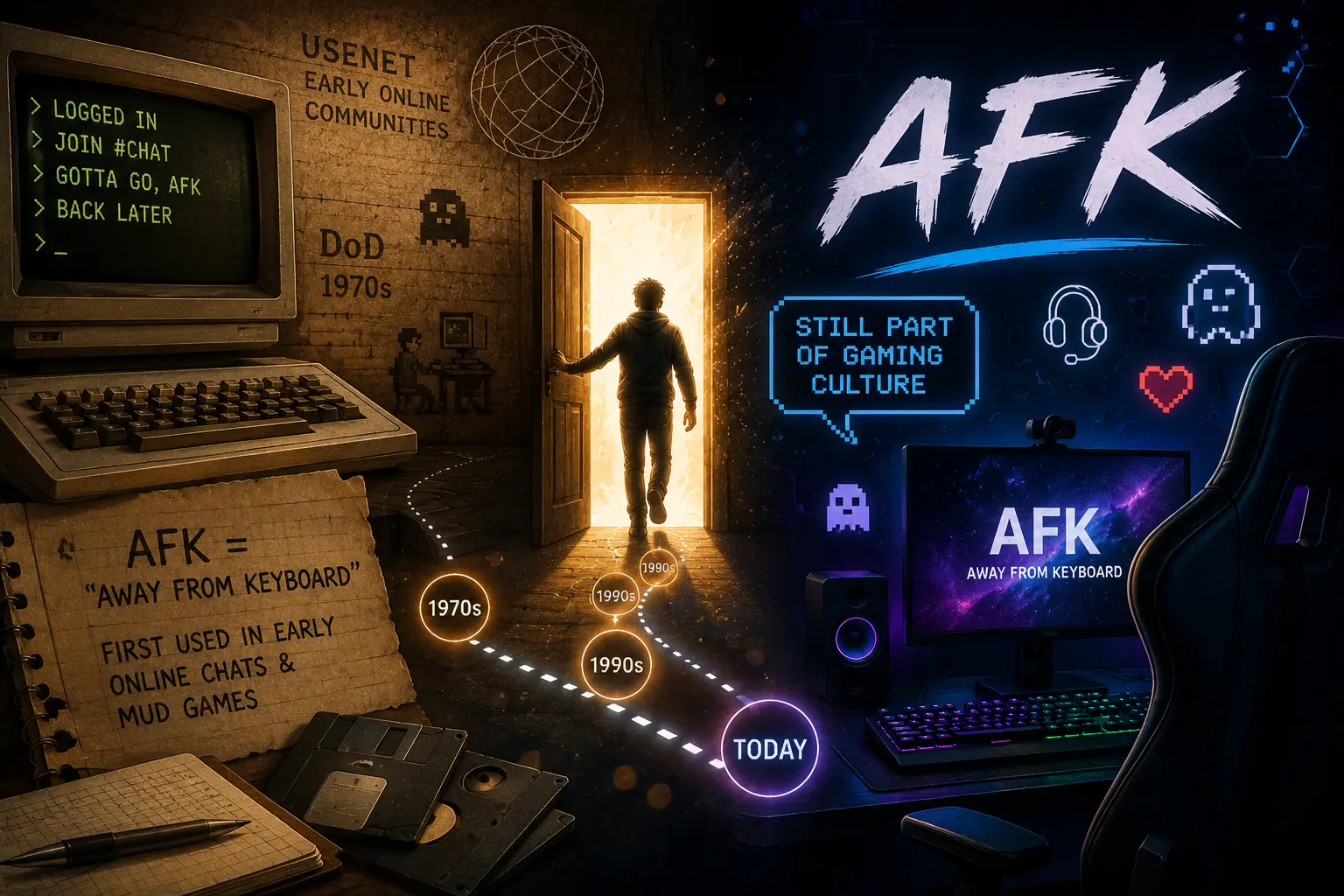
The earliest known use of AFK dates back to the early 1990s. It appeared in Internet Relay Chat (IRC), one of the first real-time chat platforms. Users typed “AFK” before stepping away so others knew they had not left the conversation.
The term soon spread to Multi-User Dungeons (MUDs). These were text-based online games where every action happened through typed commands. Since players communicated constantly, AFK became a quick way to explain a long pause.
This simple habit became part of online culture long before modern multiplayer games existed.
How AFK Became Part of Gaming
As online gaming grew, players brought the term with them.
It appeared in MMORPGs first.Then players spread it into competitive shooters, strategy games, mobile games, and voice chat communities. Today, AFK is understood across almost every gaming platform.
During our research, we found that players use the term almost identically whether they play on PC, Xbox, PlayStation, Nintendo Switch, or mobile devices. The platform changes. The meaning does not.
AFK Through the Years
| 📅 Period | 📖 How the Term Evolved |
|---|---|
| Early 1990s | Used in Internet Relay Chat (IRC) to signal a temporary absence. |
| Mid-1990s | Adopted by text-based MUDs and online role-playing communities. |
| Late 1990s–2000s | Became common in early MMORPGs such as Ultima Online and EverQuest. |
| 2000s–2010s | Spread across games like World of Warcraft, Counter-Strike, and other competitive titles. |
| 2010s–Present | A standard gaming term used in Discord, Roblox, Fortnite, Valorant, League of Legends, and countless other online games. |
The internet has introduced thousands of gaming terms over the years. Very few survive for decades. AFK did. Not because it sounds clever, but because it solves a problem with just three letters.
📢 Key Summary: AFK originated in early internet chatrooms, not gaming. As multiplayer games evolved, the term became a universal part of online gaming language.
How Different Games Handle Inactive Players
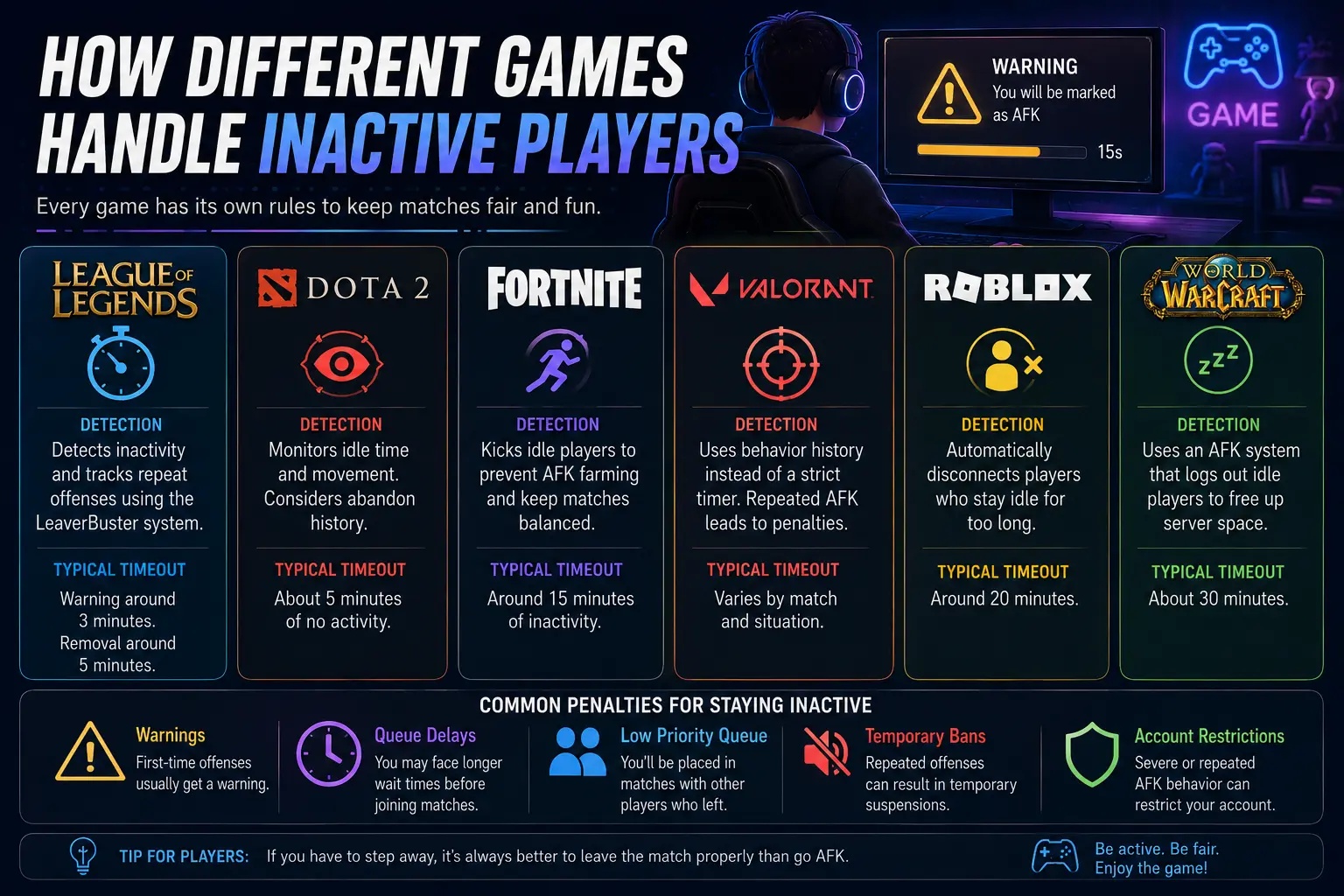
AFK always means an inactive player. The penalties, however, depend on the game. Some titles remove idle players within minutes. Others monitor repeated behavior before taking action.
During our testing and review of official support documentation, we found that no two major games enforce inactivity in exactly the same way. Competitive games usually respond much faster than casual ones.
| 🎮 Game | ⚙️ How AFK Is Handled | ⏱️ Typical Timeout | ⚠️ Possible Penalty |
|---|---|---|---|
| League of Legends | Detects inactivity and tracks repeat offenses through LeaverBuster. | A warning appears around 3 minutes. Removal occurs after about 5 minutes. | Queue delays, Low Priority Queue, and account suspensions. |
| Roblox | Automatically disconnects inactive players. | Around 20 minutes. | Auto-disconnect from the experience. |
| Valorant | Uses player behavior history instead of a fixed inactivity timer. | Varies depending on the match. | Rank Rating loss, queue restrictions, and suspensions. |
| World of Warcraft | Marks players as AFK before eventually logging them out. | AFK after about 5 minutes; automatic logout after about 30 minutes. | Automatic logout. |
| Dota 2, CS2, Fortnite, Minecraft | Each game uses its own inactivity detection system. | Varies by game. | Kick from the match, matchmaking penalties, or other game-specific actions. |
Why League of Legends and Valorant Feel Stricter
Competitive games have more at stake.
According to Riot Games, repeated inactivity affects competitive integrity. Systems like LeaverBuster analyze player behavior across multiple matches instead of judging a single game in isolation.
During our review of Riot’s documentation, we found that repeated AFK behavior leads to increasingly severe penalties. A single interruption may receive only a warning. Repeated offenses can result in queue delays, Rank Rating loss, or temporary suspensions.
Roblox Handles AFK Differently
Roblox focuses more on inactivity than player intent.
Roblox automatically disconnects inactive players after an extended period without input. Individual game developers can also create their own idle systems, which means the experience may differ from one Roblox game to another.
This explains why younger players often see different AFK behavior depending on the game they are playing.
PC, Console, and Mobile Detect AFK Differently
Every platform measures activity in its own way.
PC games usually monitor keyboard and mouse input.
Console games watch controller activity.
Mobile games look for screen touches and gestures.
The principle stays the same. No meaningful input for too long signals inactivity.
Modern multiplayer games often analyze more than simple movement. They may also track combat actions, ability usage, objective participation, or other gameplay behavior to determine whether a player is truly active.
Key Summary: Every game recognizes AFK behavior, but each uses its own detection system and penalty rules. Competitive games generally enforce inactivity more aggressively than casual titles.
Inactivity Beyond Gaming
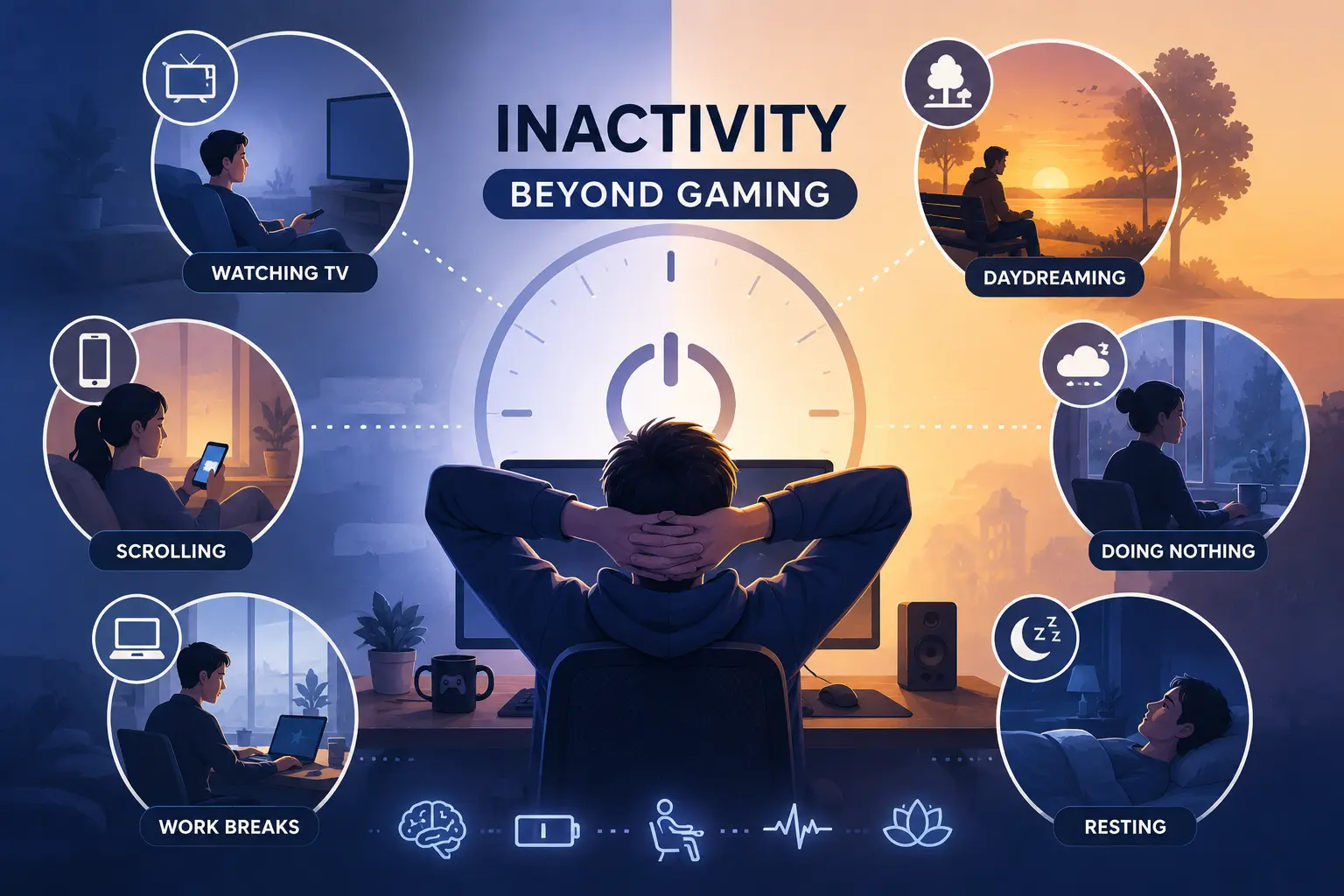
AFK is not just a gaming term. It is used across chat apps, online communities, and voice platforms. The meaning stays the same. Someone is connected but temporarily unavailable.
Long before Discord became popular, people used AFK in chatrooms to avoid confusion. Today, the habit continues across gaming communities, workspaces, and social platforms.
You might see messages like:
- “AFK for five minutes.”
- “Dinner. AFK.”
- “Back soon. AFK.”
The message is simple. It tells others not to expect an immediate reply.
Platforms like Discord even include dedicated AFK voice channels. Users can move there without leaving the server, letting others know they are present but not actively listening.
📢 Key Summary: AFK is part of internet culture, not just gaming. It signals a temporary absence while staying connected.
AFK vs BRB: What’s the Difference?
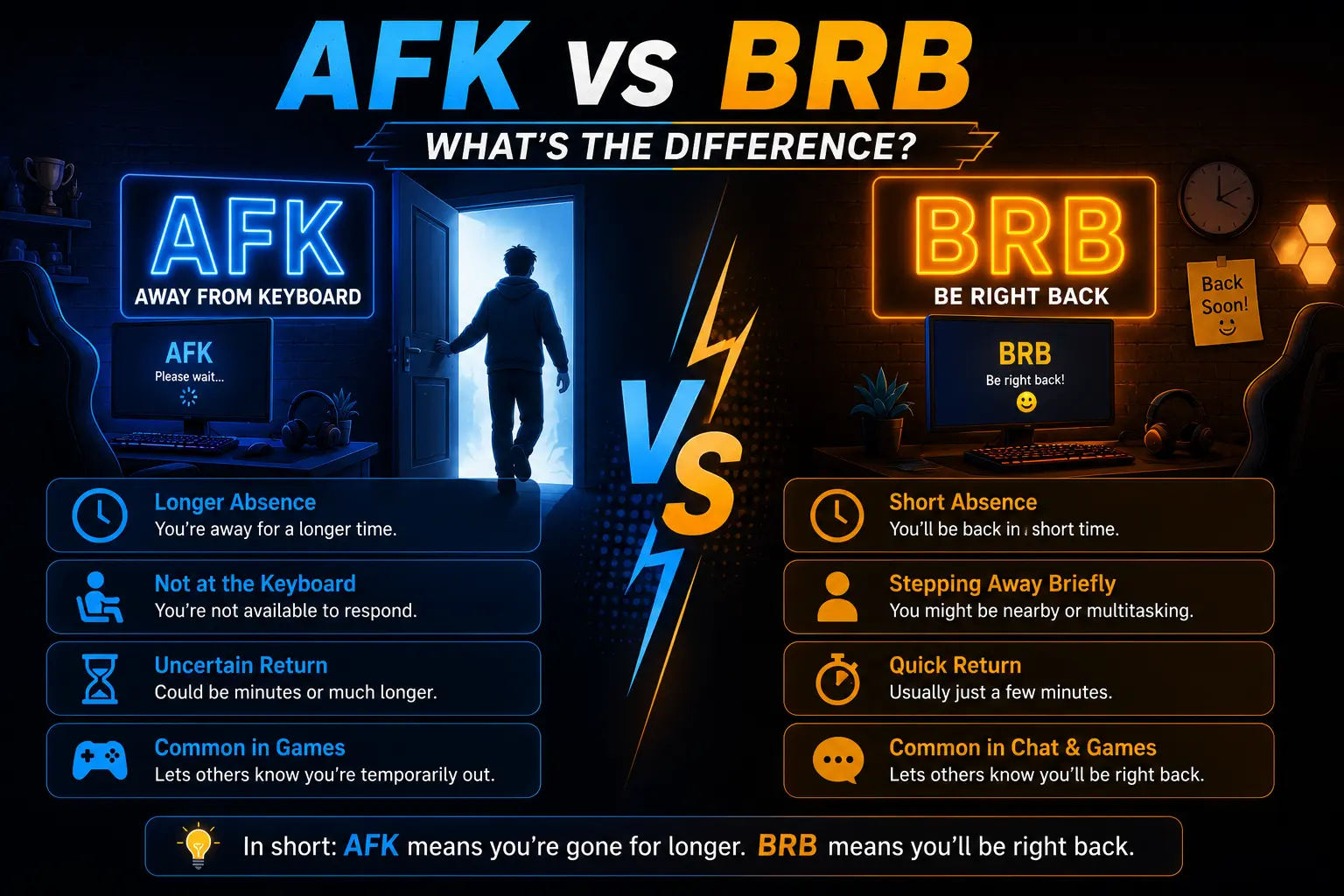
AFK and BRB seem similar, but they send different signals.
BRB means “Be Right Back.” It tells others the player expects to return soon.
AFK is less certain. The player may return in a minute. They may return after the match. Sometimes, they do not return at all.
| 📌 Term | 💬 Meaning | 💡 What It Usually Implies |
|---|---|---|
| AFK | Away From Keyboard | An unknown or longer absence. |
| BRB | Be Right Back | A short break with an expected return. |
| Term | Meaning | Typical Use |
| AFK | Away from keyboard | Longer or unclear absence; player may not return soon |
| BRB | Be right back | Short break; player expects to return quickly |
Imagine a ranked match.
One teammate types:
“brb, water.”
Most players wait.
Another teammate types:
“afk.”
Now the team begins planning without them.
The words are short. The expectations they create are very different.
📢 Key Summary: BRB suggests a quick return. AFK leaves the duration uncertain, which is why teammates often react differently.
Common AFK Terms You’ll See in Chat
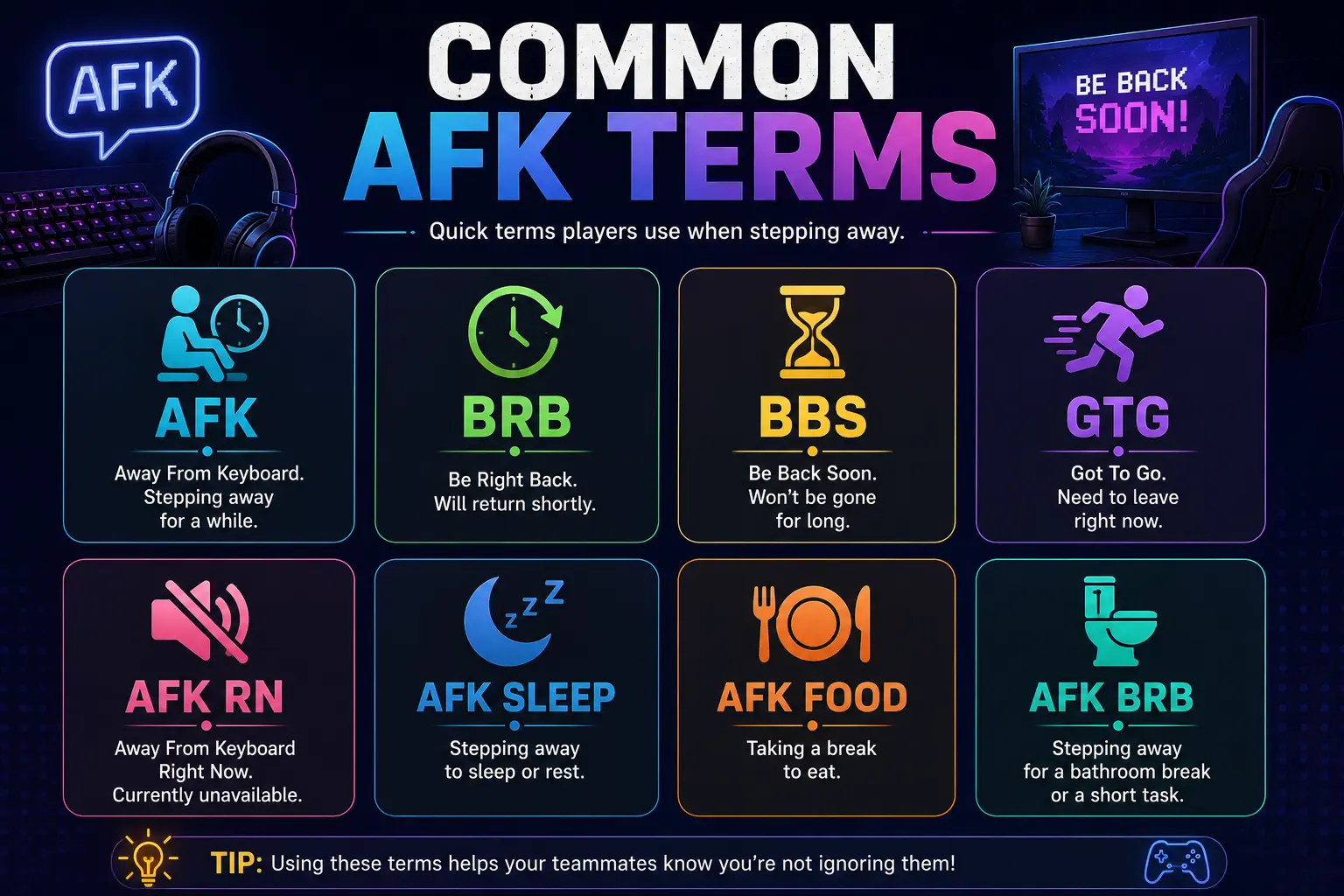
Gaming communities rarely stop at one word. Once a term becomes popular, players create variations.
Some become jokes. Others become part of everyday gaming language.
Here are the ones you’ll see most often.
Brain AFK
- The player is physically present.
- Their character moves.
- They click.
- But they stop making good decisions.
Players jokingly say someone is “brain AFK” when they seem distracted or completely unaware of what is happening.
Ninja AFK
- A player quietly disappears without saying anything.
- No warning.
- No explanation.
- Just silence.
- The team only realizes it after the player has already stopped contributing.
AFK Kill
- An AFK Kill happens when someone eliminates an inactive player.
- It usually requires little effort.
- Some communities see it as free experience.
- Others see it as bad sportsmanship.
- The reaction often depends on the game.
Real Chat Examples
These examples reflect how players naturally use the term.
Jordan: afk. Back in five.
Maya: We lost top because our jungle went AFK.
Alex: Bro is brain AFK today.
Enemy Team: Easy AFK kill.
Notice something.
Nobody explains what AFK means anymore.
The community already understands it.
That is usually how you recognize a mature piece of internet language. It no longer needs an introduction.
📢 Key Summary: AFK has evolved into several community phrases. While the wording changes, they all describe some form of inactivity or reduced participation.
Why Do Players Go AFK?
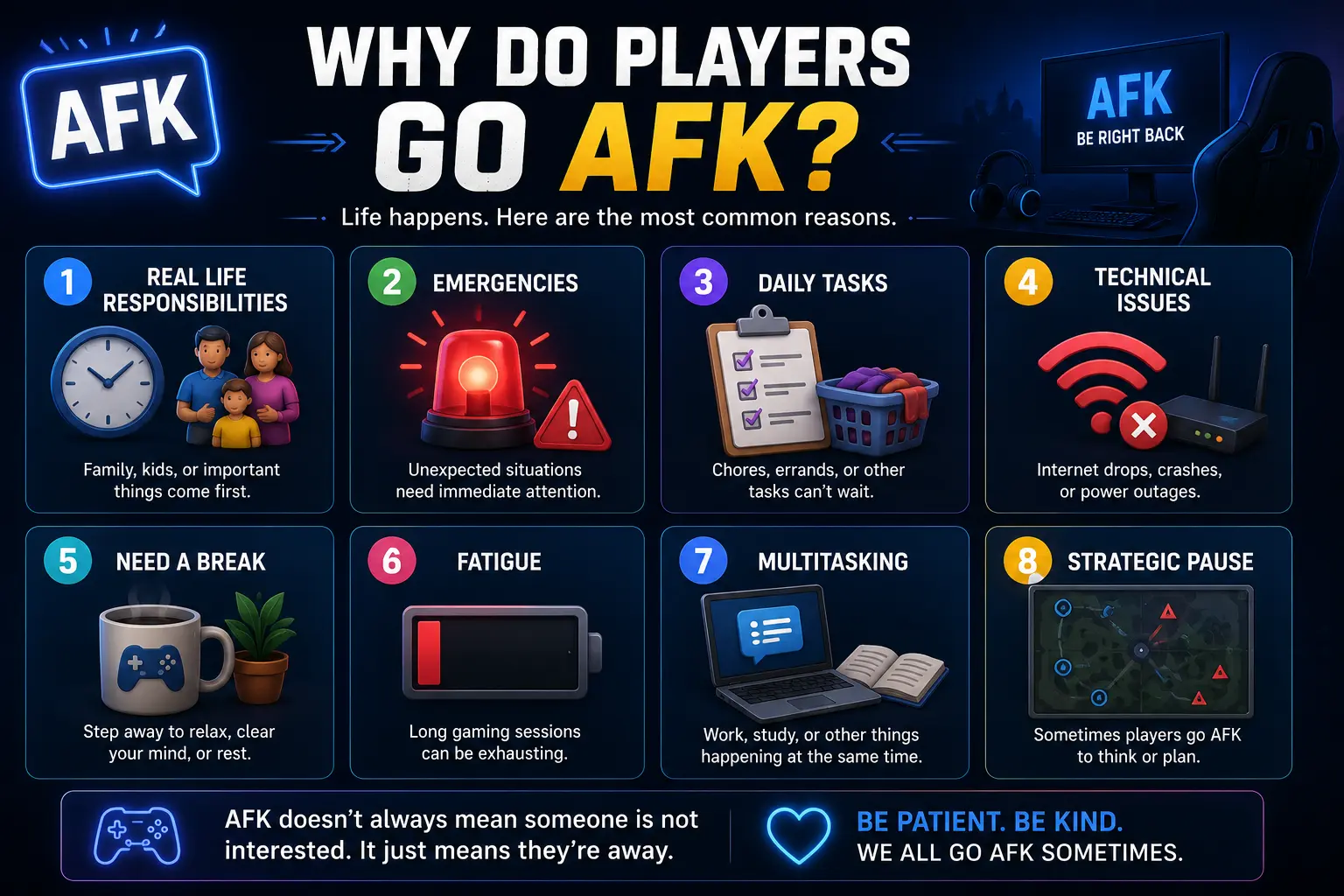
Players go AFK for many reasons. Some are unavoidable. Others are intentional. The reason often determines how the game responds.
During our research and testing, we found that most games do not judge why you became inactive. They only detect that you stopped participating. Competitive games may apply penalties even if the interruption was outside your control.
Common Reasons Players Go AFK
| 📌 Reason | ⚠️ What Usually Happens |
|---|---|
| 📞 Phone Call or Family Interruption | Usually harmless if it happens rarely. |
| 🌐 Internet Connection Drops | May still trigger inactivity penalties. |
| 🎮 Hardware or Controller Failure | Can be detected as inactivity. |
| 🤖 AFK Farming for Rewards | Allowed in some games. Penalized in others. |
| 🚪 Rage Quitting or Giving Up | Often leads to reports and matchmaking penalties, while players may sometimes forfeit a match when they decide not to continue. |
| 🚑 Real-Life Emergency | Understandable, but the game cannot always tell the difference. |
One important detail often gets overlooked.
The game only sees your actions.
It cannot see the reason behind them.
That is why a genuine emergency and an intentional AFK can sometimes receive the same penalty.
📢 Key Summary: Players go AFK for many reasons, but games usually detect inactivity instead of intent. The system reacts to what happened, not why it happened.
Why Do Games Punish AFK Players?
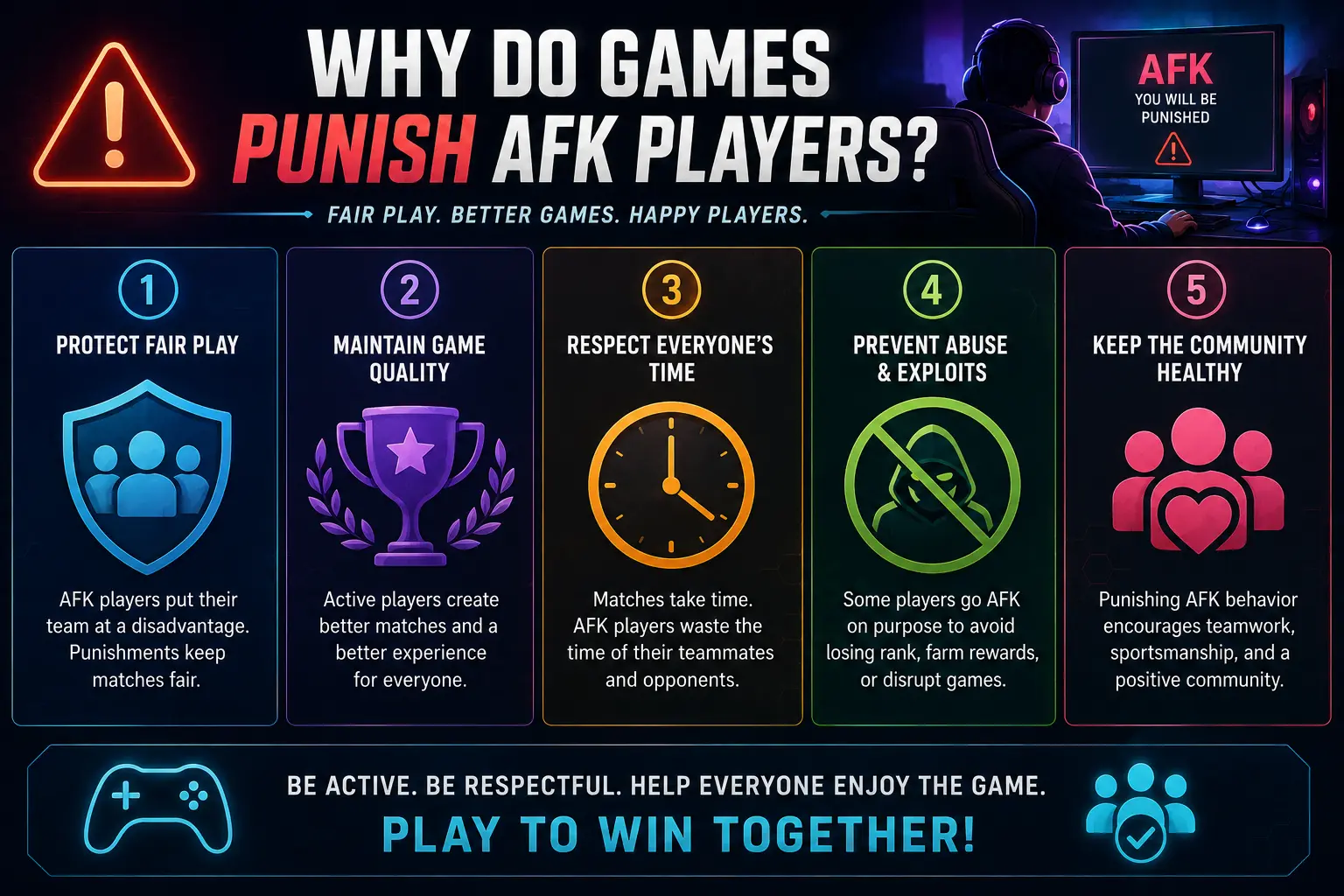
Multiplayer games depend on teamwork. Players who regularly team up with others can also use LFG systems to find suitable teammates for ranked matches, raids, and other multiplayer activities.
When one player stops contributing, everyone else feels the impact.
One inactive teammate can turn a balanced match into an unfair one. That affects the experience for both teams.
This is why developers invest heavily in AFK detection systems.
Their goal is not simply to punish players. It is to protect competitive fairness.
Most games enforce AFK penalties to:
- Keep matches fair.
- Reduce frustration for teammates.
- Prevent players from abandoning games.
- Protect ranked matchmaking.
- Discourage repeated inactivity.
Games with competitive ladders, such as League of Legends, Valorant, and Dota 2, generally enforce stricter penalties because rankings depend on every player participating.
During our review of official developer documentation, one pattern became clear. Every major competitive game treats repeated AFK behavior more seriously than a single isolated incident.
📢 Key Summary: AFK penalties exist to protect fair play. Most games focus on repeated inactivity rather than one accidental interruption.
How Do Games Detect AFK Players?
Most games detect AFK players by monitoring activity. If meaningful input stops for too long, the system marks the player as inactive.
The process sounds simple.
In reality, modern games monitor much more than movement alone.
What Games Usually Track
Depending on the game, the system may monitor:
- Character movement.
- Keyboard or controller input.
- Mouse movement.
- Touchscreen interactions.
- Ability usage.
- Combat participation.
- Objective involvement.
- Time without meaningful actions.
During our testing, we noticed that competitive games rarely rely on a single signal. Most combine several activity checks before deciding that a player is AFK.
This helps reduce false detections while making it harder to fool the system.
Can Games Make Mistakes?
- Yes, Not every inactive player intentionally walked away.
- A sudden lag spike may freeze your character.
- A controller battery might die.
- A keyboard could disconnect.
- Your internet connection might drop without warning.
- To teammates, every situation looks identical.
- To the game’s detection system, however, each produces slightly different activity patterns. Modern games increasingly analyze these patterns before deciding whether a player should receive a penalty.
- To the game’s detection system, however, each produces slightly different activity patterns. Modern games increasingly analyze these patterns before deciding whether a player should receive a penalty.
- Even so, mistakes can happen.
- No automated system is perfect.
📢 Key Summary: Modern games detect AFK players by monitoring different forms of player activity, not just movement. While detection has become smarter, false positives can still occur.
What Is AFK Farming?
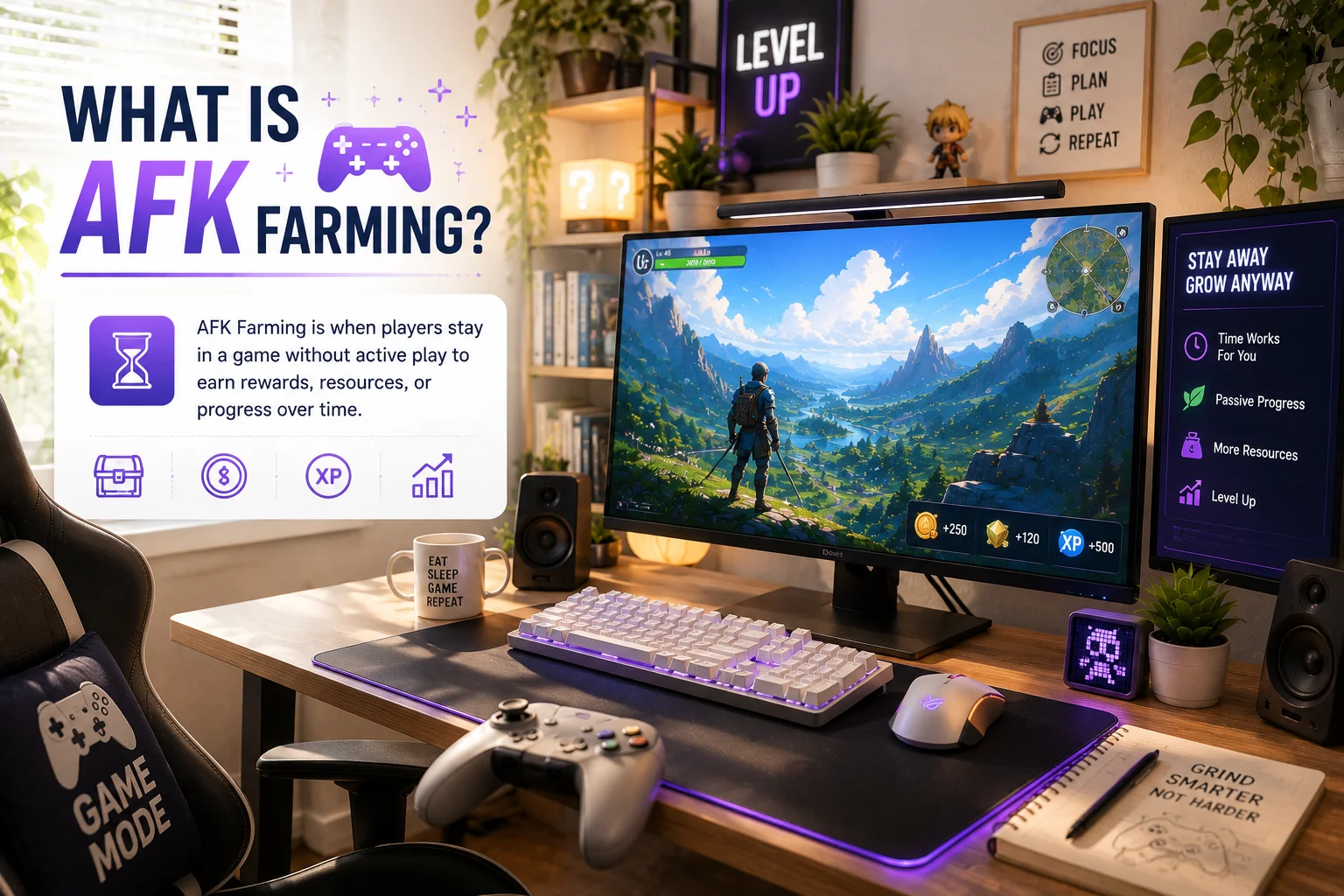
AFK farming is the practice of earning rewards while staying mostly inactive. Players set up their character to collect experience, gold, loot, or other resources with little or no manual input.
Not every game treats AFK farming the same way.
Some games design idle progression into the game. Others consider it an exploit.
During our research, we found that the rules depend entirely on the game’s mechanics and Terms of Service. What is perfectly acceptable in one game may result in penalties or even a permanent ban in another.
How AFK Farming Works
AFK farming reduces active gameplay.
Instead of controlling every action, players rely on game mechanics that continue generating rewards over time.
Common examples include:
- Offline training systems.
- Automatic resource generation.
- Passive experience gains.
- Idle combat mechanics.
- Long-duration gathering activities.
Some MMORPGs intentionally include these features. They are part of the game’s design.
Competitive multiplayer games usually do not.
Not Every “AFK” Player Is Actually Away
Some communities use the term differently.
For example, Old School RuneScape players often describe low-effort activities as AFK, even though they still interact with the game every few minutes.
Fishing.
Woodcutting.
Mining.
The player remains present. They simply do not need constant attention.
The meaning shifts slightly, but the idea stays familiar. Very little input is required.
📢 Key Summary: AFK farming means earning progress with minimal interaction. Whether it is allowed depends entirely on the game’s design and rules.
Pros and Cons of AFK Farming
AFK farming saves time. It also creates risk. Before using any idle strategy, understand both sides.
| ✅ Pros | ❌ Cons |
|---|---|
| Earns XP, gold, or resources with less effort. | Many games classify it as an exploit. |
| Useful in games built around idle mechanics. | May trigger warnings, suspensions, or permanent bans. |
| Reduces repetitive grinding. | Can ruin matches in competitive games. |
| Some MMORPGs officially support offline progression. | Anti-cheat systems improve constantly, making old methods unreliable. |
The biggest mistake players make is assuming every game follows the same rules.
It does not.
Always check the official documentation before using any AFK strategy.
📢 Key Summary: AFK farming can be a legitimate feature or a rule violation. The difference depends on the individual game’s policies.
Are Auto-Clickers and Macros Allowed?
Usually, no.
Most competitive online games prohibit software or hardware that simulates player activity.This includes auto-clickers, keyboard macros, controller scripts, and similar automation tools.
Many players believe hardware software is safe because trusted brands make it.
That assumption is often wrong.
During our review of official policies from major game developers, one message appeared repeatedly:
If a tool automates gameplay or fakes player activity, it may violate the game’s Terms of Service.
Common Methods That Can Trigger Penalties
Players sometimes use:
- Auto-clickers.
- Keyboard macros.
- Mouse macros.
- Controller scripts.
- Rubber bands on analog sticks.
- Automatic input software.
These methods attempt to fool inactivity detection systems.
Modern anti-cheat technologies are designed to recognize repetitive input patterns and unusual player behavior.
As detection systems continue to improve, these workarounds become less reliable.
If you are unsure whether a tool is allowed, assume it is not until the game’s official rules say otherwise.
Protecting your account is always worth more than saving a few minutes of grinding.
📢 Key Summary: Auto-clickers and macros may violate a game’s rules, even when they come with gaming hardware. Always follow the official Terms of Service before using automation tools.
Common Mistakes Players Make
Many AFK penalties are avoidable.
Players often believe they are safe because they only stepped away for a minute. The game may see it differently.
During our testing and research, we noticed the same mistakes appearing across different communities and games.
Mistakes That Often Lead to AFK Penalties
- Switching to another app during an online match.
- Assuming a loading screen pauses the inactivity timer.
- Leaving a controller or keyboard untouched for too long.
- Typing “AFK” without actually returning.
- Ignoring internet or hardware issues.
- Starting a match when you know you may need to leave.
None of these actions guarantees a penalty.
Repeated behavior is usually what causes problems.
Good habits matter more than most players realize.
Key Summary: Most AFK penalties happen because players underestimate how quickly games detect inactivity. Small habits can prevent bigger problems.
📢 Key Summary: Most AFK penalties happen because players underestimate how quickly games detect inactivity. Small habits can prevent bigger problems.
Expert Tips for Avoiding AFK Penalties
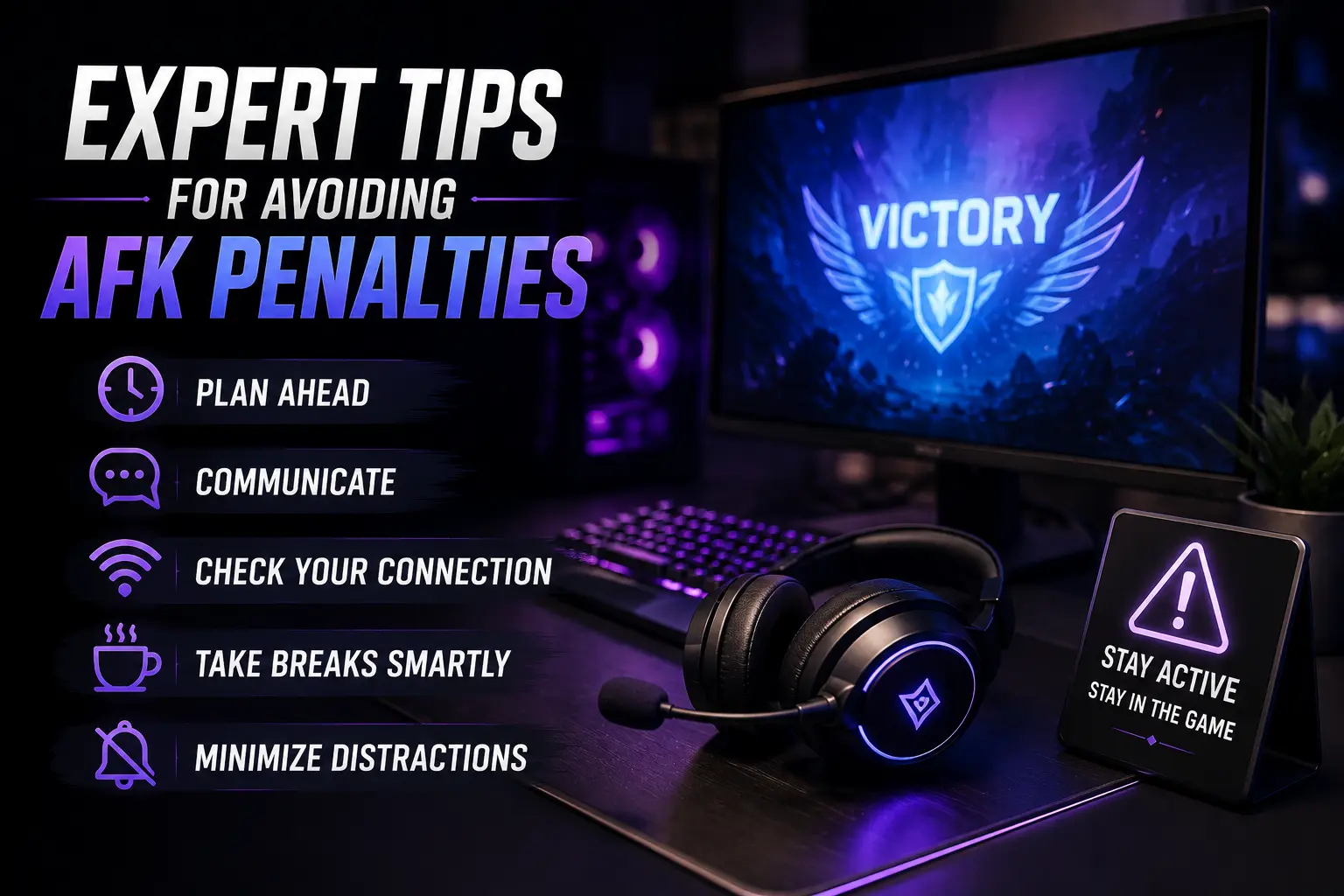
Avoiding AFK penalties is usually simple. The goal is not to trick the system. It is to avoid becoming inactive in the first place. Here are a few habits that make a real difference.
Before Starting a Match
- Play only when you have enough uninterrupted time.
- Check your internet connection.
- Charge your controller or wireless devices.
- Close unnecessary background apps.
During the Match
- Tell teammates if you must step away.
- Return as quickly as possible.
- Avoid unnecessary alt-tabbing.
- Stay engaged with objectives and team fights.
Before Trying AFK Farming
- Read the game’s official Terms of Service.
- Check whether idle progression is a supported feature.
- Never assume another game’s rules apply here.
During our review of official game policies, one pattern stood out. Developers are becoming better at detecting repeated inactivity and automated behavior. Trying to bypass these systems usually creates more risk than reward.
Good preparation prevents most AFK penalties long before the match begins.
📢 Key Summary: The safest strategy is simple. Stay active, communicate with your team, and follow the game’s official rules.
Frequently Asked Questions
Conclusion
AFK began as a simple internet shortcut.
Today, it is one of the most recognized terms in gaming.
The meaning has never really changed. A player is present, but not participating.
What has changed is how games respond.
Modern multiplayer titles actively detect inactivity. Some issue warnings. Others apply matchmaking penalties, rank loss, or account restrictions. The exact rules differ, but the goal remains the same: protect fair play.
During our research, one pattern appeared across every major game we reviewed. Developers reward active participation and discourage repeated inactivity.
Understanding AFK is about more than learning gaming slang. It helps you communicate with teammates, avoid unnecessary penalties, and make better decisions before stepping into your next match.
The next time someone types “AFK”, you’ll know exactly what it means—and why those three letters matter more than they seem.