What Does Proc Mean in Gaming? (Full Explanation)
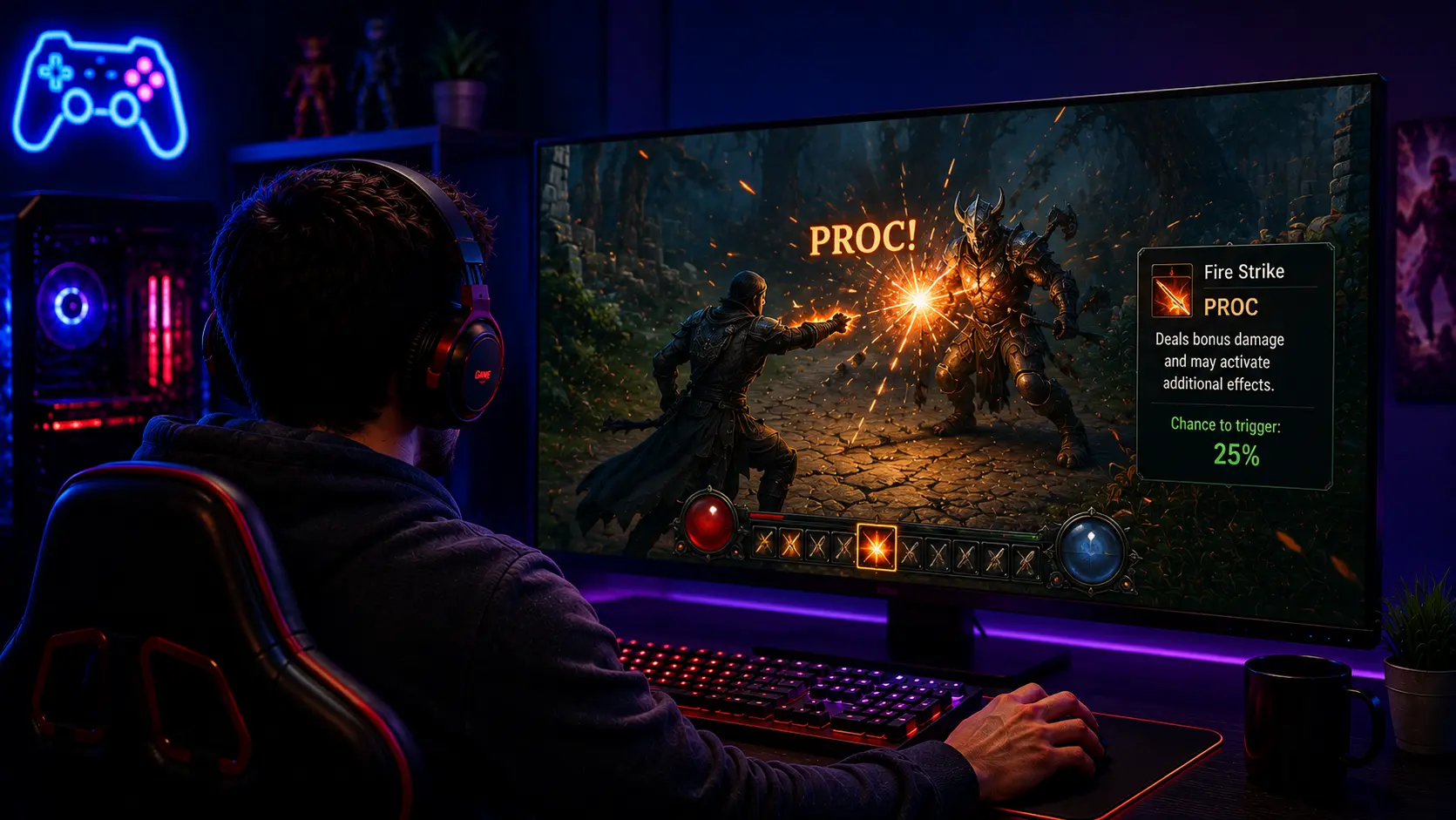
If you’ve ever caught yourself wondering what does proc mean in gaming, you’re not alone. “Proc” is one of gaming’s most useful and most misunderstood terms. If you’ve played RPGs, MOBAs, fighting games, or any game with special abilities or loot mechanics, you’ve experienced procs constantly, often without realizing the term applies.
A proc is an automatic triggered effect that activates based on specific conditions, usually with a random percentage chance. That’s it. No button press required. No cooldown management. The effect just happens when certain conditions are met.
Understanding procs fundamentally changes how you build characters, select gear, and plan strategies. But first, let’s understand where this term actually comes from and what’s really happening under the hood.
What Is a Proc?
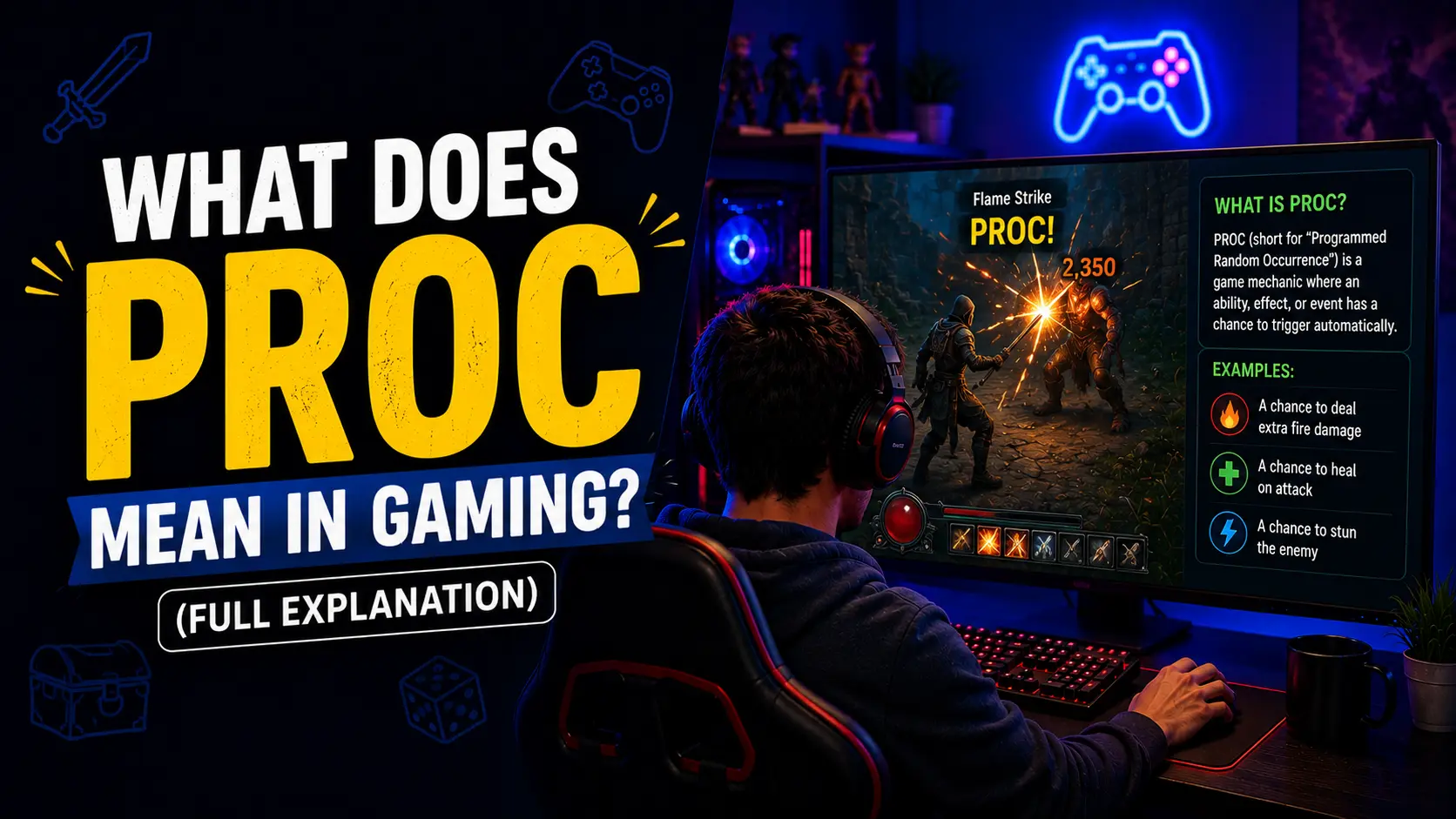
So, what does proc mean in gaming in practical terms? A proc is any game mechanic where an effect triggers automatically when specific conditions occur. The player doesn’t activate it the game does.
Here’s what defines a proc:
Automatic Activation: When conditions are met, the effect happens immediately without player input. You don’t click, press a button, or cast a spell to make it trigger. It just fires.
Condition-Based: Every proc has specific conditions. Common conditions include:
Landing a critical hit Dealing physical damage Dealing ability damage Taking damage from enemies Using a specific ability Attacking with a weapon Moving a certain distance Hitting with a melee strike Applying status effects Dealing elemental damage
Usually Probabilistic: Most procs have a percentage chance to occur. A 25% proc rate means roughly one in four triggering events causes the effect. Some procs are guaranteed (100% chance), but randomness is typical.
Automatically Resolves: Once triggered, the proc effect activates completely automatically. A proc-triggered stun stuns the target without you doing anything. A damage-over-time proc applies damage over time with zero additional input.
Examples of Actual Procs:
A sword that has a 15% chance to apply bleed on hit An ability that restores mana every third cast A passive effect that triggers after landing five attacks in a row An item that deals bonus damage when you move A weapon enchantment that slows enemies
These are all procs because they activate automatically based on conditions.
Where Does the Word Proc Come From?
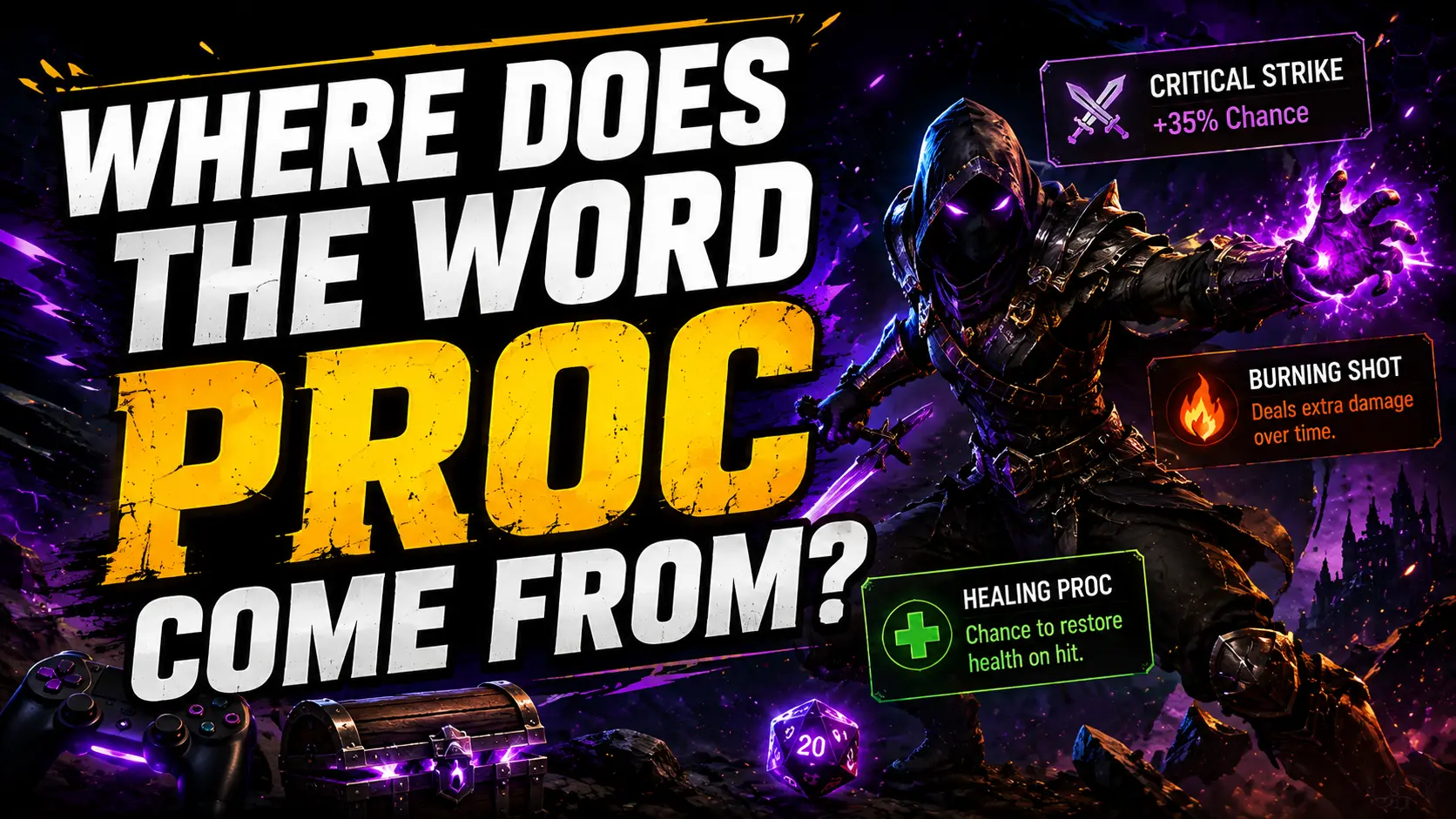
The origin of “proc” is genuinely disputed among gaming historians and programmers, but the leading explanation is solid.
“Proc” most likely stands for “Programmed Random Occurrence.” This term emerged in early MUDs (Multi-User Dungeons) and text-based MMOs during the 1980s and 1990s. As games became more complex, designers needed a word for “effects that trigger automatically based on code logic.”
The term likely started as programmer shorthand. Coders would write “proc” in documentation to refer to triggered events in the code. The gaming community adopted it, and it stuck.
Alternative theories exist:
Some suggest “proc” comes from “procedure”a programming term for a block of code that executes. When certain conditions run a procedure, that’s a proc.
Others claim it’s from “Procedural Random Occurrence,” emphasizing that these effects are handled procedurally by the game engine.
A smaller group argues the term originated from “process” or “progression,” though this is less supported.
The reality: Nobody knows with absolute certainty, and game developers still debate this. But “Programmed Random Occurrence” remains the most widely accepted explanation across MMORPGs, MOBAs, and competitive gaming communities.
What matters is that every major gaming platform from World of Warcraft to League of Legends to Dark Souls uses “proc” to mean the same thing: an automatic triggered effect.
How Procs Actually Work (The Mechanics)
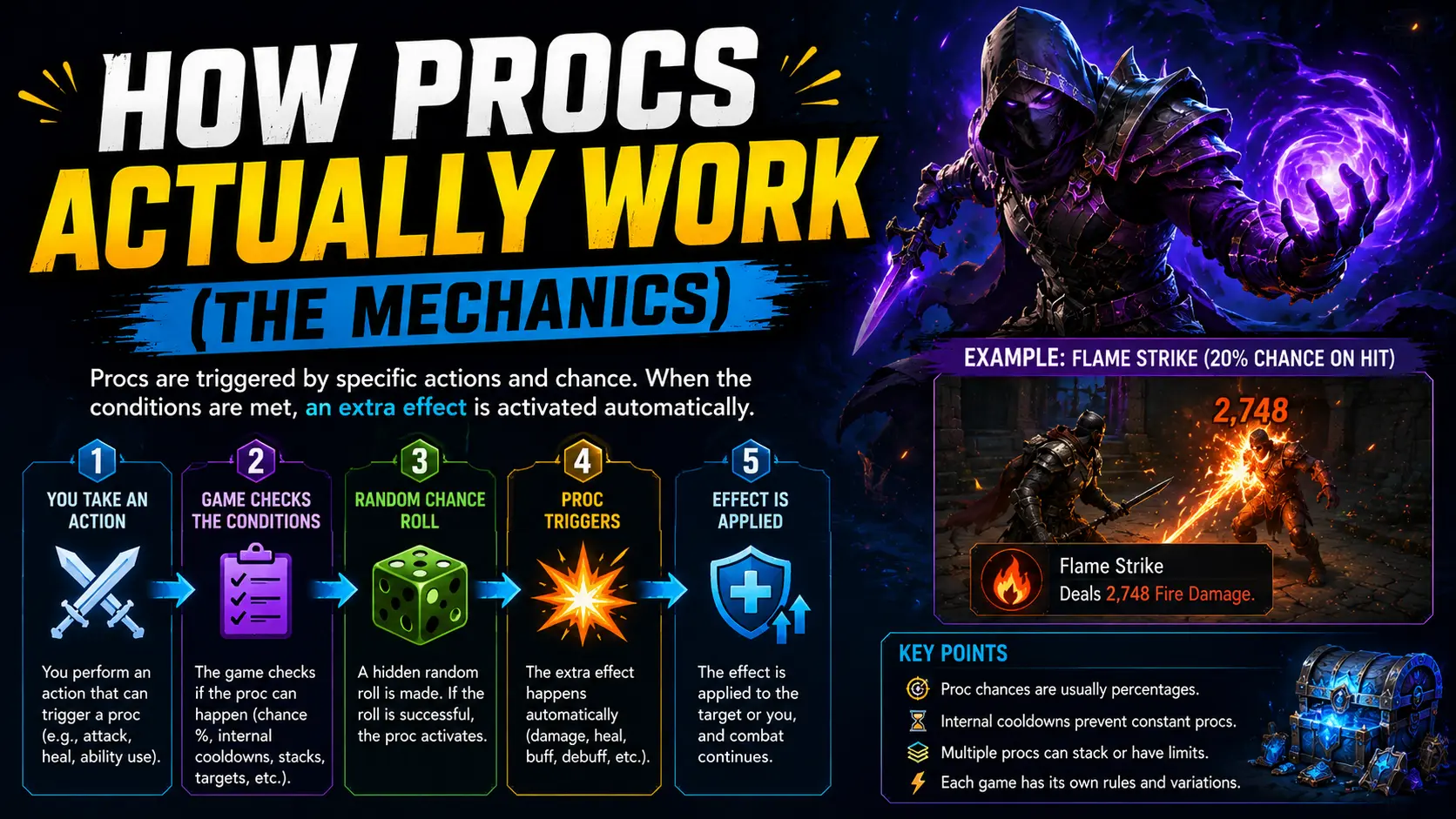
Understanding proc mechanics requires understanding the interaction between triggers, rates, and effects.
The Basic Flow:
- Trigger occurs (you attack, cast an ability, take damage, etc.)
- Condition is checked (Does this trigger match the proc condition?)
- Probability is rolled (Random number generated against the proc rate)
- Effect activates (If the roll succeeds, the effect happens immediately)
Proc Rate Explained:
A proc rate is a percentage that determines how often the effect triggers. It’s expressed as “X% proc rate” or “X% chance to proc.”
A 20% proc rate means:
On average, the effect triggers once every five attempts Over 100 trigger events, you’d expect roughly 20 procs Short-term, you might get zero procs in ten attempts or three procs in five attempts This is average over hundreds or thousands of attempts
Important caveat: Probability doesn’t guarantee distribution. A 50% proc rate doesn’t mean every other hit procs. That’s a common misunderstanding. It means over many attempts, approximately half will succeed.
Internal Cooldowns (ICD):
Many procs have internal cooldownsa minimum time between triggers. Even if conditions are met repeatedly, the proc won’t trigger again until the cooldown expires.
Example: A weapon with a 30% proc rate and a 3-second internal cooldown. You attack three times in two seconds and it procs on the first hit. Your next three attacks in the following two seconds won’t trigger the proc because the 3-second cooldown hasn’t expired yet.
Game designers use internal cooldowns to prevent procs from stacking infinitely and breaking game balance.
Proc Stacking:
Some games allow multiple instances of the same proc effect to stack. Others prevent it.
In World of Warcraft, certain procs can stack, creating massive damage windows. In Diablo, stacking procs enabled overpowered builds that forced balance patches.
In League of Legends, most proc items have limits on how many instances can affect a single fight, preventing infinite scaling.
Proc Mechanics Across Different Games
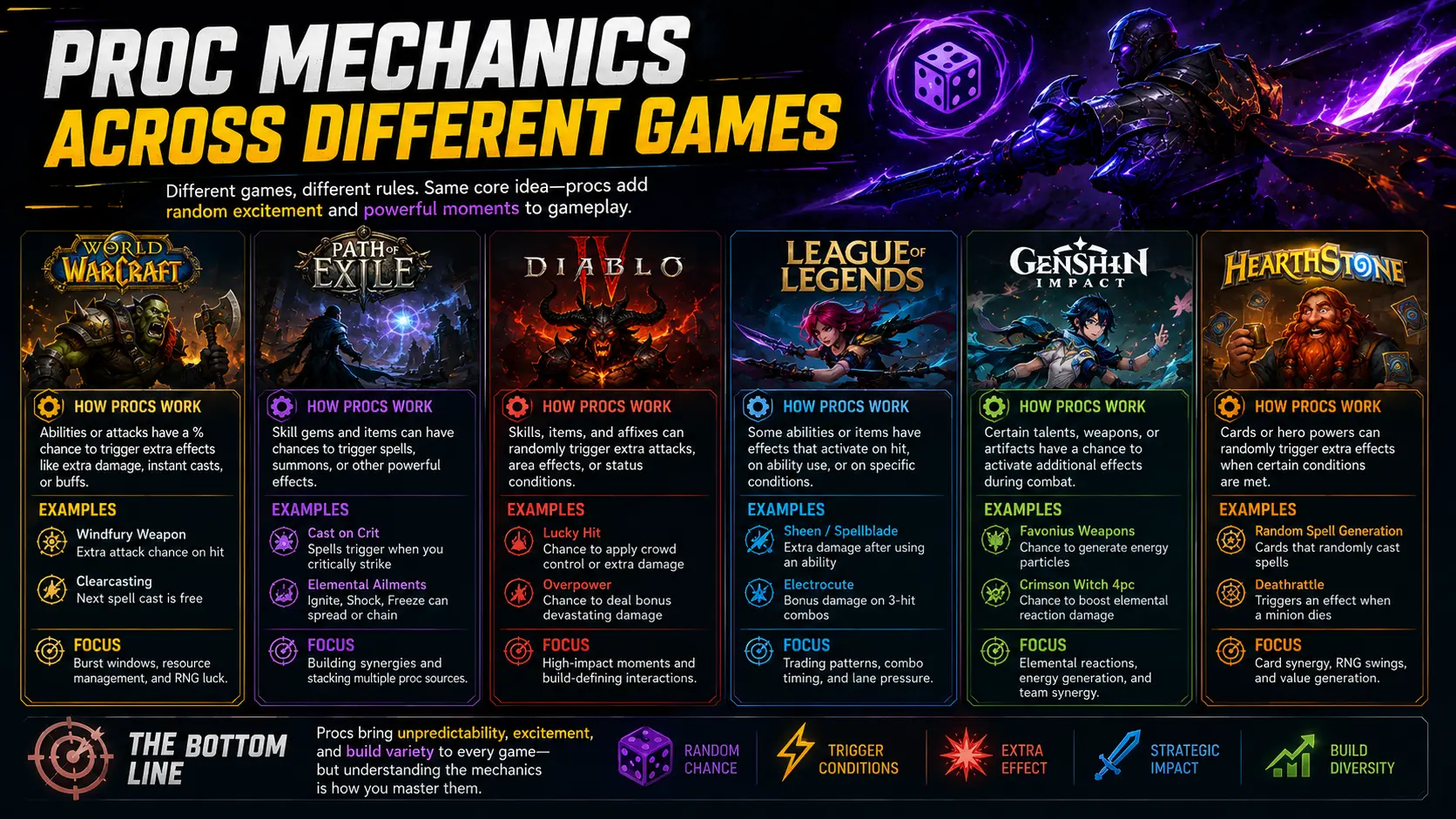
Different games implement procs completely differently. Understanding these variations is essential if you play multiple titles.
| 🎮 Game | ⚙️ Proc Type | 🔧 How It Works | 🎯 Player Impact |
|---|---|---|---|
| Dark Souls / Elden Ring | Weapon status effects | Bleed, poison, and frost buildup trigger through repeated hits. | Encourages specific weapon choices for different enemies. |
| League of Legends | Item passive effects | Liandry triggers DoT on spell hits; Sheen triggers bonus damage. | Core to itemization and damage calculations. |
| World of Warcraft | Ability and item procs | Spells trigger related abilities, while items can proc additional damage or buffs. | Determines optimal DPS rotations and playstyle. |
| Path of Exile | Skill gems and passive trees | Linked procs can cascade through connected skill gem combinations. | Entire builds can revolve around powerful proc chains. |
| Hearthstone | Card battlecry / triggered abilities | Minions trigger effects when played or when specific conditions occur. | Influences deck-building strategy and value generation. |
| Valorant | Gun accuracy and ability resets | Headshots and ability kills can trigger resets or temporary buffs. | Creates skill expression and clutch potential. |
| Monster Hunter | Weapon sharpness and element buildup | Elemental damage and status effects trigger through successful hits. | Encourages element-specific gear for certain monsters. |
Game-Specific Details:
In League of Legends, Liandry’s Torment procs apply a damage-over-time effect when you deal ability damage. Trinity Force procs bonus damage every time you use an ability. Rylai’s Crystal Scepter procs a slow effect. These procs don’t just happen they’re calculated into itemization strategy because competitive players know the exact damage values.
In Elden Ring, weapons have buildup meters for status effects like bleed, poison, and frost. Landing repeated hits fills the meter. When full, the status effect procs, dealing its effect (bleed health damage, poison damage over time, frost poise break). This encourages strategic weapon pairing and planning.
In World of Warcraft, class abilities have proc rates that trigger related spells. A protection warrior might have an ability that procs a shield bash with every blocked attack. A mage might have a talent that procs instant casts. These proc chains define playstyles.
Why Game Designers Use Procs
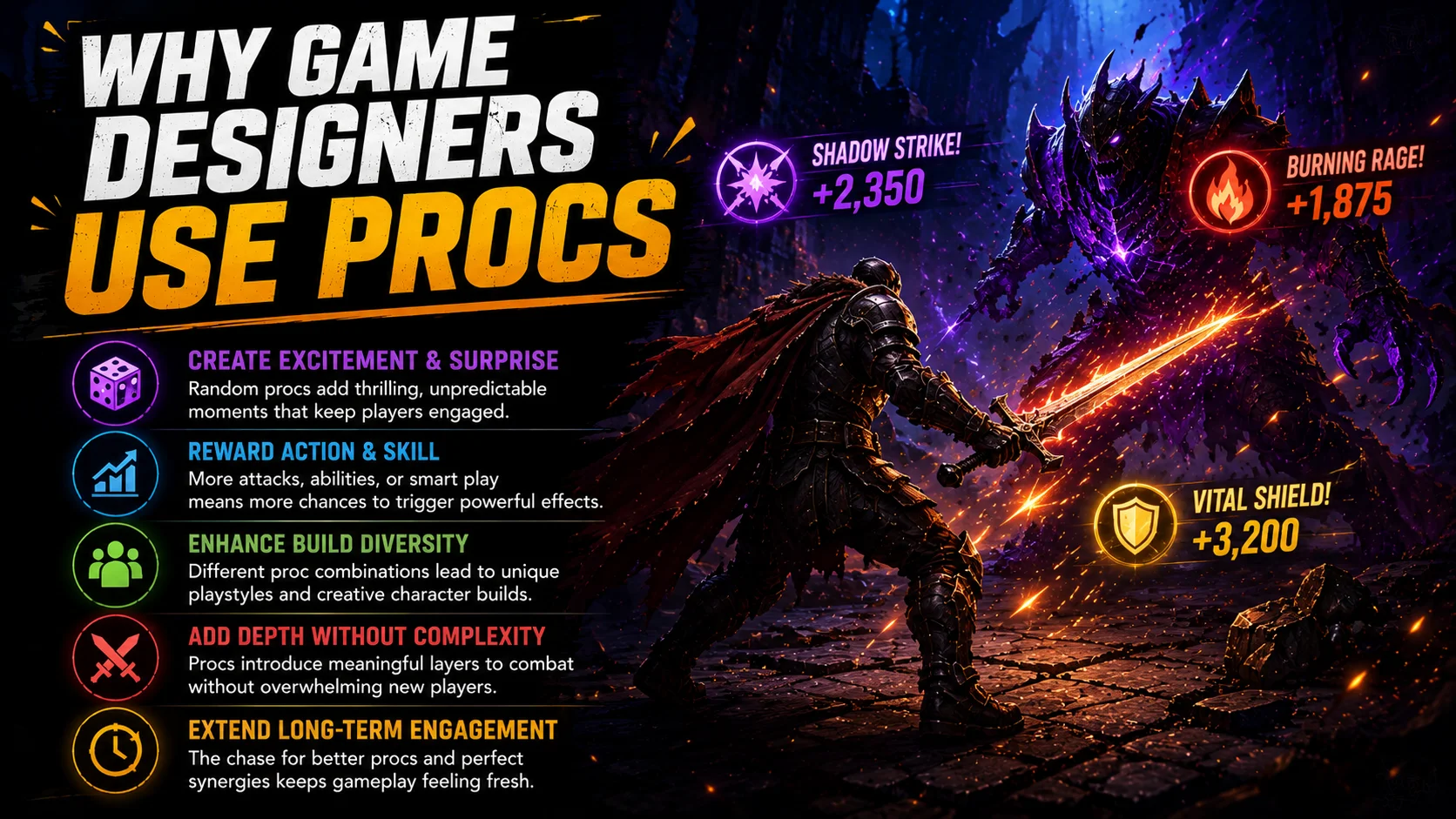
Game designers use proc mechanics strategically. They’re not random for randomness’s sake.
Adding Strategic Depth Without New Abilities:
Instead of creating ten new active abilities, designers add proc effects to existing systems. A new weapon isn’t just stronger, it has a unique proc that changes how you use it. This expands gameplay depth without button bloat.
Rewarding Skill Indirectly:
Procs reward good play indirectly. A player who lands more attacks naturally triggers more attack-based procs. A player with better ability rotation triggers more ability procs. Procs tie randomness to skill by making trigger conditions depend on player performance.
Creating Build Identity:
Different proc combinations create different playstyles. One build might stack critical-hit procs for burst damage. Another stacks damage-over-time procs for consistent damage. A third focuses on utility procs like slows and stuns. Procs enable players to express different strategies through itemization.
Maintaining Engagement Through Variability:
Procs create unpredictability within a strategic framework. You might expect a proc-based weapon to average X damage, but sometimes it underperforms and sometimes it overperforms. This variance keeps gameplay exciting without making it feel completely random.
Balancing Power Creep:
A guaranteed damage source is easier to balance than a random one. A proc that might or might not trigger allows designers to give items more potential upside without guaranteeing overpowered damage. This lets them print powerful items without breaking the game.
How Procs Affect Gameplay and Strategy
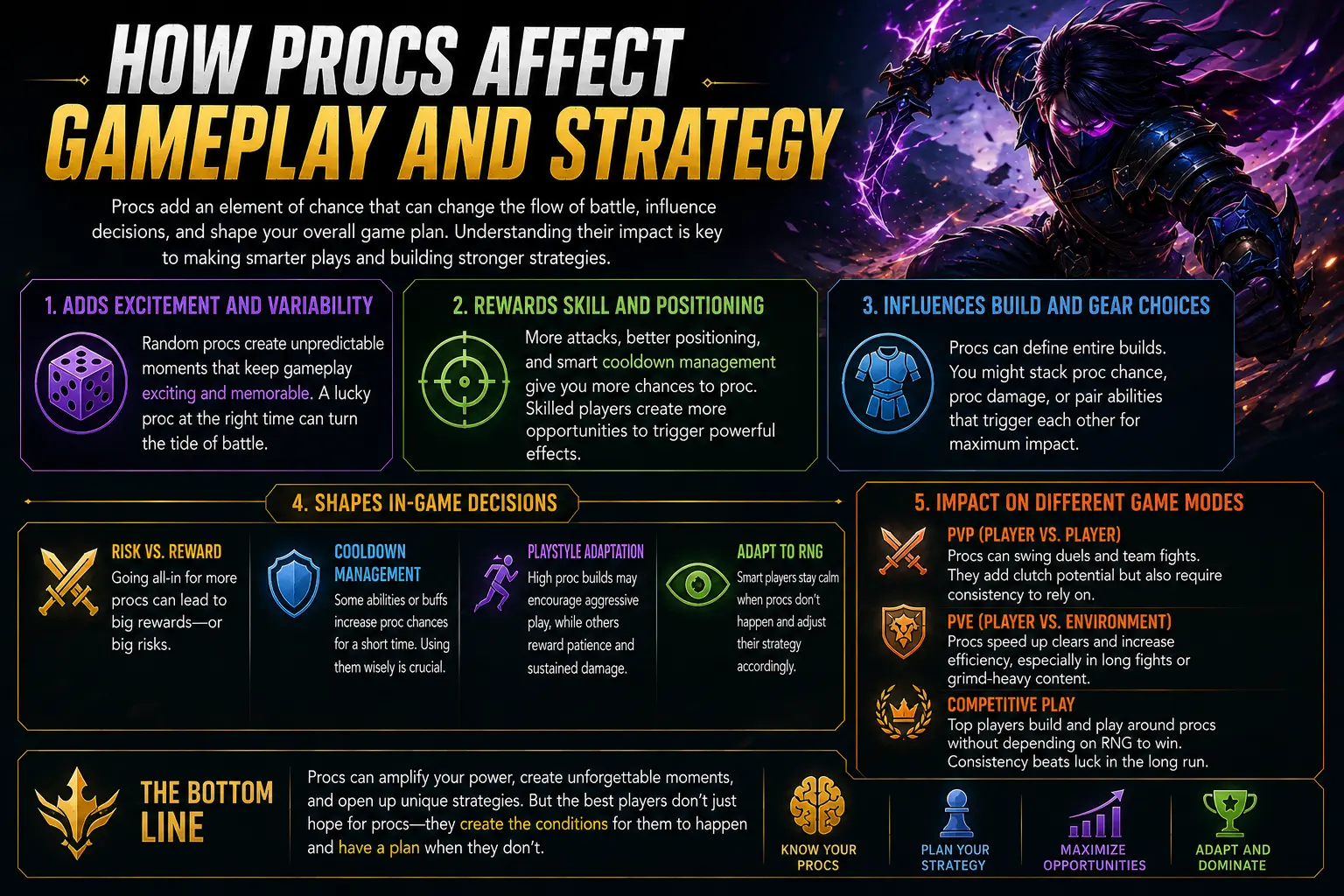
Procs influence nearly every strategic decision in games with proc systems.
Item Selection and Build Crafting:
In itemization-focused games, procs determine which items are viable. A slightly weaker item with a powerful proc might be better than a stronger item with a weaker proc. High-level players calculate proc damage when choosing between similar items.
Example: In World of Warcraft, a DPS player choosing between two weapons of similar base damage would compare proc rates, proc damage, and internal cooldowns. The weapon with worse base damage but better procs might deal 10% more total damage per fight.
Synergy-Based Builds:
Some games reward stacking specific proc types. Path of Exile enables entire character builds around proc synergies. A player might build a character specifically to trigger a certain spell repeatedly through linked procs, creating a cascade of automatic effects.
Playstyle Variation:
Procs enable the same class to play differently based on gear. A warrior with crit-proc gear plays like a burst-damage character. The same warrior with DoT-proc gear plays like a sustained-damage character. Procs allow class versatility.
Risk-Reward Decisions:
High proc rates often come with tradeoffs. An item with a powerful 50% proc rate might have lower base damage or cost more resources. Players decide whether the proc upside justifies the tradeoff.
RNG Management in Competitive Play:
In esports and high-level play, teams account for proc variance. A team might plan an engagement knowing that certain procs could trigger, changing the outcome. They calculate both “lucky proc” and “unlucky proc” scenarios.
Proc Rate vs. Damage Per Second (DPS)
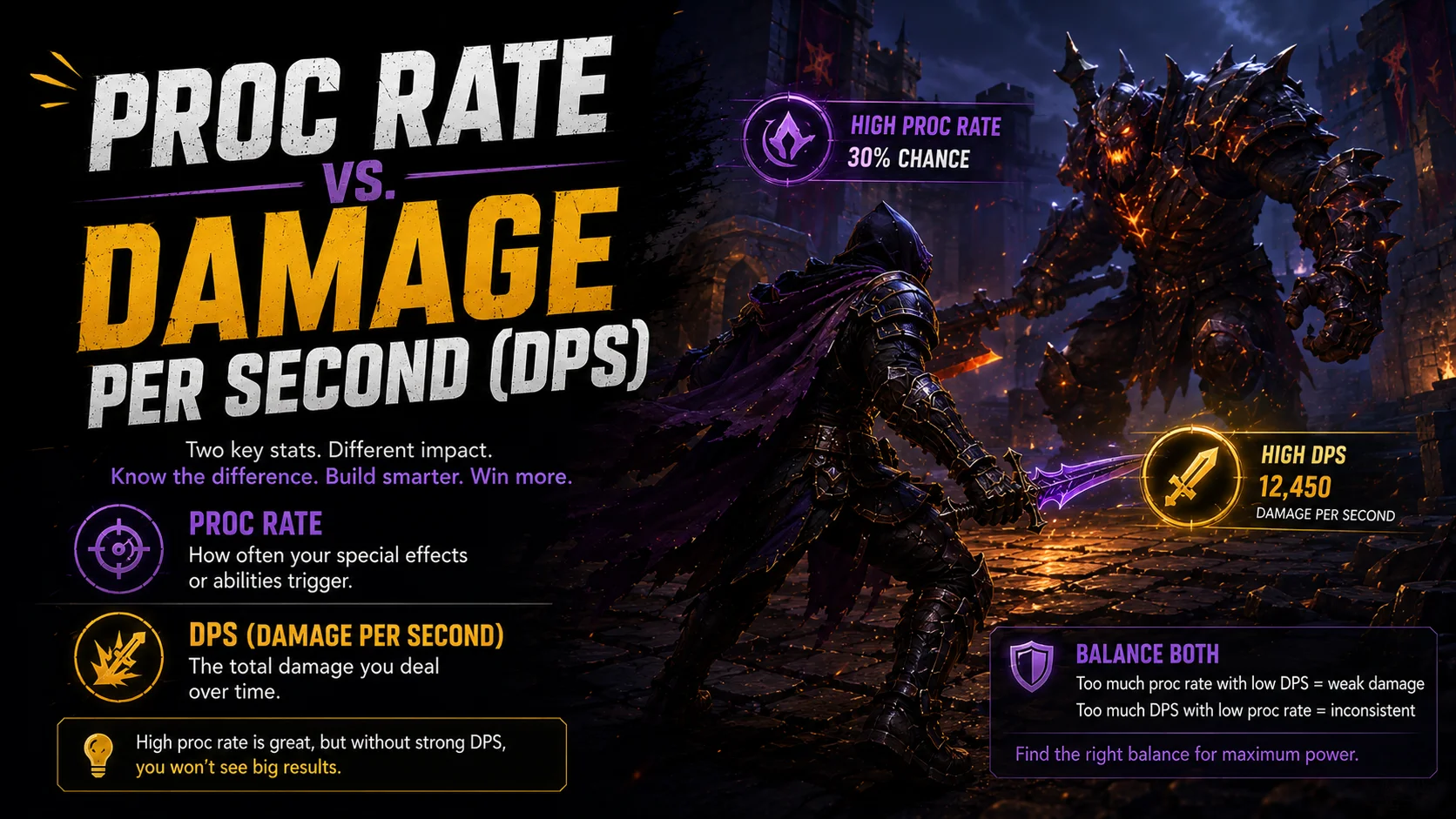
Many new players misunderstand how proc rates translate to actual damage.
The Math:
If a weapon deals 100 base damage per attack and has a 25% proc that deals 50 bonus damage, the average damage per attack is:
100 + (25% × 50) = 100 + 12.5 = 112.5 average damage per attack
But in any single attack, you deal either 100 damage (no proc) or 150 damage (proc triggers). You never deal exactly 112.5 damage. The 112.5 is the average over many attacks.
Short-Term Variance:
Over four attacks with 25% proc rate, you might see:
- Zero procs (unlucky)
- Two procs (lucky)
- One proc (average)
All three are realistic outcomes. Probability doesn’t guarantee even distribution over small samples.
Why This Matters:
In competitive games, proc timing matters. If you need burst damage right now and your proc doesn’t trigger, you’re in trouble. But over a long game, that proc’s average value matters more than its instantaneous unreliability.
Casual players experience frustration when procs don’t trigger when needed. Competitive players accept variance and plan around average values.
Common Proc Terminology
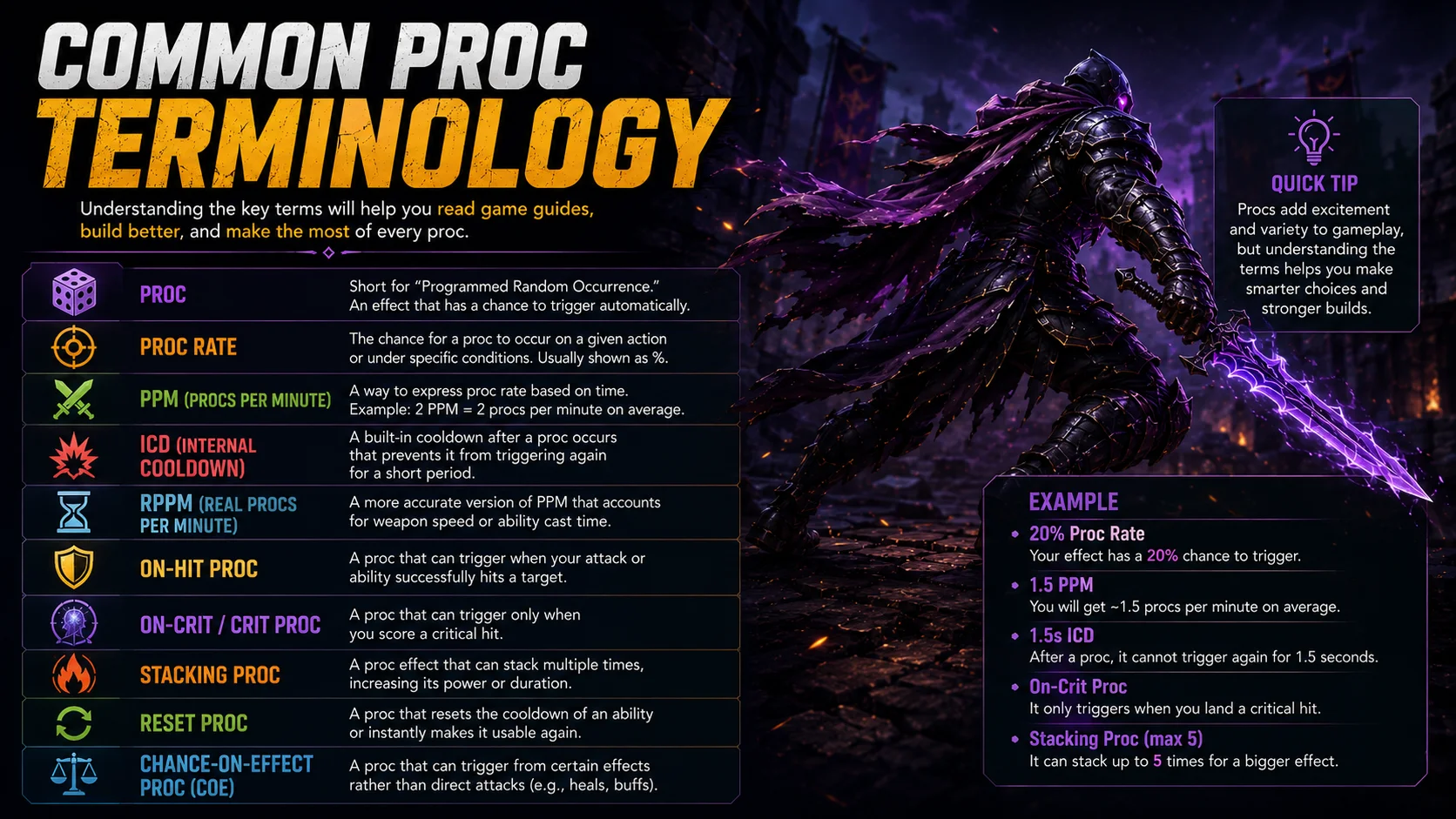
Proc Rate / Proc Chance: The percentage chance for the effect to trigger each time conditions are met.
Internal Cooldown (ICD): The minimum time between consecutive proc triggers. Example: 15-second ICD means the proc can’t trigger more than once every 15 seconds.
Proc Stacking: When multiple instances of the same proc effect can exist simultaneously. “This proc doesn’t stack” means only one instance can be active at a time.
Triggered Effect / Proc Effect: The actual effect that activates when the proc triggers (damage, stun, heal, buff, etc.).
Proc Condition / Trigger Condition: The specific event that can cause a proc to trigger (attack hit, spell cast, taking damage, etc.).
PPM (Procs Per Minute): How many times a proc triggers in 60 seconds of combat. Used in MMORPGs for balance calculations. A weapon with 10 PPM triggers on average ten times per minute of combat.
Guaranteed Proc: A proc with 100% trigger rate. The effect always happens when conditions are met.
Proc Scaling: How much a proc’s power increases with stats. Does a proc deal more damage if you have higher attack power? Does it scale with ability power? This varies by game.
Hard Proc vs. Soft Proc: (Community terms) Hard proc = guaranteed or very high rate. Soft proc = low chance.
Procs vs. Related Mechanics
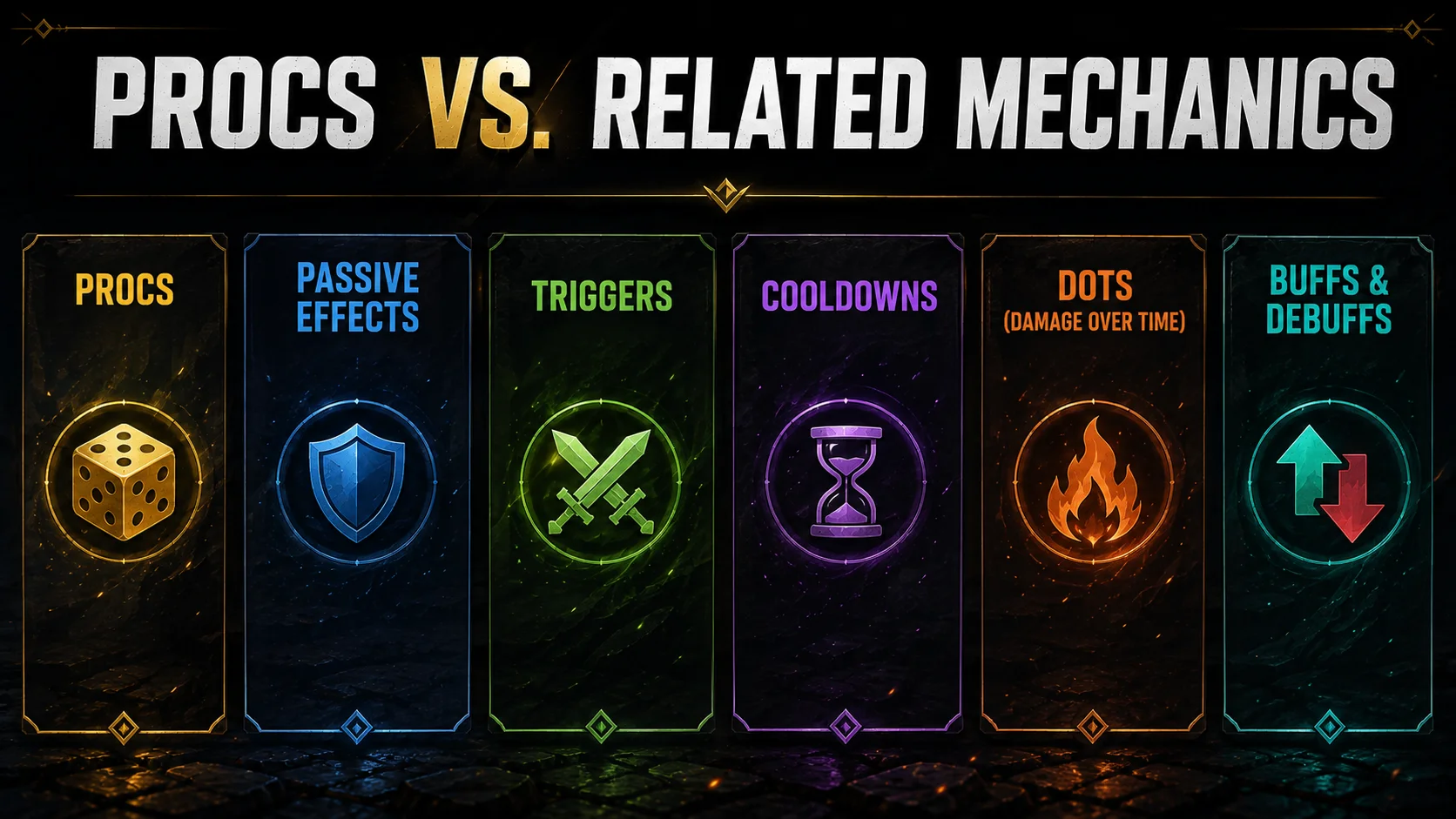
Understanding what procs are NOT clarifies the concept.
| 📌 Aspect | ⚡ Procs | ⏱️ Cooldowns |
|---|---|---|
| Control | Automatic, condition-based | Player-controlled activation |
| Predictability | Often random and unpredictable | Consistent and predictable |
| Activation | Triggers automatically | Requires player action |
| Timing | Depends on RNG | Fixed timing between uses |
| Frequency | Variable | Consistent |
Cooldowns are ability timers. After using an ability, you wait a fixed duration before using it again. You control when to activate it; the cooldown just controls how often you can use it.
Procs trigger automatically without player activation. You create conditions that allow procs to trigger, but you don’t directly activate them.
Procs vs. Passive Abilities
Passive abilities grant static bonuses. “Gain 10% more damage” is passive. It’s always active and always the same.
Procs are dynamic. They activate sometimes, not always, based on conditions. A passive that grants 10% more damage every time is functionally different from a proc that grants 50% bonus damage 20% of the time (roughly equivalent average, but very different feel).
Procs vs. Triggered Spells
Triggered spells are abilities that activate from other abilities. In World of Warcraft, a warrior’s revenge ability might be triggered by incoming attacks. Is this a proc?
Technically, yes. But gamers usually distinguish between “proc” (automatic effect) and “triggered ability” (activated ability that was triggered).
Procs vs. Status Effects
Status effects like poison, bleed, or stun are conditions applied to characters. Procs are the mechanisms that apply status effects.
A bleed proc is an effect that applies bleed status. The bleed itself is the status effect.
Advanced Proc Mechanics
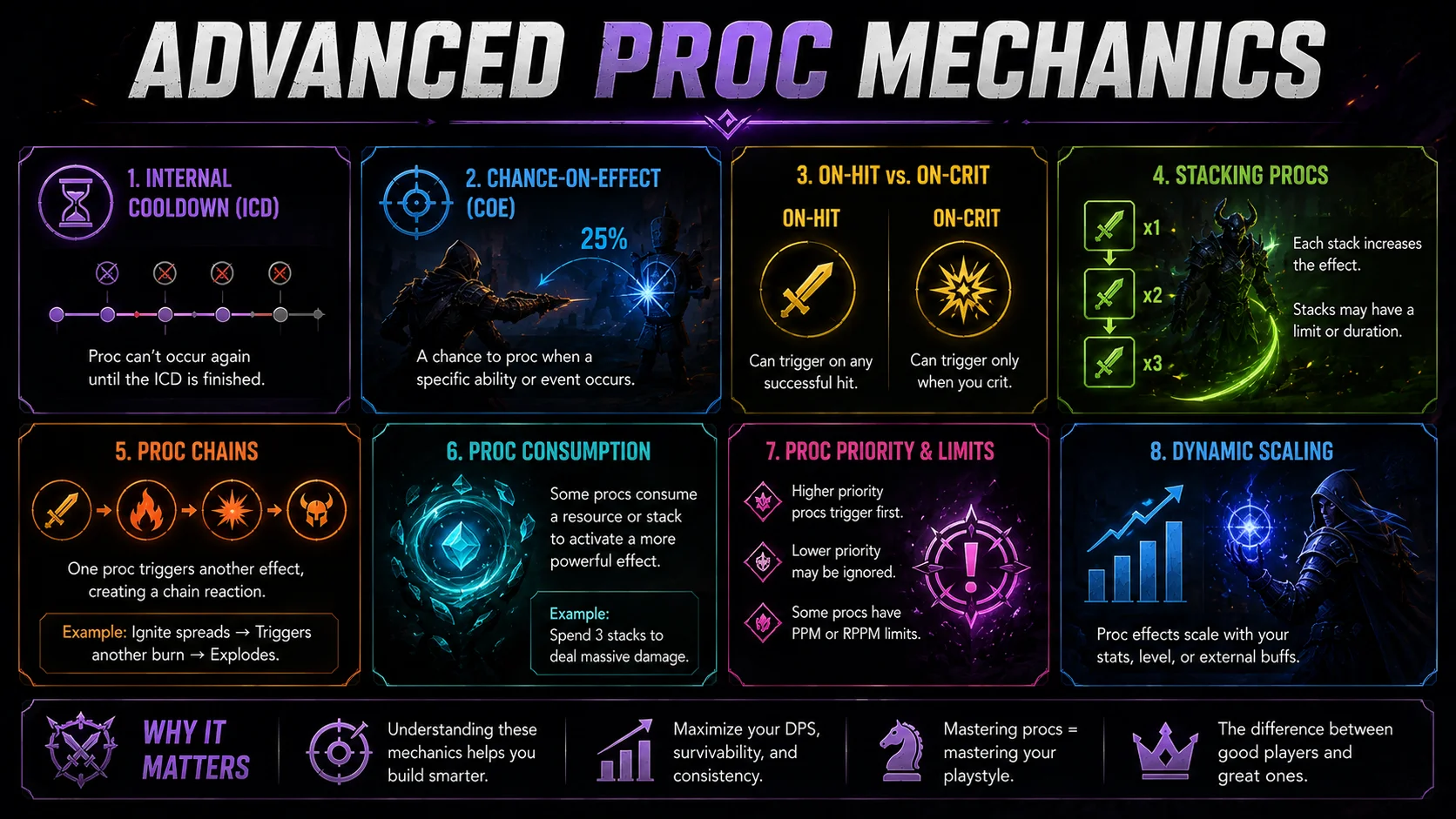
Higher-level understanding of procs opens strategic depth.
Proc Weighting:
Some games weigh certain proc outcomes. A proc might have:
- 40% chance: 50 damage
- 35% chance: 100 damage
- 25% chance: 200 damage
This isn’t a simple percentage chance. The game calculates weighted probabilities for different outcomes.
Conditional Procs:
Procs can have conditions within conditions:
- “25% chance to proc when hitting at full health”
- “Proc rate increases with higher crit rate”
- “Only procs on critical hits”
These create strategic layers. A champion with high crit might build to maximize crit-based procs.
Proc Interactions:
Multiple procs can interact. One proc might trigger another. Item A procs, which triggers Item B’s proc, creating a cascade.
Disabling Procs:
Some abilities explicitly prevent procs. Crowd control might disable procs. Certain enemy defenses might block proc effects.
Procs in Competitive Gaming
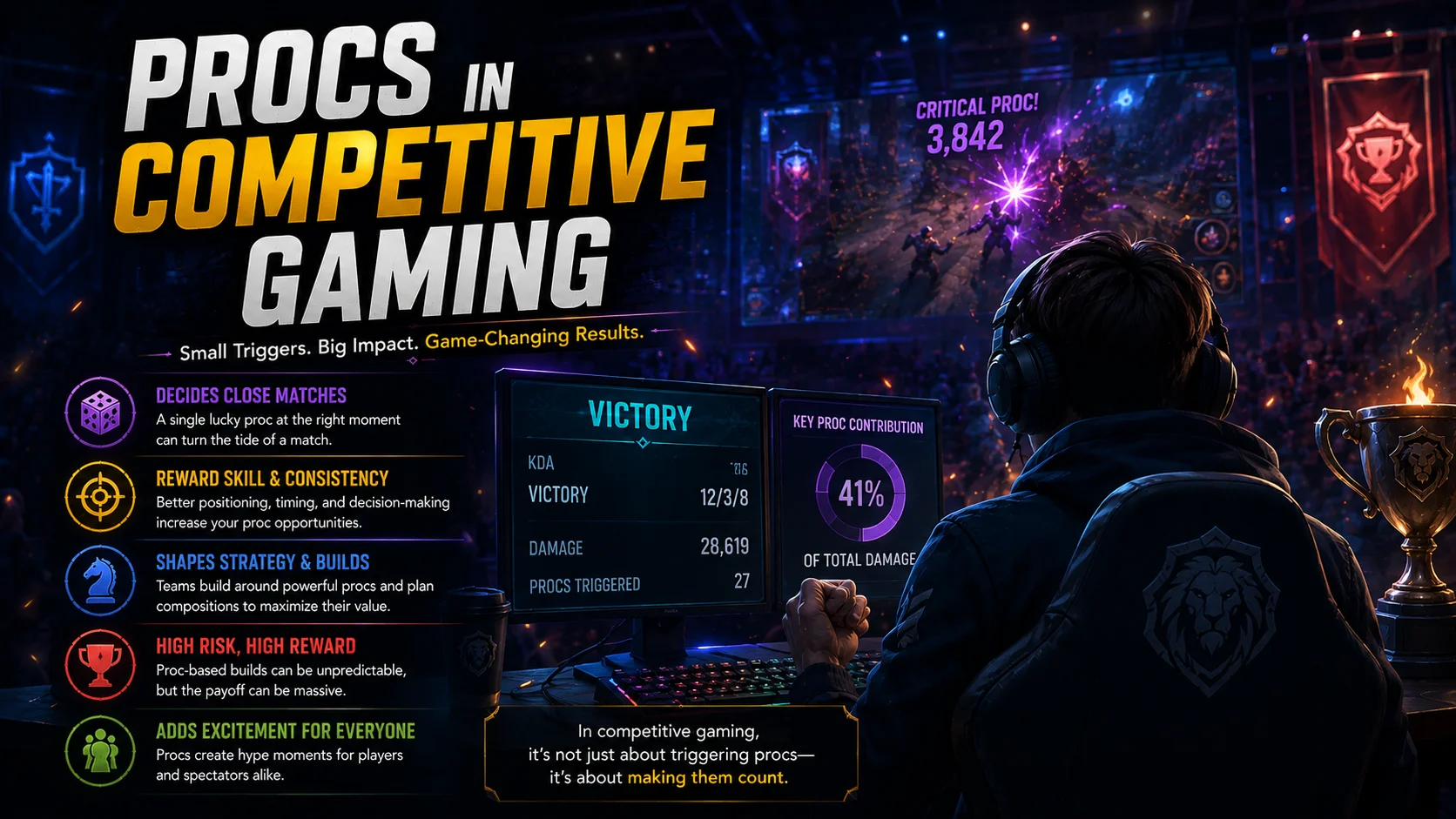
Esports teams factor procs into strategy and itemization.
In League of Legends, winning teams optimize proc damage into their itemization paths. A team might build an ADC’s items specifically to maximize proc damage against that enemy team composition.
In World of Warcraft PvP, knowing opponent proc items informs strategy. A player might avoid engaging when the opponent’s powerful proc is likely active.
In fighting games, proc-like mechanics (move properties that trigger follow-ups) define competitive viability. Characters with strong proc chains are often top-tier.
Competitive players accept proc variance but plan around it. They know that sometimes procs won’t trigger when needed, and they account for that in their strategies.
Proc mechanics are just one part of the broader competitive gaming experience. Players who want to improve their gameplay need to understand how different mechanics, strategies, builds, and game systems work together.
Common Misconceptions About Procs
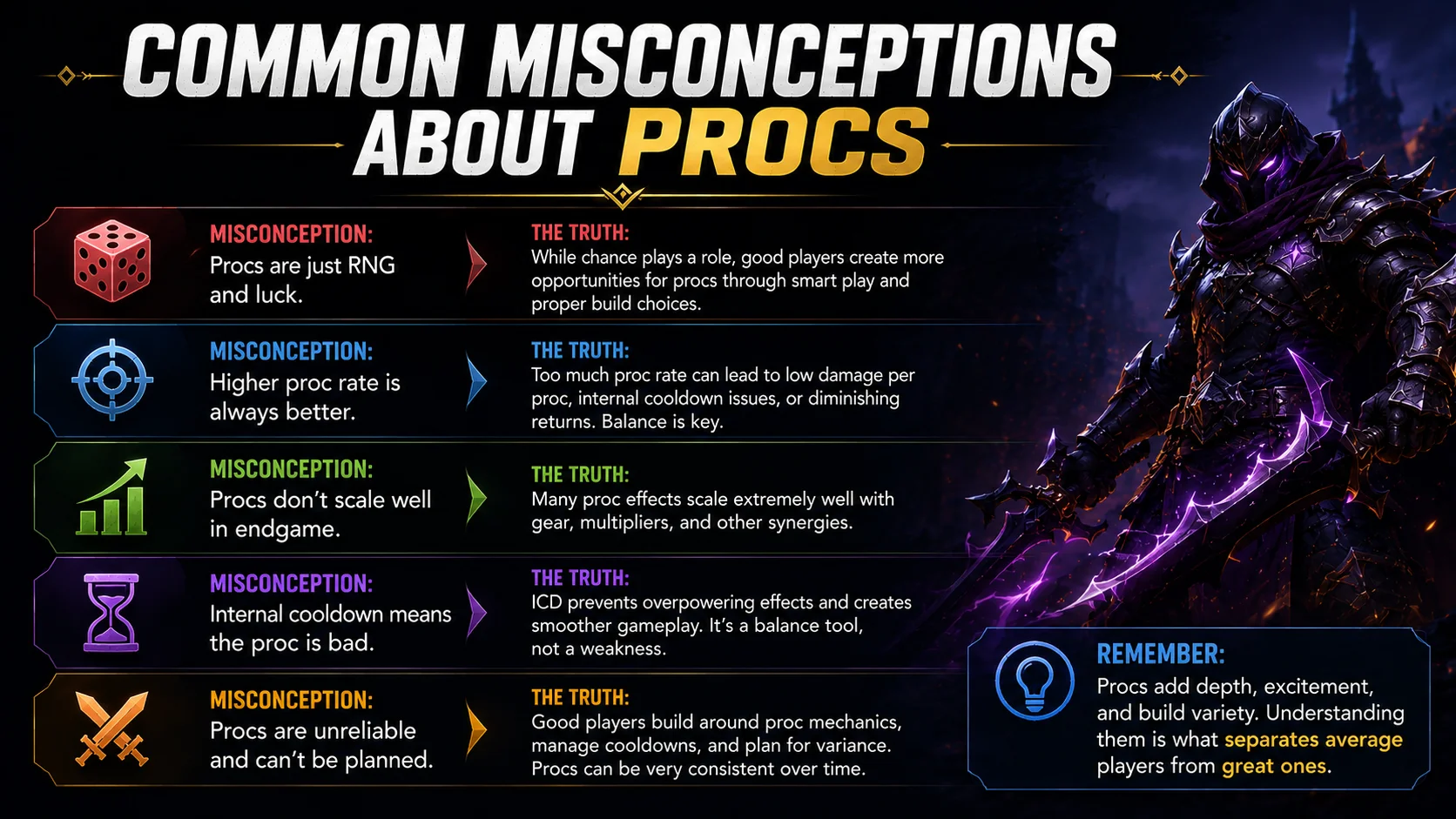
Misconception: “Procs only happen in RPGs.”
False. Procs appear in shooters (headshots triggering certain effects), fighting games (move properties triggering combos), strategy games, card games, and almost every game with conditional mechanics.
Misconception: “Every proc is random.”
False. Some procs are guaranteed (100% trigger rate). Others are conditional but certain. Only some procs involve probability.
Misconception: “Procs don’t require skill.”
False. Procs reward skill indirectly. A player who positions better, dodges more, or deals more damage naturally creates more opportunities. Proc systems reward good play.
Misconception: “A 25% proc rate means guaranteed procs every four hits.”
False. This is the most common misconception. A 25% proc rate means roughly 25% over many hits, but variance is real. You might get zero procs in eight hits or two procs in two hits.
Misconception: “Procs are completely random and unpredictable.”
Mostly false. While procs have random elements, they follow mathematical patterns. Over enough attempts, proc behavior becomes predictable. Strategic players factor proc averages into their decisions.
Misconception: “Proc damage doesn’t scale with stats.”
Depends on the game. Some procs scale with attack power, ability power, or other stats. Others deal fixed damage. Check your specific game.
Misconception: “Internal cooldowns make procs useless.”
False. Internal cooldowns balance procs. They prevent infinite scaling while keeping procs valuable. A well-designed ICD makes procs consistent without overpowering them.
Pros and Cons of Proc Systems
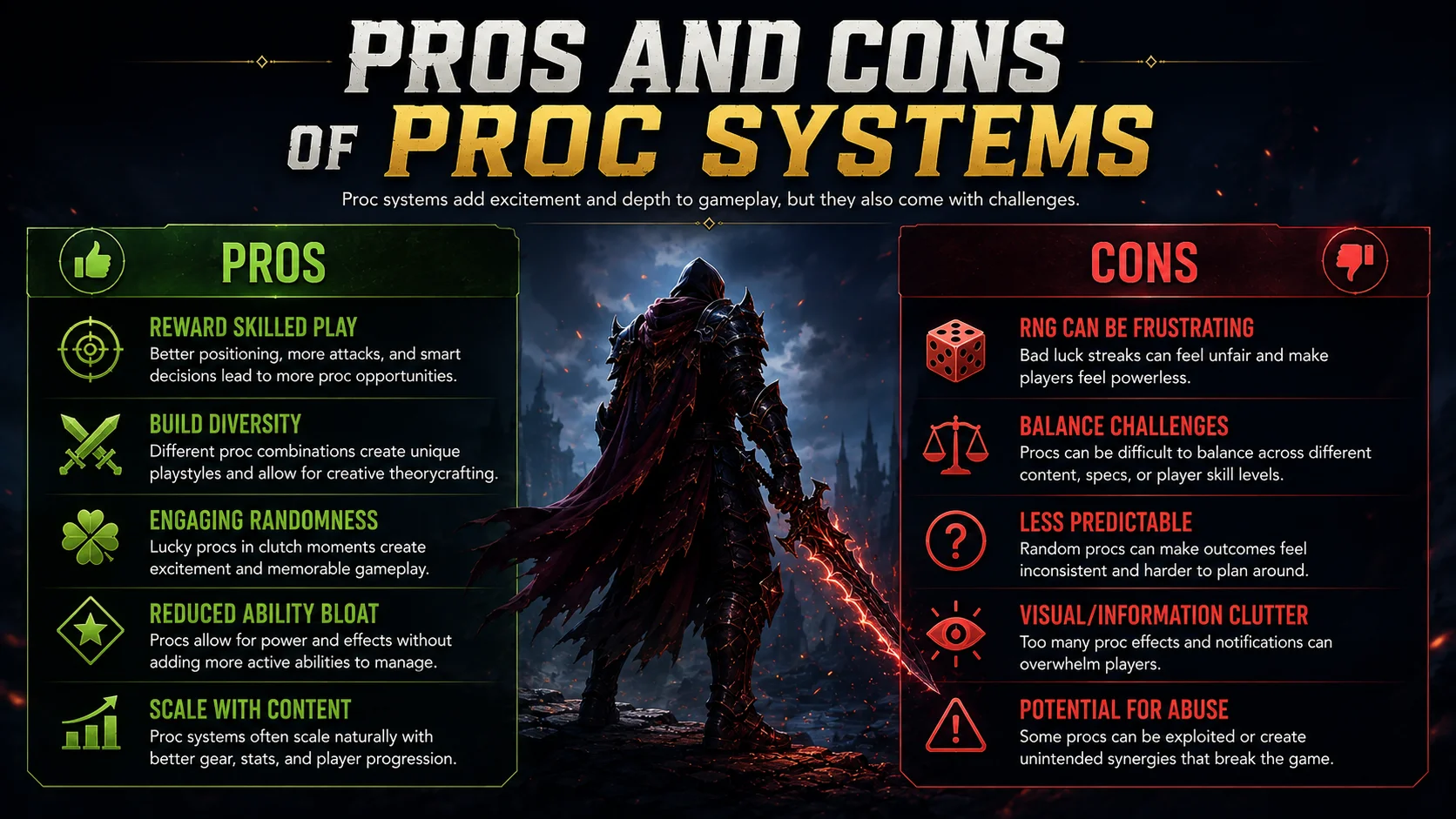
Proc mechanics have clear advantages and legitimate drawbacks. Understanding both sides helps you appreciate why games use them despite their challenges.
| ✅ Pros / Advantages | ❌ Cons / Disadvantages |
|---|---|
| Reward Skilled Play – Better positioning and more attacks can create more proc opportunities. | Frustrating RNG Variance – Missing crucial procs can feel unfair and swing matches. |
| Build Diversity – Different proc combinations can create unique playstyles. | Theorycrafting Complexity – Optimizing proc value may require math, testing, and spreadsheets. |
| Engaging Randomness – Lucky procs during clutch moments can make gameplay exciting. | Constant Balance Issues – Proc systems often require frequent balancing and patches. |
| Reduced Ability Bloat – Passives add power without requiring more active buttons. | Reduced Skill Expression – Excessive RNG can make outcomes feel less skill-based. |
| Strategic Itemization – Proc effects make gear choices more meaningful. | Item Dependency – Poor proc choices can waste resources or weaken a build. |
| Indirect Scaling – Powerful procs can make weaker items competitive with expensive gear. | Snowballing RNG – Early lucky procs can create advantages that grow throughout a match. |
Proc Examples in Practice
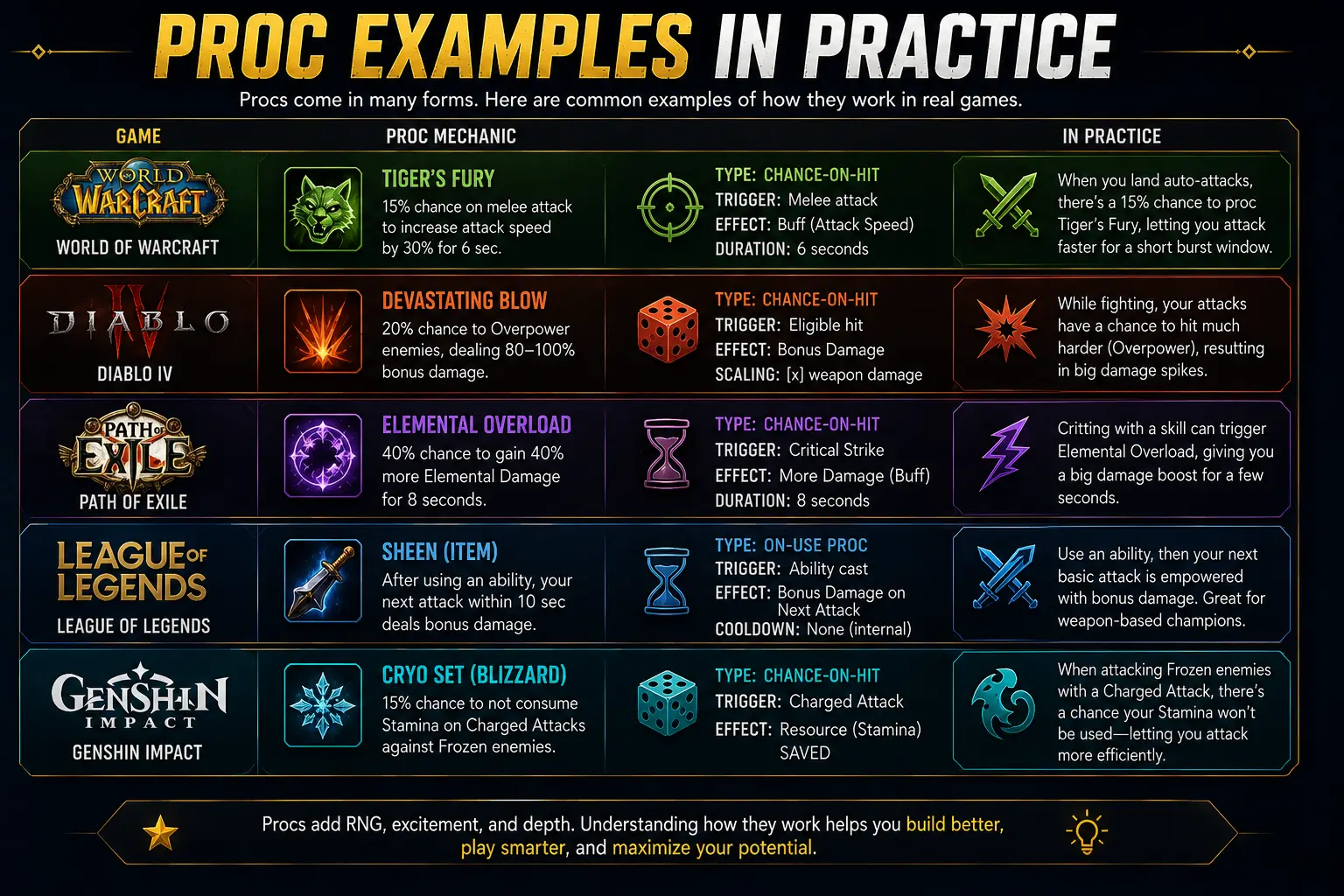
Example 1: Dark Souls Bleed Build
You’re using a weapon with bleed status buildup. Every hit fills the bleed meter slightly. After roughly ten hits, the meter fills and the bleed status procs, dealing a chunk of health damage instantly. The meter resets and you start building bleed again. Over a long fight, bleed procs add significant total damage.
Example 2: League of Legends Sheen Proc
You’re playing a champion with Sheen item. Every time you cast an ability, Sheen’s passive resets, and your next attack deals bonus damage (the proc). You cast ability → next attack procs bonus damage. This proc defines your playstyle, forcing you to alternate between abilities and attacks.
Example 3: World of Warcraft Fire Mage
Your talent tree includes a 15% proc that, when triggered by your fire spells, instantly resets your fireball cooldown, letting you cast it immediately. You cast fireball → sometimes it procs → you cast fireball again instantly. This creates moments of burst damage and makes the gameplay feel dynamic.
Example 4: Hearthstone Murozond’s Vengeance
A card reads: “Trigger all Deathrattles of minions that died this game.” This is a proc-like mechanic. When the condition is met (card played), all stored effects proc automatically without additional player input.
Real-World Proc Calculations
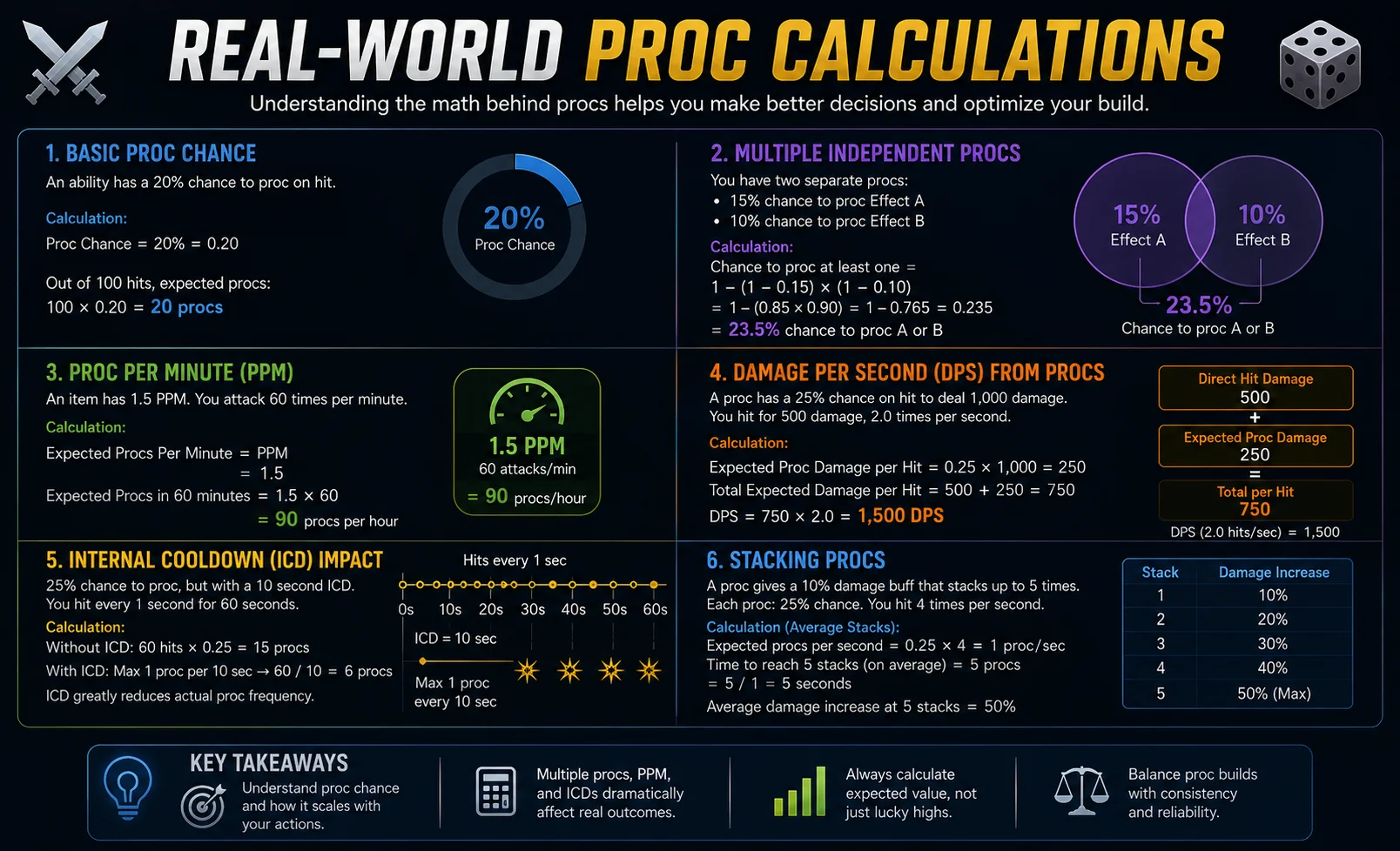
Scenario: Comparing Two Items
Item A: 100 damage, no proc Item B: 80 damage, 40% proc rate for 60 bonus damage, 6-second internal cooldown
In combat lasting 60 seconds with average 2 attacks per second (120 total attacks):
Item A: 100 × 120 = 12,000 total damage
Item B: Base damage: 80 × 120 = 9,600 Proc opportunities (adjusted for ICD): roughly 10 procs in 60 seconds Proc damage: 10 × 60 = 600 Total: 9,600 + 600 = 10,200 damage
Item A is better in this scenario. But if the fight lasts longer or your attack speed is higher, Item B might win.
This is why theorycrafting exists. Proc items require context-specific calculations.
Frequently Asked Questions
Conclusion
Procs are fundamental to modern game design. They add strategic depth, reward skill indirectly, and create the build variety that keeps players experimenting.
The next time someone asks you what does proc mean in gaming, you’ll know exactly what to say: an automatic triggered effect. Probably with a percentage chance. Definitely worth understanding if you want to optimize your builds and strategies.
Whether you’re evaluating gear in an MMORPG, itemizing in a MOBA, crafting a build in an action RPG, or planning a card combo in a digital card game, procs are working behind the scenes. Understanding how they work and how they interact with your character, items, and playstyle separates casual players from players who consistently make better decisions.
And if someone asks you where “proc” comes from, you can confidently tell them: it almost certainly means “Programmed Random Occurrence,” born in the early days of text-based gaming and never replaced because it’s the perfect word for what it describes.