
What Does MMR Stand For in Gaming? (Matchmaking Rating Explained)

Every ranked game you play uses a hidden number that determines everything: who you face, how many points you gain or lose, and whether you can actually climb. That number is your MMR Matchmaking Rating and understanding it changes how you view your entire ranked experience.
Your MMR works behind the scenes while your visible rank sits in the client for show. The system matches you by the invisible number, not the flashy tier next to your name. This gap between what you see and what actually matters confuses millions of competitive gamers every single day.
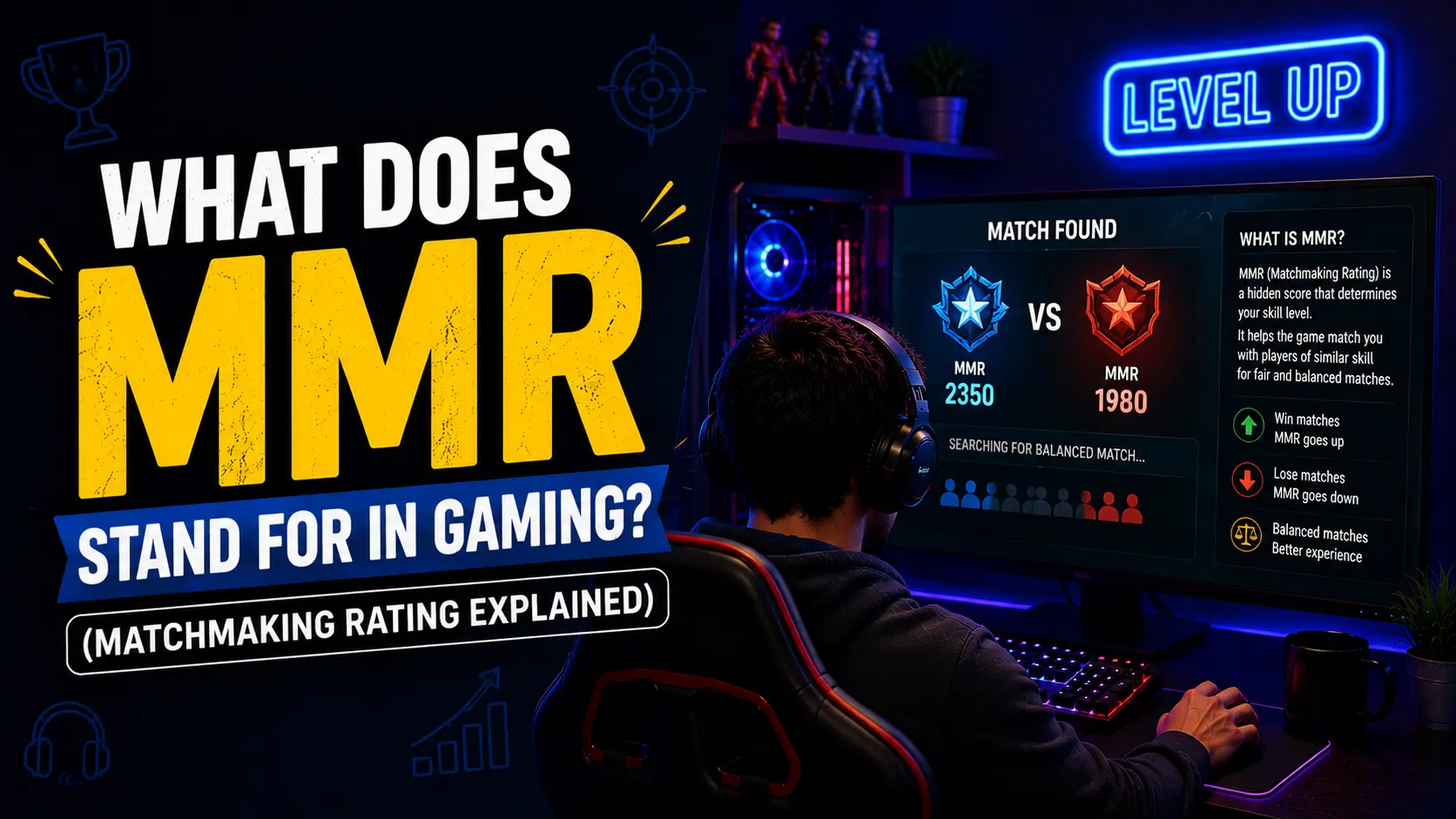
This guide explains what MMR stands for in gaming, how Matchmaking Rating works, where it came from, and how games use it to match players with similar skill levels. It also covers how MMR changes after wins and losses, how it differs from ranks like ELO, LP, and SR, and why it matters in competitive gaming.
What Does MMR Stand For in Gaming?
The Core Definition
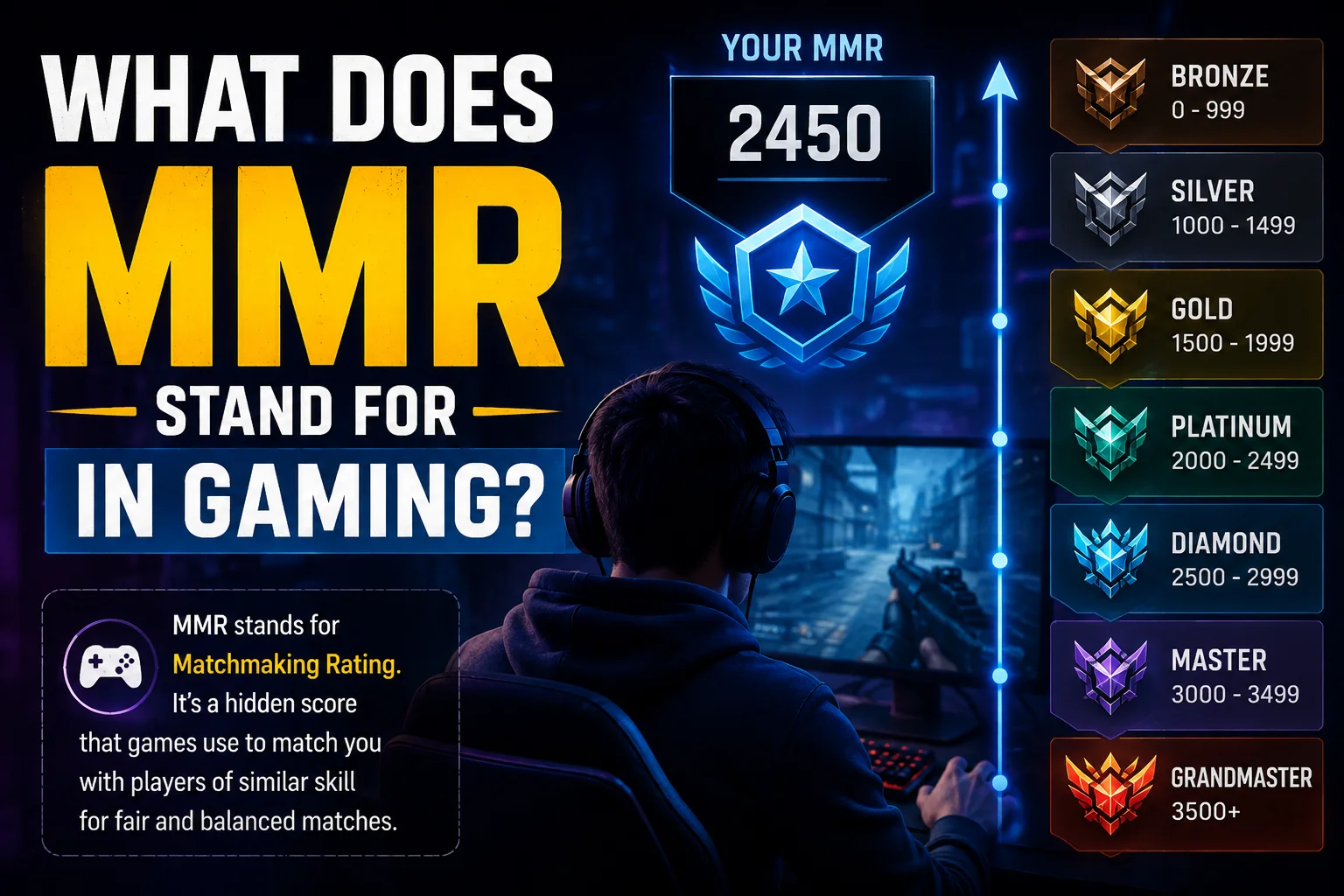
MMR (Matchmaking Rating) is a hidden numerical value used by multiplayer competitive games to assess player skill and create balanced matches. Unlike visible ranks or tiers, MMR updates dynamically after every match based on match outcomes and relative opponent strength.
Think of MMR as your real rating and your visible rank as a lagging summary that updates slowly on purpose. The game cares about MMR; it uses that number to find opponents. The rank you display? That’s purely a psychological reward structure that makes climbing feel less volatile than your actual rating swings.
How Every Game Calculates MMR
Every game calculates your MMR differently, but they all follow the same principle: beat opponents stronger than you, gain more points; lose to opponents weaker than you, lose more points. The system punishes underperformance against weaker opponents and rewards beating stronger ones, creating constant correction toward your true skill level.
How the Matchmaking Engine Uses Your MMR
The Queue Process
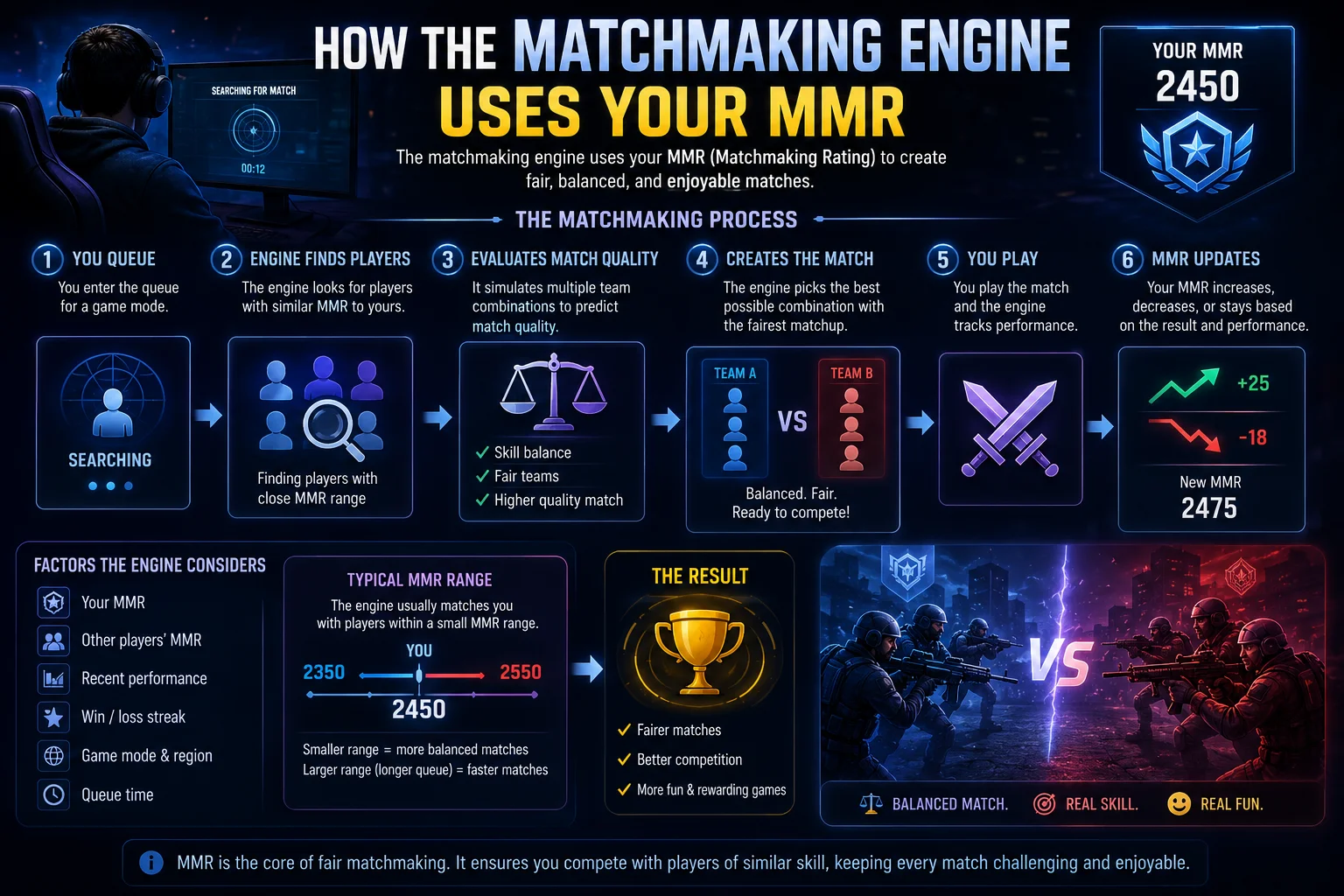
When you queue for ranked, the matchmaking system searches for five to ten other players within your MMR range depending on game type:
- It doesn’t hunt for exact matches
- It casts a net and accepts the best available players within reasonable parameters
- Queue times matter more than perfect skill distribution
- If the system demanded mathematically balanced matchups every single game, mid-tier players would wait 10+ minutes just to start
- Most player bases concentrate in 2k-4k MMR brackets (42% of all ranked players in Dota 2 sit in Archon and Legend)
- The wait for perfect matches is impossible at scale
Dynamic Range Adjustment
The system widens your acceptable MMR range as queue time increases:
- Wait 30 seconds → you play someone 50 points away
- Wait 90 seconds → maybe 150-200 points away
- Wait 3+ minutes → ranges widen dramatically
- This keeps games flowing while maintaining general skill balance
- Prevents players from waiting indefinitely for perfect matches
MMR and Rank Are Not the Same Thing
The Critical Distinction
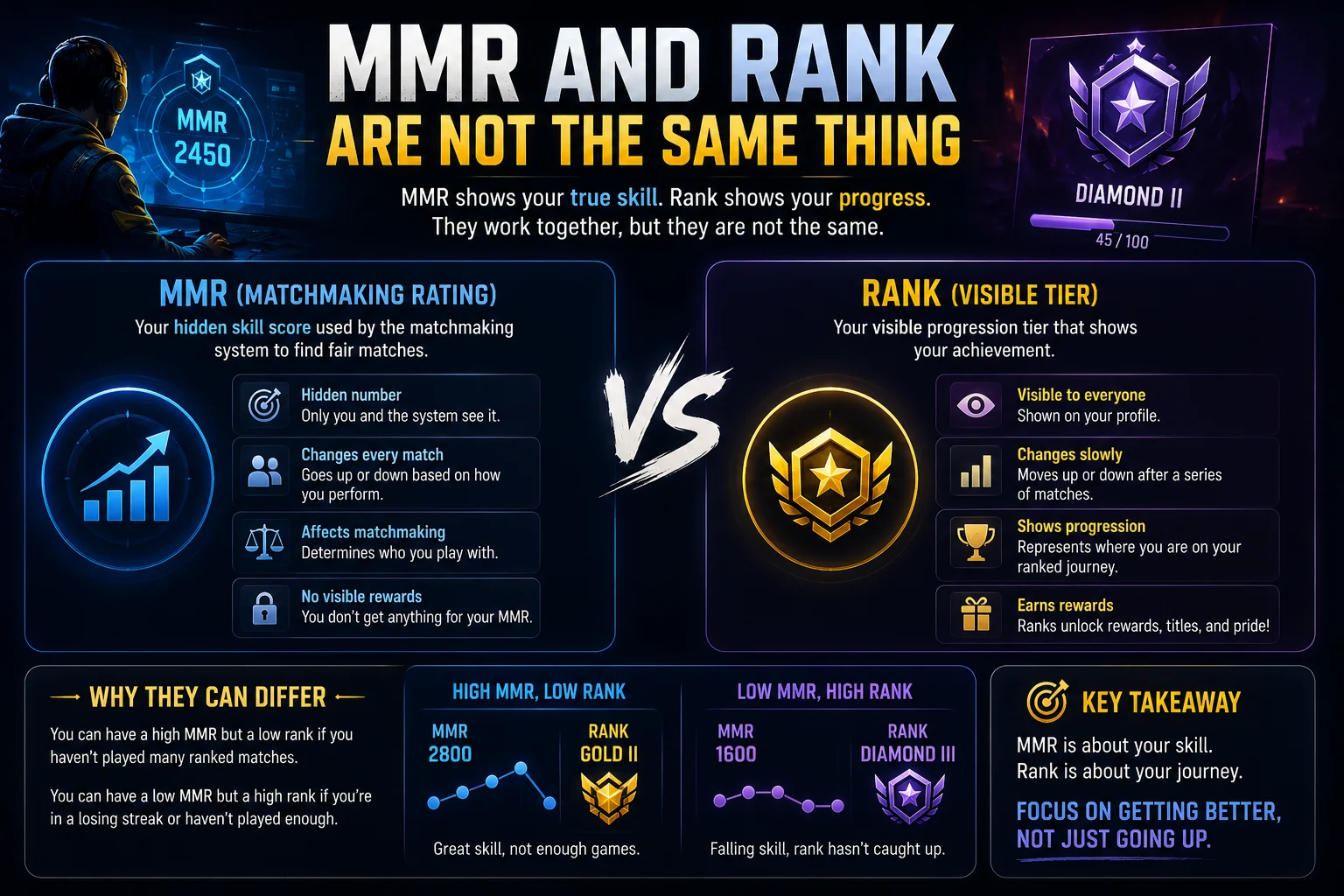
This single misconception ruins more climbing strategies than anything else. Your rank displays in the client (Gold, Platinum, Diamond). Your MMR lives invisible and controls your actual matchmaking. Grasping what is mmr in gaming versus what rank represents is the single biggest unlock for understanding your own climb.
You can have Diamond rank with Platinum MMR (slowly dropping until you equalize) or Gold rank with Diamond MMR (climbing rapidly until your rank catches up). The gap between these two numbers determines your progression speed. High MMR, low rank? You climb fast. Low MMR, high rank? You stall out quickly.
Developer Insight on Rank Locking
Valorant uses Rank Rating (RR) systems—a visible tier from 0–100 per tier—while maintaining a separate hidden Matchmaking Rating underneath. The two systems operate independently, so your visible RR gain doesn’t directly equal your hidden MMR progression. This design intentionally separates cosmetic progression from actual skill measurement.
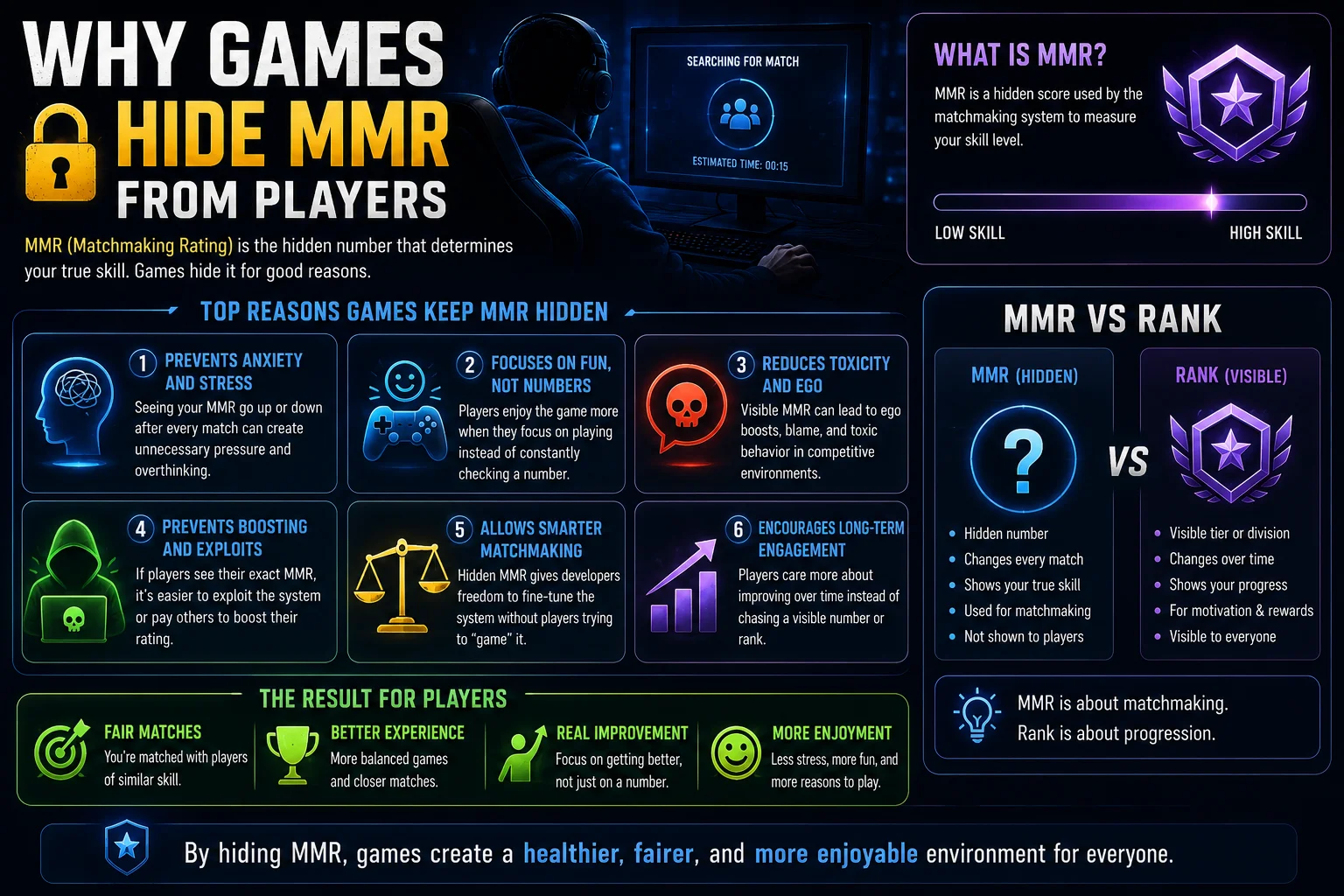
Why Games Hide MMR From Players
Psychological Protection
Showing your rating swing ±30 every single game feels brutal. Losing an entire visible tier to a bad streak feels catastrophic. Games hide MMR to make progression feel smoother while still matching you fairly based on accurate skill measurement.
Breaking Boost Services
Developers also hide MMR to break boost services. If every account displayed exact MMR publicly, boost sites could advertise “guaranteed +500 MMR” with pricing. Hidden ratings make selling boosts riskier and harder to market reliably.
Structural Flexibility
Hidden MMR also lets games restructure ranks cosmetically without touching the underlying skill foundation. When Valorant redesigned its tier system or League of Legends shifted divisions, the visible structure changed but invisible MMR continued calculating skill normally underneath.
Understanding MMR is only one part of improving your overall gaming experience. Competitive players also need to understand related concepts such as LFG systems, AFK behavior, and ping and latency, because these can all affect how players experience multiplayer games. From matchmaking and ranked progression to connection quality and finding teammates, these topics are closely connected to competitive gaming.
The Behavior Score System
Why It Matters More Than You Think
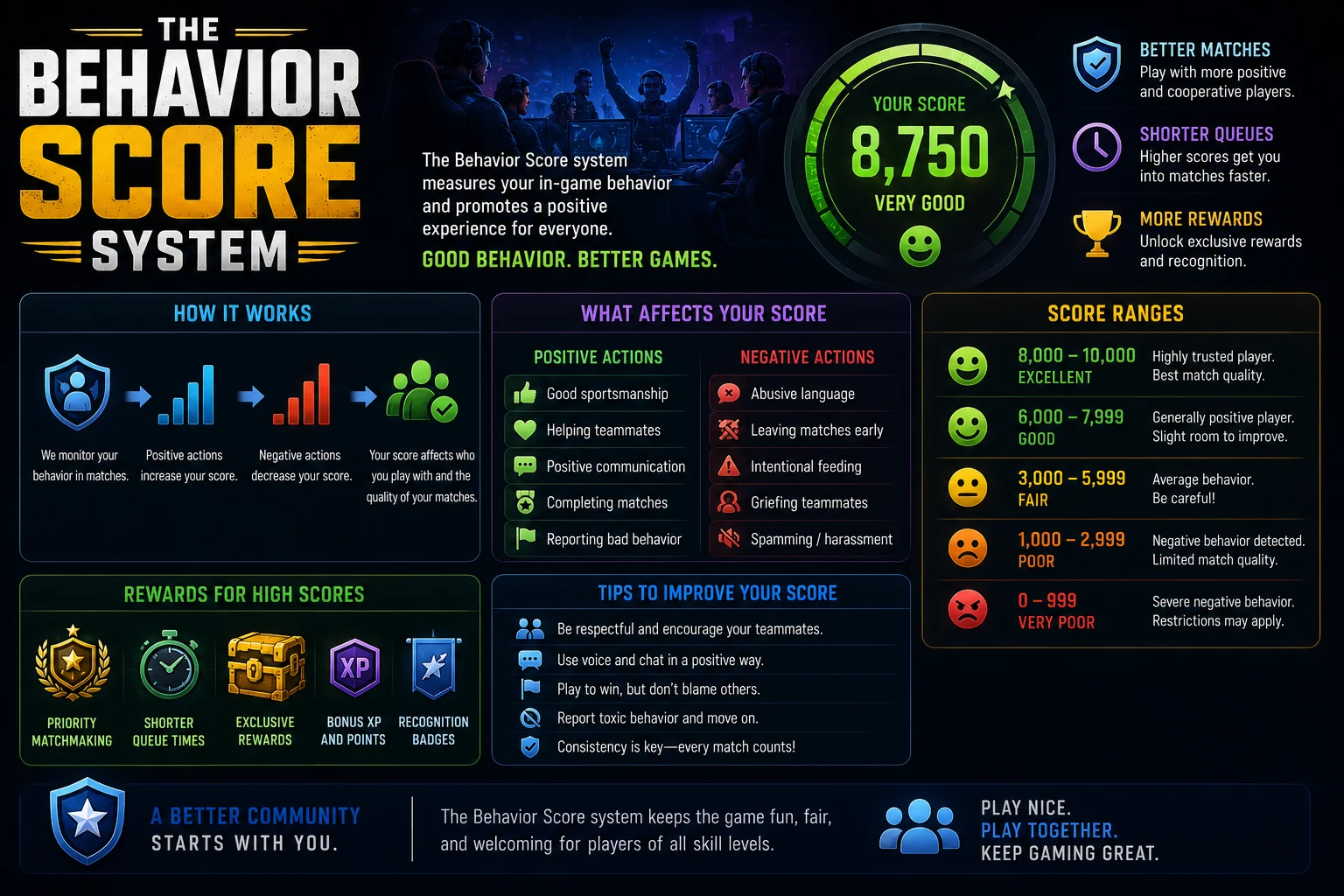
Here’s what separates informed players from stuck ones: MMR measures skill; behavior score measures conduct, and the two systems run independently. You can have high MMR and low behavior score, and the low score will ruin your climbing far more than low MMR ever could.
Ranked Access Gates
Dota 2 locks you out of ranked entirely below 3,000 behavior score. You cannot queue ranked—only unranked games count. Most players don’t discover this until they’re already stuck, raging silently in unranked while wondering why they can’t climb.
Game Quality Tiers
Below 6,000 behavior score in Dota, the system matches you exclusively with other low-conduct players. Players report that improving their behavior score from 6,000 to 10,000 feels like ranking up an entire tier in game quality—teammates communicate, nobody rage-quits, drafts make sense. Fix behavior score first; grind MMR second.
Solo Queue vs Party Queue MMR
The Rating Penalty for Groups
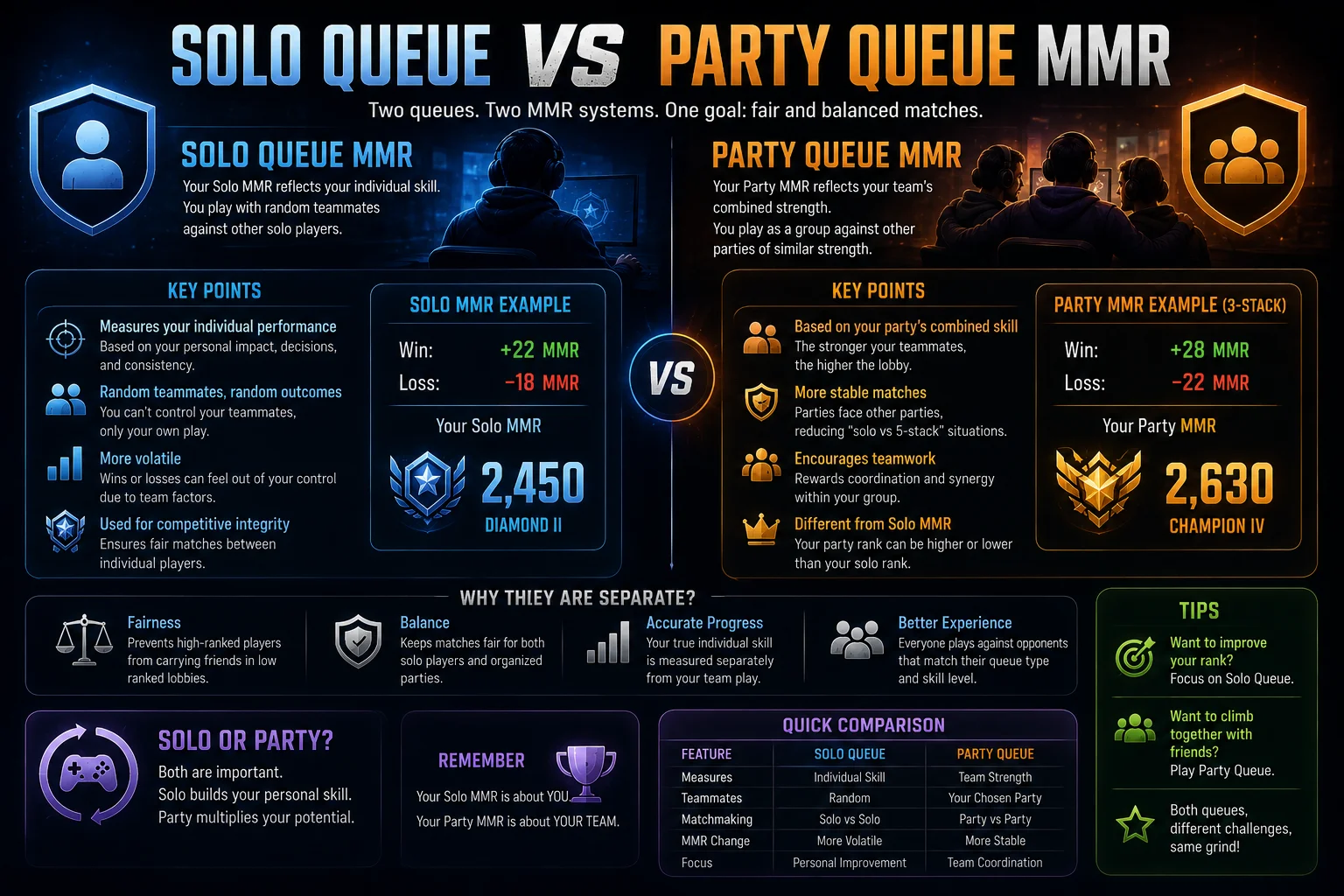
Most games calculate solo and party ranks separately because the math works differently. Play solo, you earn ±30 MMR per game. Play with a 4-stack of friends, you earn ±20 MMR per game for the same win.
Why Coordination Gets Penalized
Why the penalty? Coordination. Your premade group communicates over voice comms while random solo players don’t. The system accounts for this communication advantage by punishing party gains preventing stacks from inflating their ratings through teamwork rather than skill.
The Duo Trap
A higher-MMR duo partner inflates your win rate without inflating your skill, creating an inflated LP that collapses when you return to solo queue, forcing months of LP loss to re-stabilize your rating.
How MMR Points Actually Calculate
Scaling by Opponent Strength
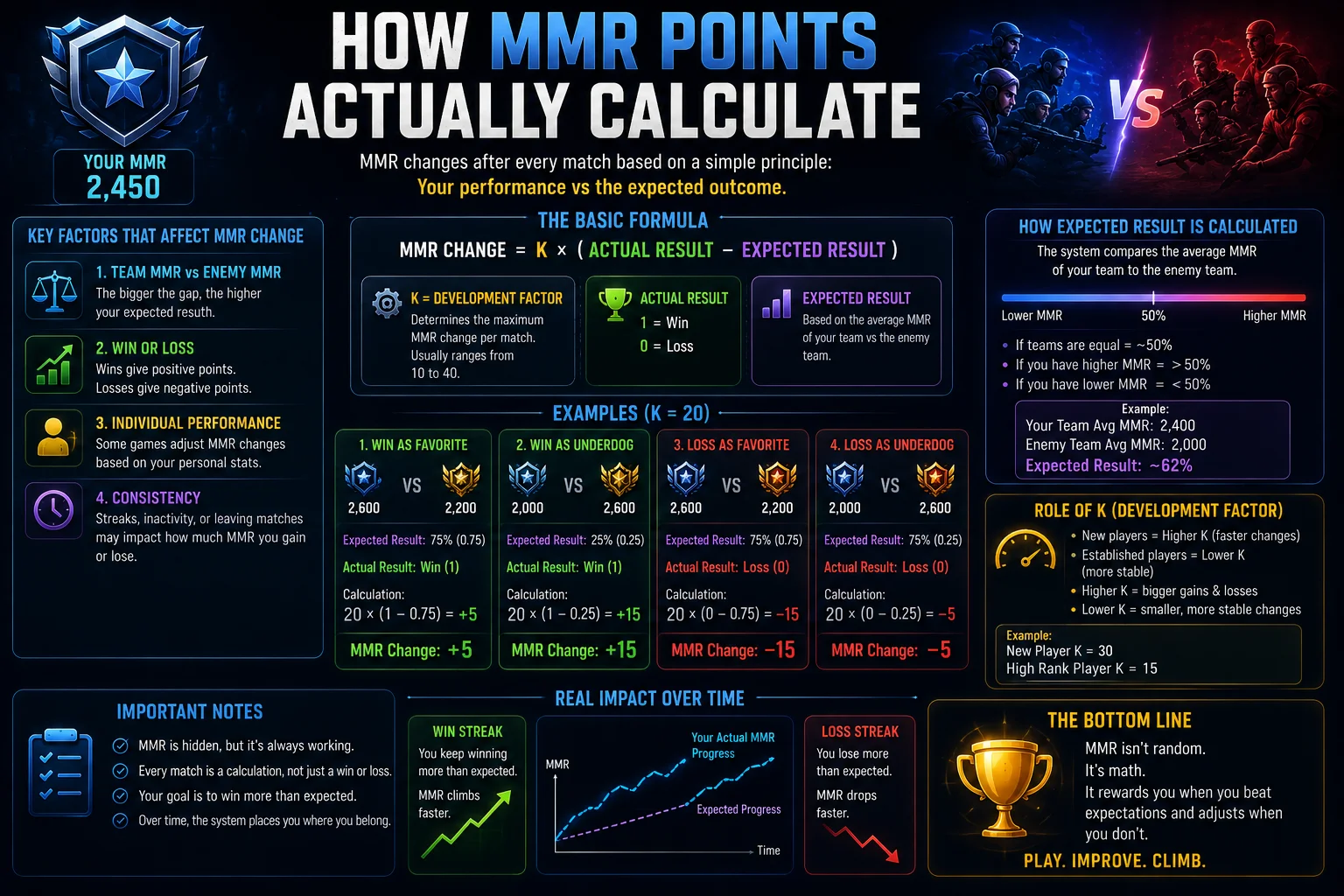
The exact formula changes per game, but the principle holds everywhere: your gain or loss scales with opponent strength relative to your rating.
Beating someone 300 MMR above you earns 40-50 points. Beating someone 50 MMR below you earns 8-12 points. This self-correcting mechanism prevents rating inflation you can’t coast at a rank by crushing weaker players.
Punishing Underperformance
Lose to someone 100 points below your rating? You lose 35-40 points instead of 25. This hits hard intentionally, punishing underperformance to keep ratings honest.
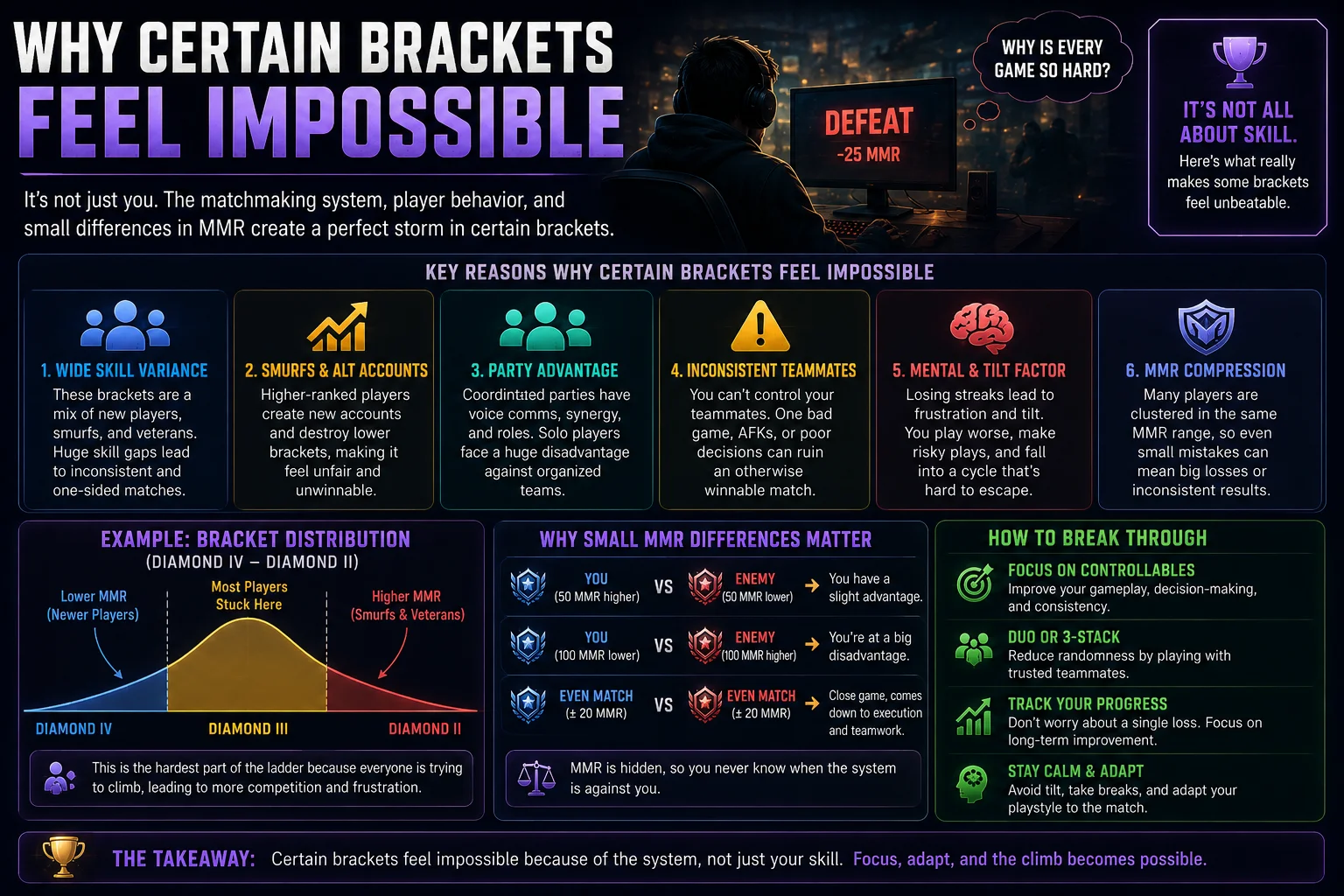
Why Certain Brackets Feel Impossible
The 2k-4k Ceiling
Players report climbing from 1.1k to 2.2k quickly, then hitting a ceiling at 2k where 90% win rate in lane produces zero rank progress despite beating Legend-tier opponents in unranked. This isn’t imagination, it’s the bracket ceiling effect.
The 2k-4k range contains the densest player concentration. You’re grinding against millions of equally skilled players, not smurfs or beginners. Below 2k, raw mechanical skill wins. You out-farm everyone, out-position everyone, and carry games through personal excellence. Your teammates’ mistakes don’t matter because your damage output overwhelms their incompetence.
The Macro Skill Threshold
Above 4k, teamfighting execution dominates. Everyone farms adequately. Everyone positions reasonably. The difference emerges in which team groups faster, controls objectives better, and converts early advantages into wins. Mechanical skill matters less; macro skill matters more.
Why It Matters to You
In 2k-4k, games become chess matches where draft and rotation timing matter more than individual mechanics. You can’t solo-carry through farming anymore because everyone farms adequately. You can’t rely on team execution because teammates still make random mistakes. You need game knowledgewave management, rotations, objective priority, resource distribution.
This creates a real skill ceiling. Learn these concepts, and you escape what feels like permanent placement. Ignore them, and you grind 2k-4k forever, blaming teammates for not executing your plan.
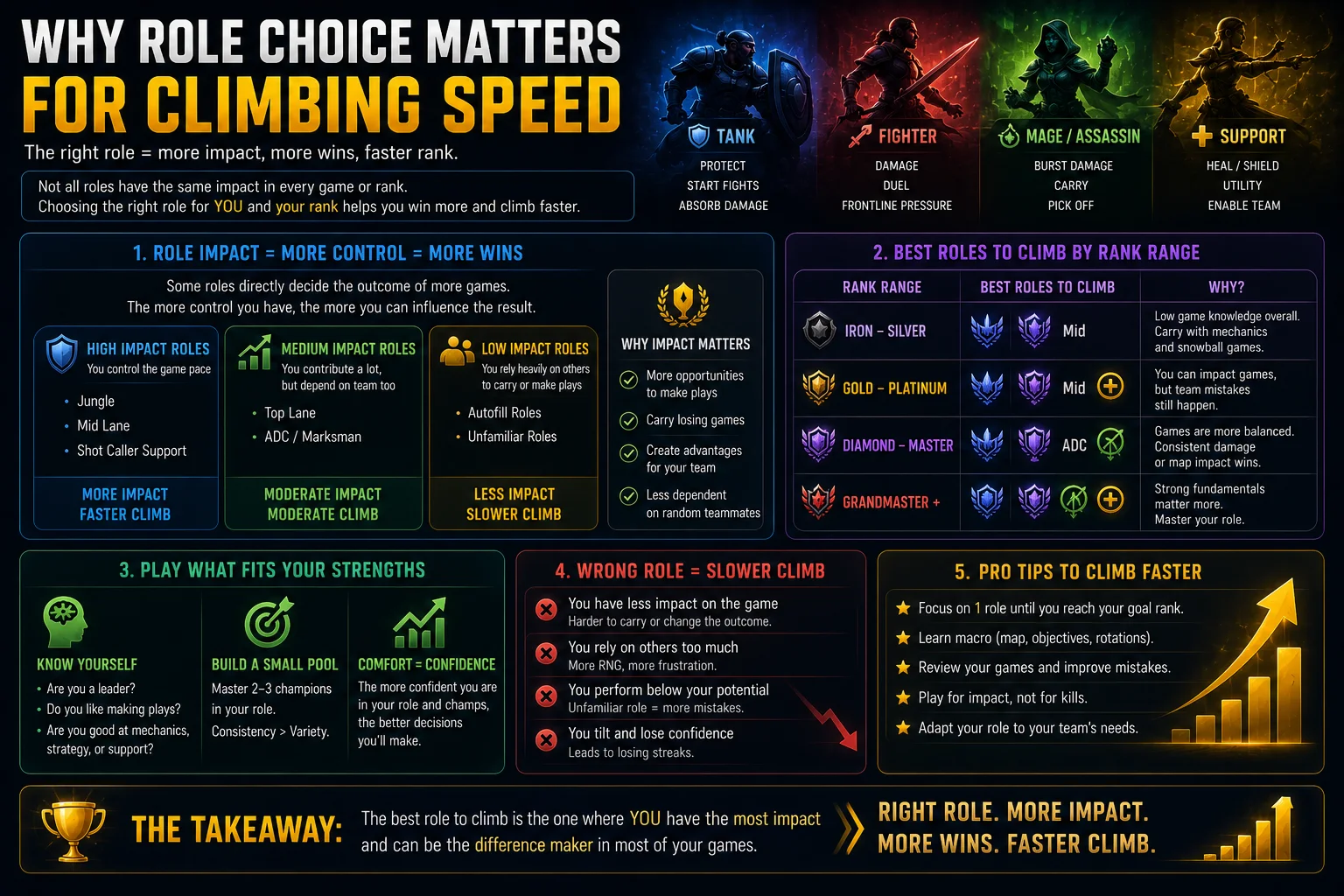
Why Role Choice Matters for Climbing Speed
Support’s Individual Skill Problem
Support players climbing from 1k to 2k face a genuine challenge that players don’t experience. You can win your lane perfectly, ward flawlessly, make ideal rotations, and still lose because your carry refuses to farm or your mid gets solo-killed. Individual excellence doesn’t scale at support.
The Carry Advantage
A carry player at 1k can just farm better than everyone, get more items, and delete the enemy team through items and levels alone. A support at 1k can’t output damage; they depend on teammates executing correctly. The system still measures your rating correctly, but climbing takes 30% longer as support than carry from identical starting MMR.
The Illusion of Plateau
This creates a skill ceiling illusion. You improve mechanically but don’t climb as fast, so you blame the system. It’s not the system’s role design. Carry players scale with individual skill; support players scale with team execution.
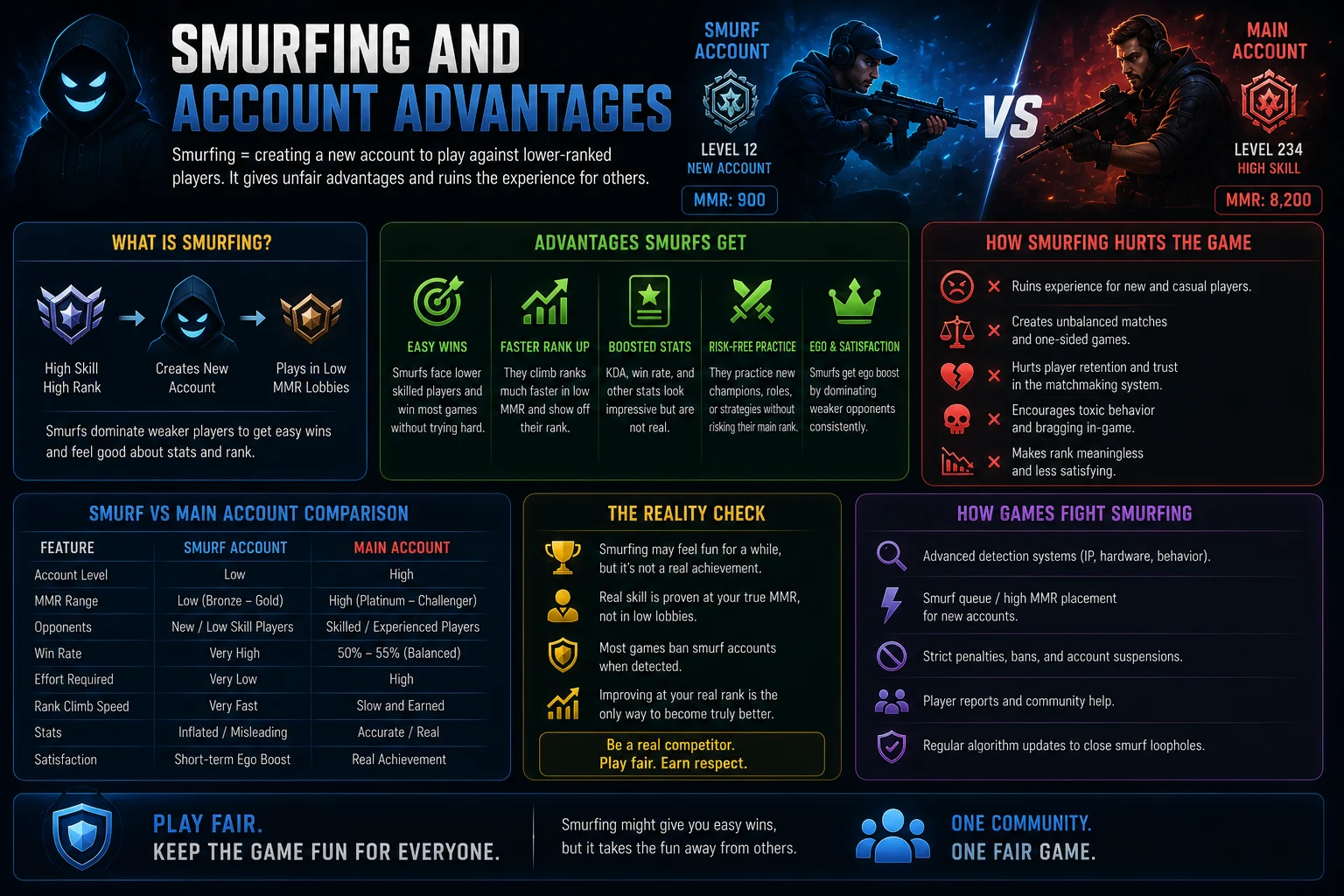
Smurfing and Account Advantages
The Calibration Exploit
A professional player creates a new account and reaches Diamond in 40 games. A regular player takes 300 games. The difference isn’t matchmaking favoring smurfs; it’s calibration exploit plus weak opposition.
New accounts start unranked. Placement games distribute around 1,200-1,500 MMR. A skilled player crushes placement games (8-2 or better) and calibrates 300+ MMR above beginner baseline. From there, they climb at ±40-50 points per game (low confidence) instead of ±25 (high confidence).
When the Advantage Ends
But this advantage evaporates at high ranks. Reach Diamond on a smurf, your confidence stabilizes, your opponent quality increases, and your win rate normalizes to your actual skill. The climb halts immediately. A Diamond player stops dominating at Diamond and starts going even.
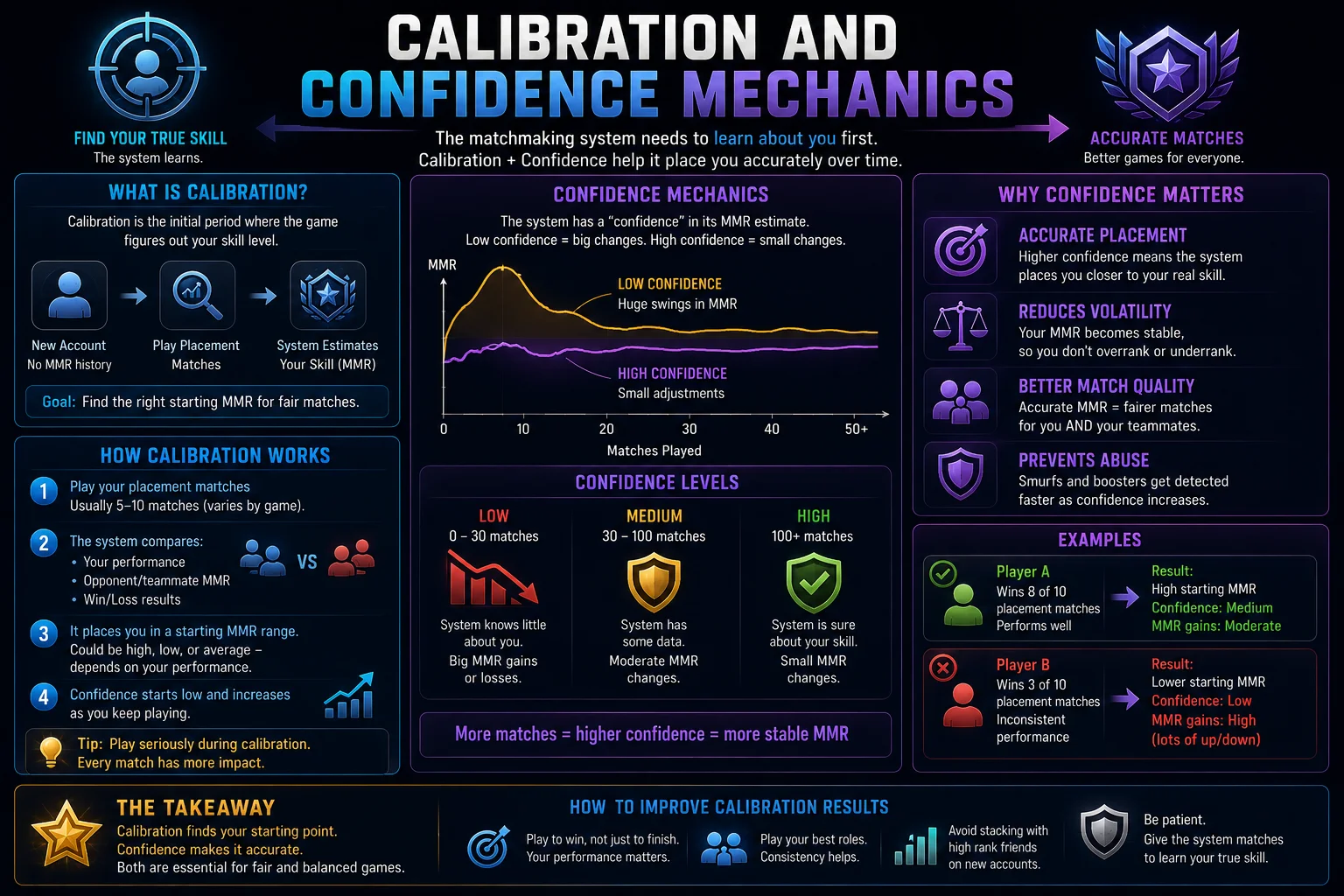
Calibration and Confidence Mechanics
Your First 10 Games Matter Most
Your first 10 ranked games matter far more than most realize. New accounts start at low confidence the system’s certainty about your skill level sits around 30%. This produces massive MMR swings.
Win your first 5 calibration games, you jump +50-60 per win. Lose them, you drop -50-60. The system wants to place you quickly, so large point swings appear at new accounts until it figures out your true level. By game 40-50, confidence rises to 70-80%, and swings normalize to ±25 points.
Cross-Game MMR Implementations
| 🎮 Game | 👁️ Rating Visibility | ⚙️ Algorithm Model | 🎯 Distinctive Matchmaking Rule |
|---|---|---|---|
| Dota 2 | Transparent numeric rating | Glicko-2 derivative | Rank matchmaking is locked below 3,000 Behavior Score. |
| League of Legends | Hidden MMR (Visible LP) | Proprietary Elo variant | Visible rank trails MMR; tier decay applies at Diamond+. |
| Valorant | Hidden MMR (Visible RR) | Proprietary skill curve | Individual combat performance influences RR gains at lower ranks. |
| Counter-Strike 2 | Premier Rating visible / Competitive hidden | Modified Glicko/Elo | Mode-dependent rating: Premier uses numerical CS Rating, while standard Competitive uses per-map ranks. |
| Rainbow Six Siege | Hidden Skill (Visible RP) | Microsoft TrueSkill | Skill value stays constant across seasons; Rank resets to Copper every season. |
Dota’s transparency creates a different psychology than League of Legends’ hidden system. Some players love seeing the exact number; others prefer the psychological buffer.
Common Misconceptions
“Your rank and MMR are the same thing.” They’re not. Rank displays in your client; MMR controls actual matchmaking. You can have significantly different rating than rank suggests. You might see Gold rank while your MMR sits in Platinum, or vice versa. The system only cares about the invisible number.
“You gain/lose the same MMR every game.” False. Beating higher-rated players yields more points, sometimes 40-50 for an upset victory. Losing to lower-rated players costs more often 35-40 instead of 25. The system personalizes every gain and loss based on opponent strength relative to yours.
“Winning streaks automatically push your rank up.” Win streaks show skill consistency, but MMR drives rank progression. A 10-game win streak matters only if your MMR already exceeded your rank. Streaks breaking naturally is variance, not punishment.
“The system breaks up winning streaks intentionally.” The system matches players by MMR, not recent performance patterns. Streaks break because you’re facing opponents closer to your real skill level now. This is the system working correctly, not sabotage.
“KDA matters for MMR gains.” Most games calculate gains on win/loss only, not performance stats. A 0-10-50 support win counts identically to a 30-0 carry win. Some games track combat score for matchmaking purposes, but it doesn’t affect rating changes directly.
“Your rank equals how you’ll be matched.” You’ll be matched by MMR, not rank. A Gold player with high MMR faces stronger opponents than other Gold players. Visible rank is just cosmetic; invisible rating is what matters for opponent selection.
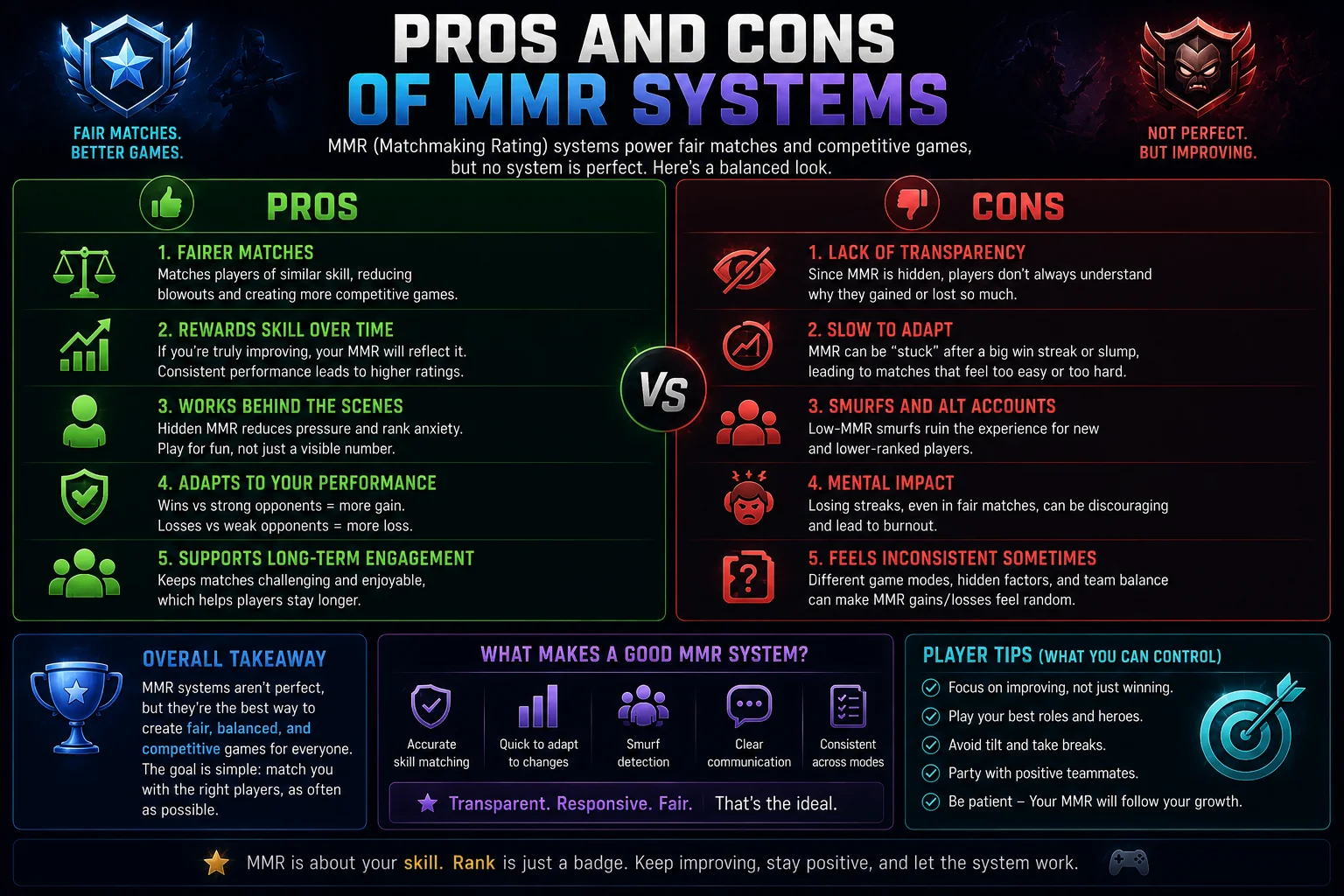
Pros and Cons of MMR Systems
| ✅ Advantages | ❌ Disadvantages |
|---|---|
| Fair Match Quality — Matches players by true ability rather than cosmetic rank, reducing one-sided blowouts. | Rank Lag Friction — Visible tier progression often lags behind actual rating gains, creating perceived stagnation. |
| Self-Correcting Accuracy — Genuinely skilled players climb consistently over large sample sizes regardless of bad streaks. | Progression Opacity — Hidden systems obscure whether point swings represent actual skill shifts or normal variance. |
| Anti-Camping Mechanics — High-tier decay and soft seasonal resets prevent dormant accounts from squatting on top spots. | Smurf & Boost Impact — New accounts with high uncertainty can distort lower-tier lobby balance. |
| Conduct Segregation — Systems factoring in player behavior can isolate toxic accounts into separate queues. | Role Volatility — Low-impact/support roles can face higher win variance when climbing out of low brackets. |
| Personalized Progression — Casual players can climb at their own pace while grinders play more frequently. Both can eventually reach their skill ceiling. | Queue Time Tradeoffs — Strict matching means longer waits for fairer games, while loose matching produces faster but potentially less balanced games. |
| Sustainable Rank Integrity — Resists rank inflation better than simple win-count systems over the long term. | Behavior Score Obscurity — Most players don’t know behavior scores exist or how significantly they can affect matchmaking. |
Seasonal Resets and LP Decay
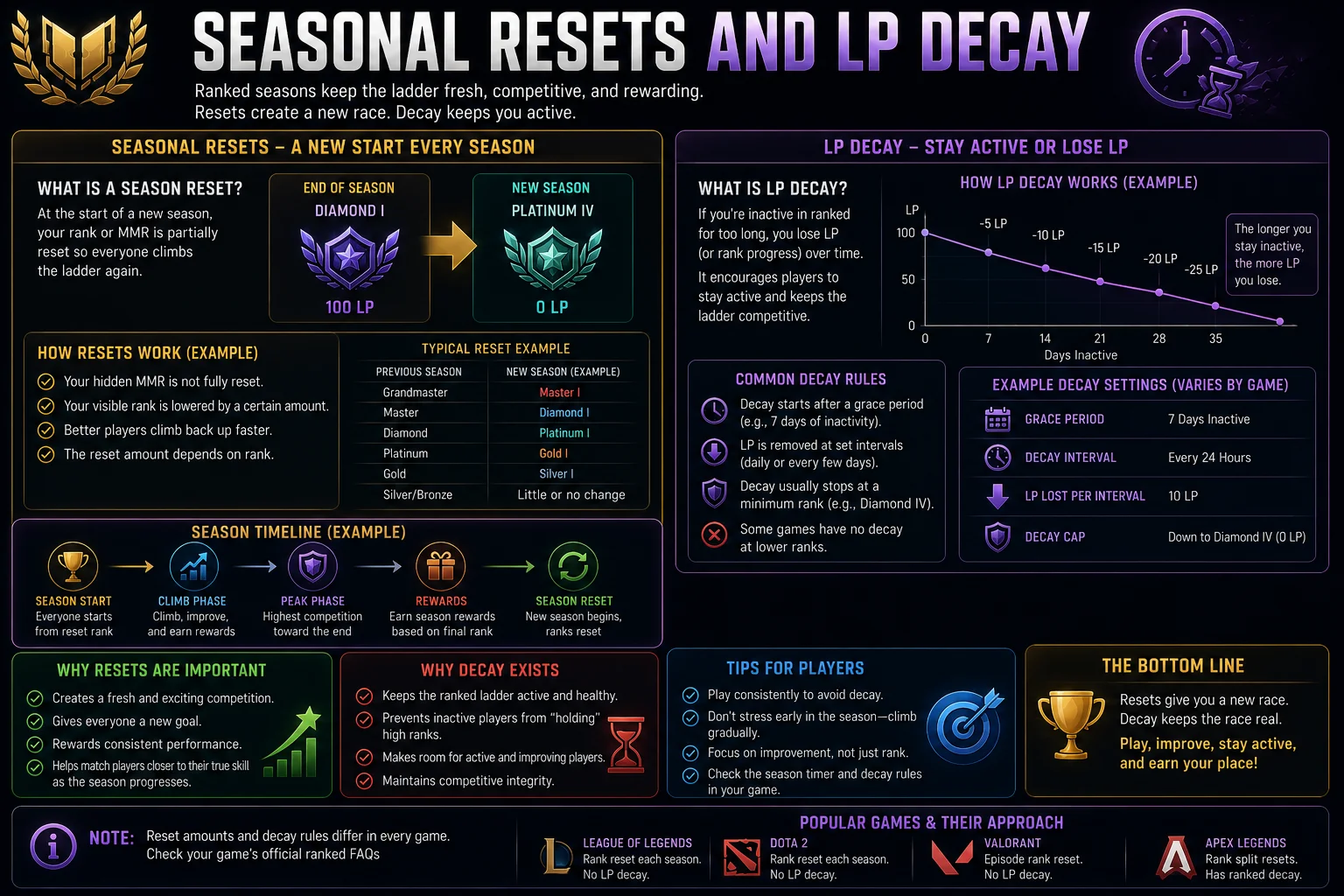
Soft Resets Explained
At the start of each season, games apply a soft reset and your rating drops about 1-1.5 tiers. You drop, but not completely. The system wants to destabilize the ladder slightly to prevent permanent rankings, but not so much that a skilled player can’t recover quickly. A Master player drops to Platinum or Diamond next season, then climbs back.
Your underlying MMR doesn’t reset; it just dampens confidence temporarily. This causes wider LP swings until you stabilize. You reclaim your rank faster than new players reach it from zero, creating a natural skill hierarchy even after resets.
Decay Mechanics at the Top
In League of Legends, Apex tiers (Master, Grandmaster, Challenger) and Diamond trigger LP decay. Stop playing ranked for 10+ days at Diamond, and the system automatically removes LP daily. LP decay does not affect MMRyour actual skill rating stays constant while your visible rank drops, creating a gap you must fill by playing again to reclaim your position.
This mechanic prevents account camping at the top. Pros and high-rated players can’t coast; they maintain activity or watch their rank crumble.
Queue Dodging Strategy
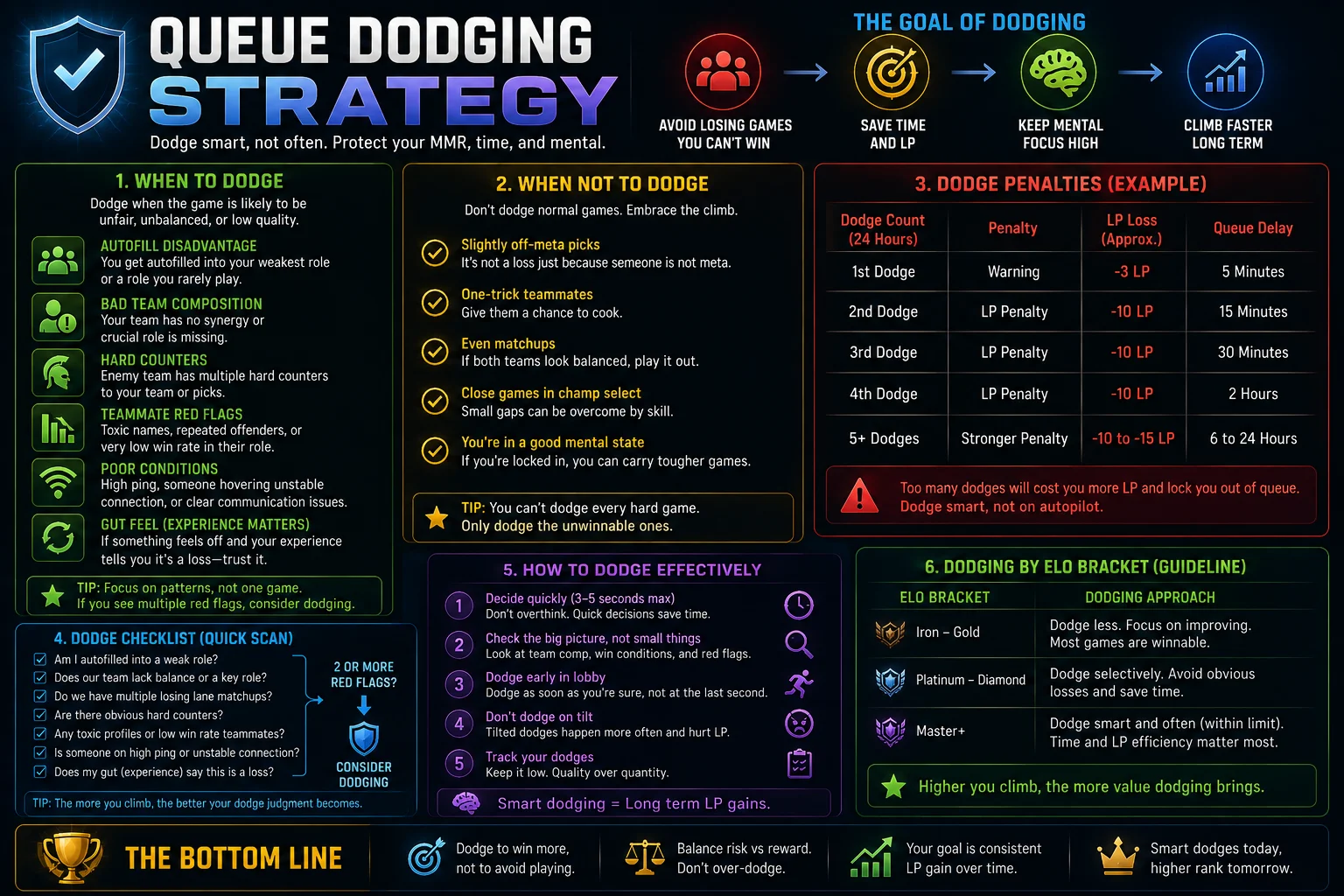
Dodging a ranked game costs LP and a queue timeout, but it does not change your MMR. This distinction matters for climbing strategy.
Competitive players also make decisions during difficult matches, including whether to continue playing or forfeit a match when the chances of winning become very low.
High-level players dodge low-percentage lobby games with troll picks, autofilled support, or unwinnable team compositions because accepting the -5 LP dodge penalty preserves MMR, whereas losing costs more LP and also damages your hidden rating through a loss.
A dodge costs -5 LP and 6 minutes. A loss at your skill level costs -25 LP and 30 minutes. If the lobby wins 20% of the time, taking the dodge is mathematically superior.
Mental Game and Inactivity
Tilt’s Real Cost
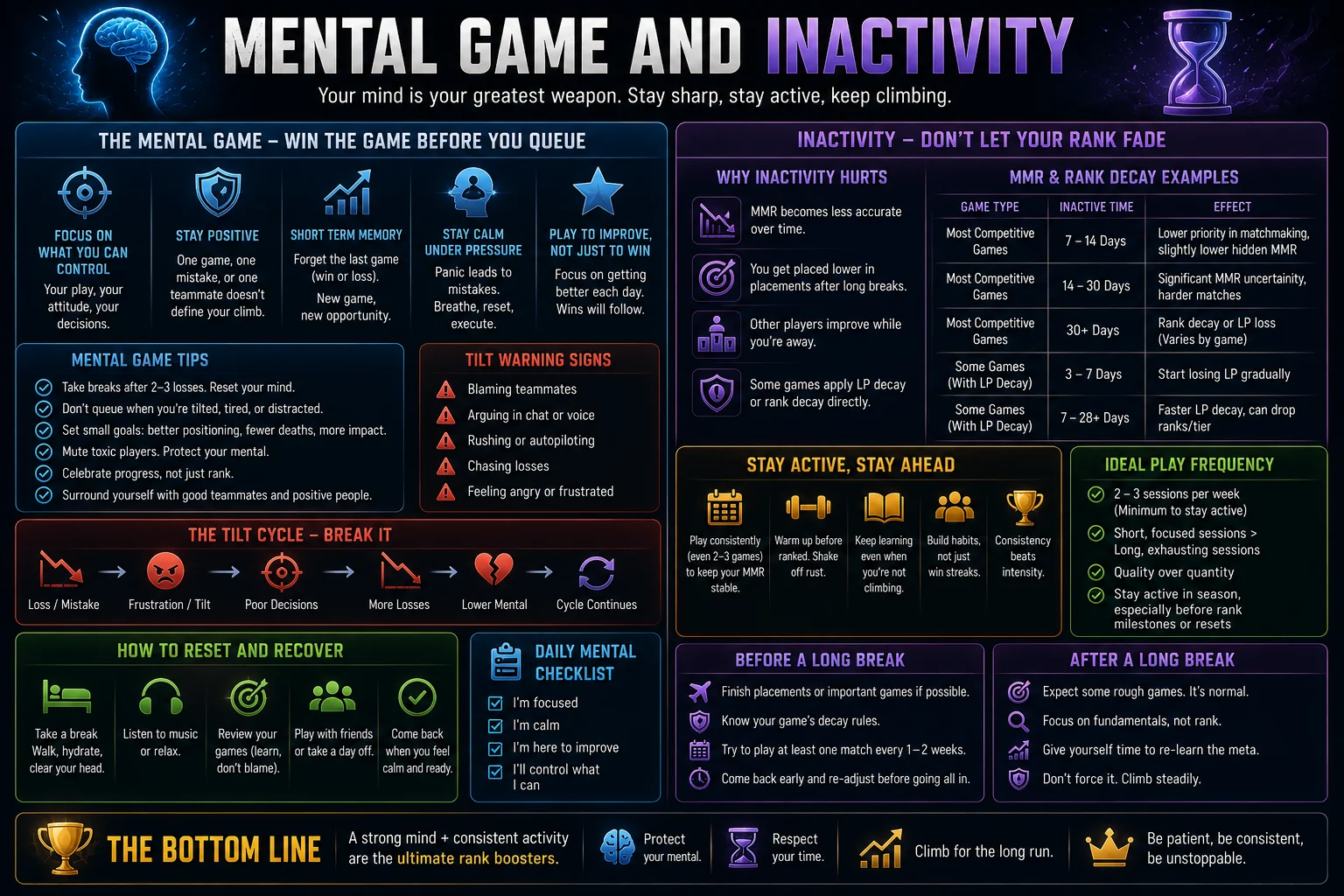
- Your mental state doesn’t directly change your MMR, but it devastates your win rate:
- Play perfectly but tilted = you lose games you’d normally win
- A 10-game losing streak drags your MMR down faster than LP
- Creates asymmetry: gain +14 per win, lose -22 per loss
- Forcing you to prove LP is deserved over next 15-25 games
- Stop playing after three consecutive losses
- Mental resets matter more than grinding additional games
- The system re-verifies your rating
- Take breaks strategically to maintain mental freshness
Detecting Inflated MMR
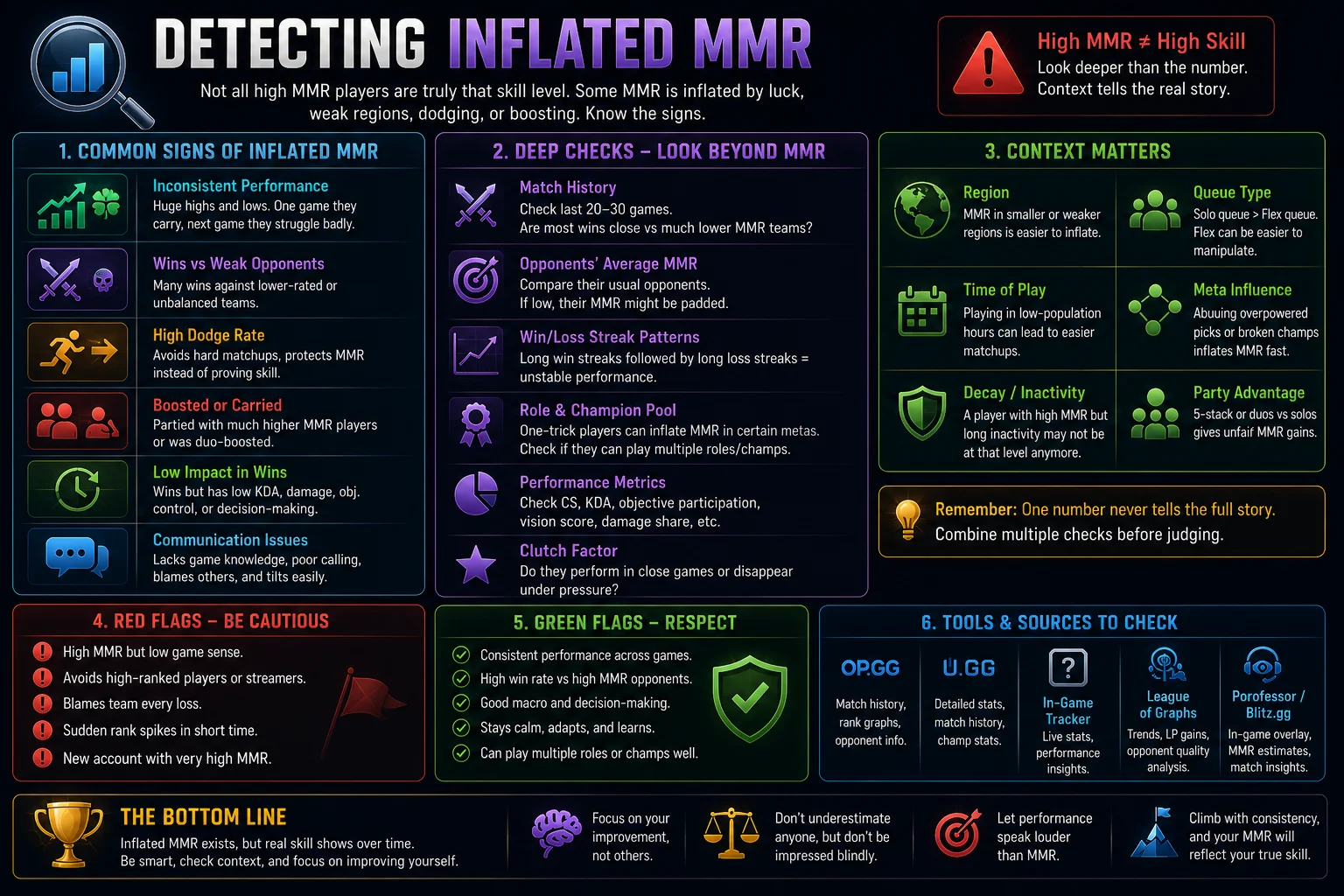
The Asymmetry Signal
If you’re gaining +14 LP per win but losing -22 per loss, your MMR is significantly below your rank. The system is correcting downward aggressively because your rating doesn’t match your visual tier.
This happens for specific reasons: (1) you hit a lucky win streak that inflated your rank artificially, (2) you played with higher-skilled duo partners who boosted your results without improving your actual skill, or (3) you experienced a recent losing streak that crashed MMR but rank hasn’t caught up yet.
The Solo Queue Fix
The fix is simple: play 50+ solo games at your rank without duo partners. Your actual win rate reveals your true skill. If you maintain 52-55%, the system eventually recognizes it and adjusts gains/losses toward ±17 (balanced). If you drop to 48%, the asymmetry stays put until you climb back above 50%.
When MMR and Rank Converge
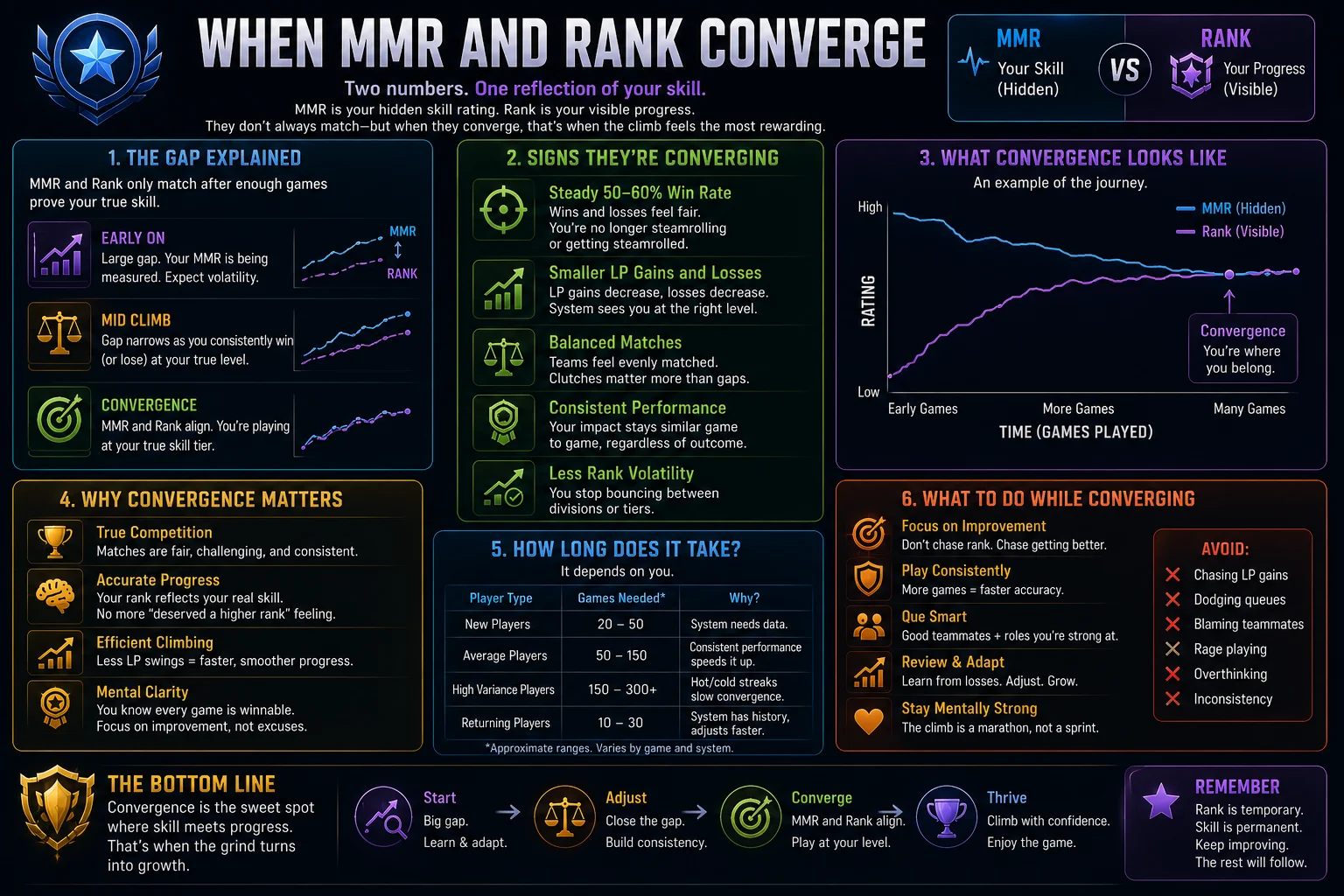
Stabilization, Not Plateau
Eventually, after enough games, your LP rank catches your actual MMR. You stop gaining bonus/penalty LP. Gains and losses equilibrate around ±17 per game.
This feels like a skill plateau, but you’re not stuck, you’re stabilized. Your MMR has finalized your skill estimate with high confidence. You’re now playing at exactly the rank your actual skill deserves. This is a milestone, not a ceiling.
Real Improvement Begins Here
From this convergence point, climbing requires actual improvement. One-trick ponies can’t grind past convergence because they’ve exploited their single playstyle to its ceiling. Learning new approaches, improving macro play, developing game knowledge, or expanding your champion pool pushes you higher. Most players never notice convergence and assume the system is rigged when gains disappear. They were actually just stabilized.
Advanced Climbing Concepts
The 3-5 Game Block Strategy
Professional players don’t grind 8 hours straight. They play 3-5 games, review one replay for mistakes, adjust one thing, then queue again. This cycle prevents tilt and produces intentional improvement.
Each 3-5 game block represents a contained experiment. Did your positioning improve? Did CS increase? Did you die less? Measurable improvement compounds faster than grinding with no feedback loop.
Role Specialization Over Flexibility
Spamming one role and 2-3 champions climbs faster than flex-queuing across 10 roles. Specialist mid-laners develop meta reads and pattern recognition that flex players never build.
Specialization compresses the timeline to 55%+ win rate. Generalists take longer because they’re rebuilding game sense every role swap.
The Warmup Queue Advantage
Playing 2-3 normal games before ranked each session prevents first-game rust. Your hands warm up, game sense calibrates, and you’re not gambling LP on autopilot. Unranked has separate MMR from ranked, making it perfect for practice without risk.
What This Means For Your Climbing Strategy
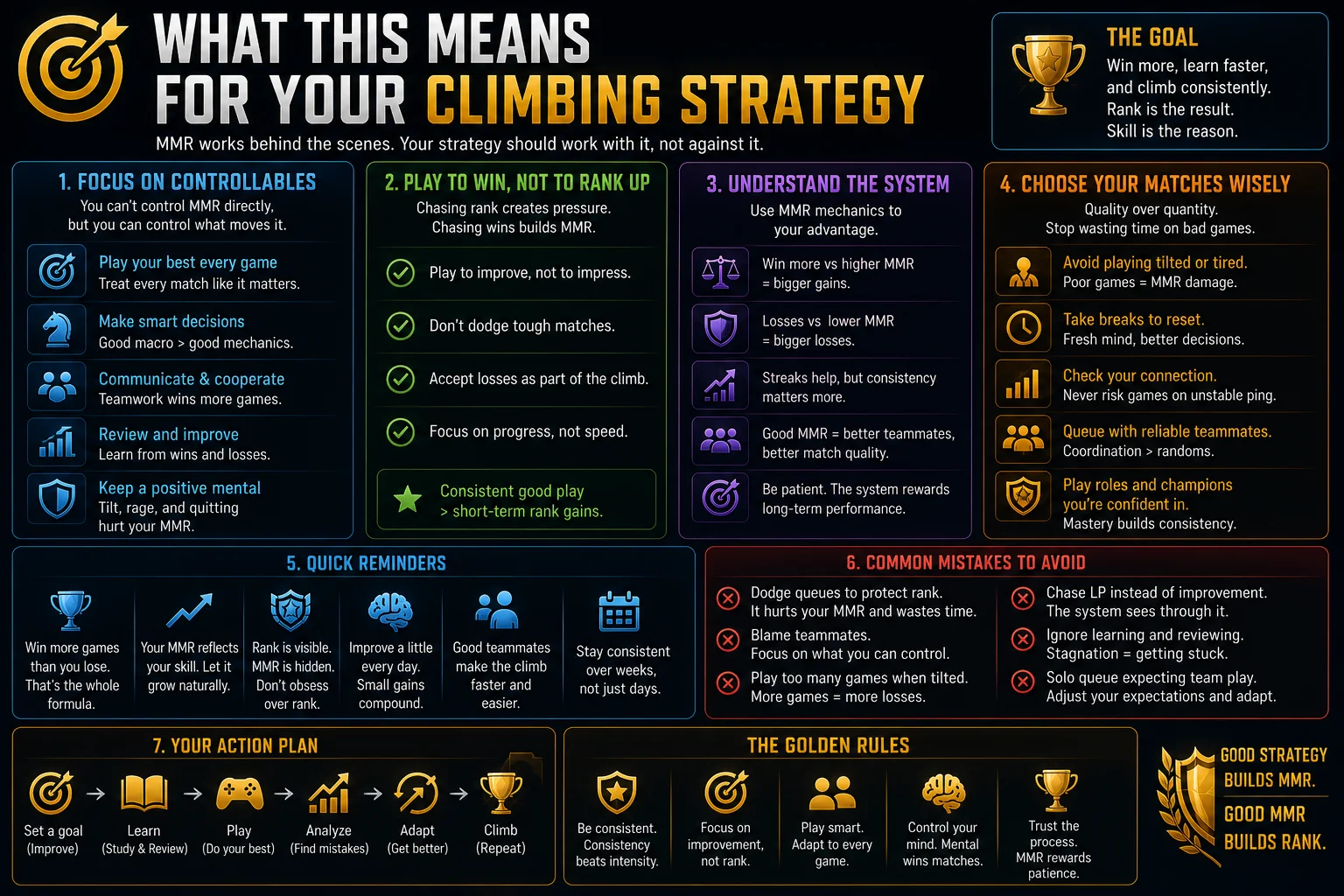
Accept the Math
Forget everything about climbing being impossibly rigged. The system corrects ruthlessly. Win more than 50%, you climb. Win exactly 50%, you stagnate. Win less than 50%, you drop.
Your Job: Consistency Over Streaks
Your job is accumulating a 52-55% win rate over 100+ games. Not a 60% win rate over 10 games, that’s statistical noise. Not a single win streak that’s variance. Long-term consistent performance reveals your true MMR every single time.
Change Your Question
The players who climb fastest stop blaming teammates and start asking “what did I do wrong in that loss?” That question orientation produces faster improvement than “my team sucks” orientation. Self-criticism beats blame for skill development.
Focus on Process, Not Results
Stop watching your LP gains. Stop refreshing your rank display. Stop expecting dramatic rank jumps every week. Focus on consistent performance over 50-game samples. Track your win rate. Measure improvement in 10-game blocks. Your MMR will climb. Your rank will follow. The system guarantees it mathematically.
The Winning Routine
Play in 3-5 game blocks. Warm up in unranked games first. Dodge broken lobbies sparingly (not every game). Specialize in one role and 2-3 champions to build mastery. Prioritize solo queue over duo queue. Stop tilting and take mental breaks after losses. Review your losses for patterns. Repeat this cycle.
This routine accumulates wins. Wins accumulate MMR. MMR accumulates rank. Rank displays your actual skill level eventually. There are no shortcuts. There are no secrets. There are no rigged systems. Just consistent execution against a mathematically honest matchmaking engine.
Frequently Asked Questions
Conclusion
MMR is the honest measurement hiding beneath your flashy rank. It corrects toward your true skill level relentlessly, punishing underperformance against weaker opponents and rewarding beating stronger ones.
Your visible rank is a lagging display designed to feel rewarding. Your invisible MMR is what actually matters. Understanding what does mmr stand for in gaming ends the “rigged matchmaking” complaints the system works perfectly; it just doesn’t advertise how.
The fastest climbers don’t obsess over individual game results. They track win rate over 50-game stretches, improve consistency, and let MMR climb naturally while rank catches up. They fix behavior scores before grinding MMR. They understand that their role, region population, and time of day all affect game quality, but none overcome 55% win rate over time.
Your MMR reflects exactly what you deserve. If you want a higher rating, you need higher skill. The system will find it and reward it. That’s not punishment, that’s the most honest competitive system gaming has ever created.
Play consistently. Improve steadily. Trust the math. Your rank will follow.