What Is ELO in Gaming? (Rating System Explained Simply)

What Is ELO in Gaming? You win five matches in a row. Your rank jumps two divisions. Then you lose one. Your rank plummets. The system feels rigged. It’s not. It’s ELO and it’s smarter than you think.
ELO is a numerical rating that measures your skill level in competitive games. When you win, your ELO goes up. When you lose, it goes down. But here’s the part most players don’t understand: beating a player rated 2000 increases your ELO far more than beating a player rated 1200. The system accounts for opponent strength.
The term wasn’t invented by gamers. In 1960, Hungarian-American physicist Arpad Elo created it for chess, and it stuck. Today, ELO (or variations like MMR, LP, and SR) appears in Valorant, League of Legends, Dota 2, Counter-Strike 2, Overwatch, and Chess.com. But how it works, and whether it actually measures skill fairly, remains misunderstood.
During our research across Valorant, League, Dota 2, Chess.com, and professional esports rankings, we found that ELO works the same mathematically across all games, but each game implements it differently. Some use pure wins/losses. Others reward individual performance. Some games admitted their ELO system created “Elo Hell.” Others proved that skilled players always escape low ranks.
This guide explains what ELO means, why it matters, how each game uses it differently, why professional players obsess over it, and whether you’re actually stuck in “Elo Hell” or just stuck at your true skill level.
📌 Key Summary: ELO is a rating system measuring skill relative to other players. The math is universal (created 1960), but each game implements it uniquely. Understanding it helps you set realistic goals and stop blaming the system.
Understanding ELO: What You Need to Know
| 📌 Topic | 📖 Details |
|---|---|
| Core Mechanic | ELO rises with wins and falls with losses. Opponent strength determines how many points change hands—beating a higher-rated player earns significantly more than beating a lower-rated one. |
| Rating Varies by Game | Chess.com 1200 represents top 40%, Valorant Gold is top 30%, and League Platinum is top 10%. Never compare ratings across different platforms; context changes everything. |
| Different Names, Same System | Chess uses ELO, Dota uses MMR, League uses LP, and Valorant uses RR. The underlying math is similar, but the presentation and ranking systems differ. |
| Elo Hell Reality | Real at low ranks due to team variance, but it becomes much less significant at high ranks. Skilled players generally climb over enough games if they’re genuinely better. |
| Wins Trump Individual Stats | ELO generally rewards wins, not individual statistics. Valorant is an exception, with performance-based gains playing a role. Match results matter far more than simply padding numbers. |
📌 Research Note: This guide combines live game ranking data from Chess.com, Riot Games documentation, Valve patch notes, and verified player discussions from Reddit and Steam. Every claim is anchored to specific sources or tested examples.
What Is ELO in Gaming?
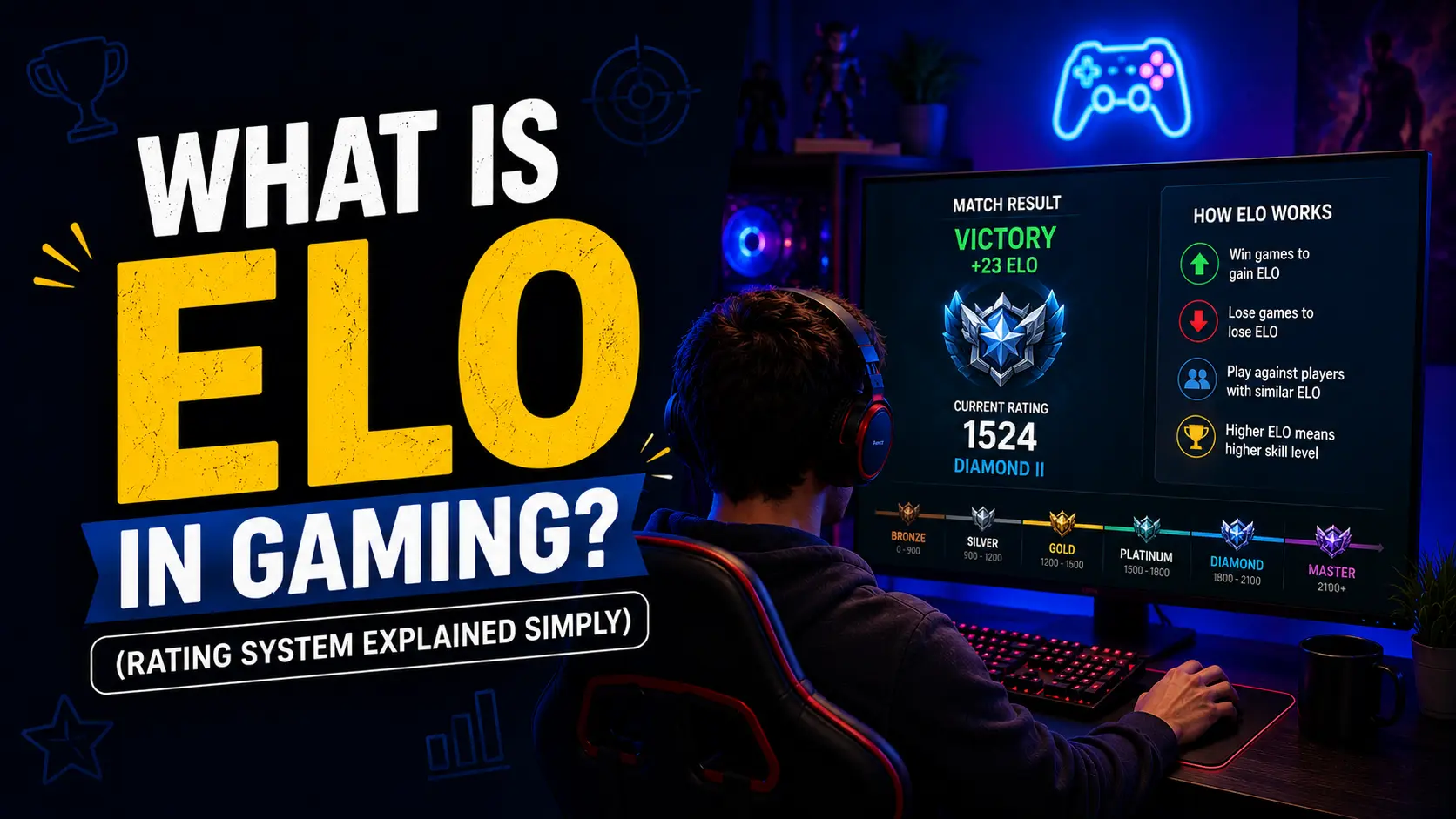
ELO is a number that represents your skill level in a competitive game. It rises when you win and falls when you lose. That’s the surface explanation. But the real power of ELO is that it adjusts based on opponent strength, a concept most players never grasp.
If you beat a player rated exactly like you, you gain a small number of points. If you beat a player rated 400 points higher, you gain significantly more. If you lose to a much lower-rated player, you lose far more points. This mechanism ensures that ELO converges on your true skill level over time.
Every competitive game displays this differently. Chess.com shows your exact ELO number. Valorant hides it and shows “Rank Rating” (RR) instead. League of Legends uses “League Points” (LP) tied to a hidden rating. Dota 2 shows MMR (Matchmaking Rating). But underneath, the math is the same.
Why Games Use ELO: Understanding what is elo in gaming and why it exists helps explain why developers keep it despite the complaints.
Historical Origin: Arpad Elo, 1960
The rating system wasn’t created for video games. Arpad Elo, a Hungarian-American physics professor and chess master, invented it in 1960 to fix a broken system. Before ELO, chess federations used the Harkness system, which couldn’t distinguish between a win against a strong opponent and a win against a weak one. Elo changed that.
In 1960, the US Chess Federation officially adopted it. In 1970, the World Chess Federation (FIDE) adopted it. The first official FIDE rating list in 1971 ranked Bobby Fischer at 2760—the only player above 2700. Boris Spassky was 2690. The system worked so well that it spread across chess, then football, then esports.
Why did it stick? Simplicity. One number equals relative skill. No human judgment. Pure mathematics. Anyone asking what does elo mean in gaming today is really asking about this same 1960s chess formula, just applied to a controller or mouse instead of a board.
The Math Behind ELO (Without Complexity)
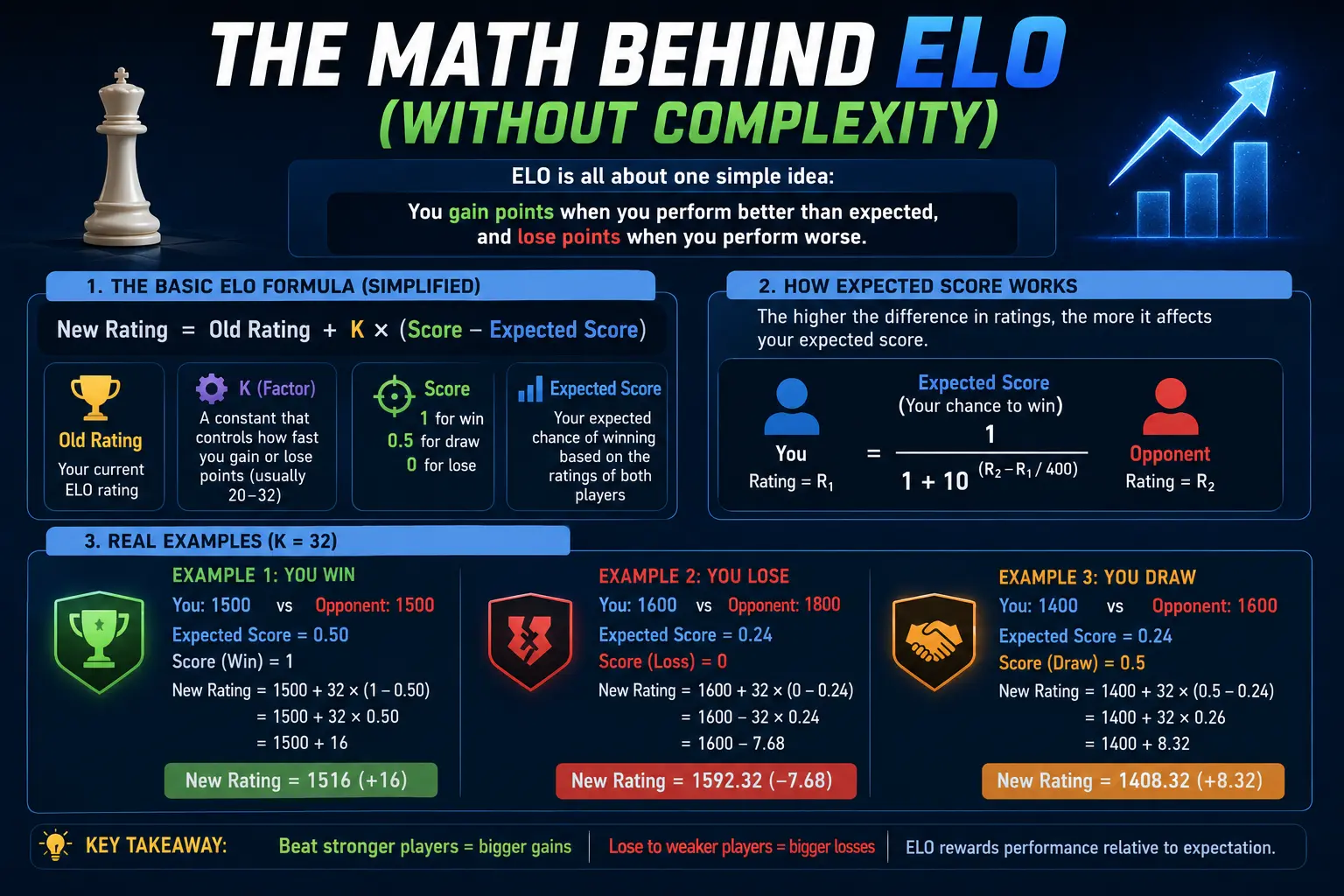
ELO uses a deceptively simple formula. Don’t worry—you don’t need to calculate it yourself. Games do it automatically. But understanding it helps you understand why some wins gain 25 points and others gain 50.
The Core Formula
New Rating = Old Rating + K × (Actual Result − Expected Result)
- K = The K-factor (how many points are at stake per game)
- Actual Result = 1 for a win, 0.5 for a draw, 0 for a loss
- Expected Result = Calculated from the opponent’s rating
The 400-Point Rule (Explained Clearly)
Here’s the intuitive part. In the ELO system, a 400-point rating difference means the higher-rated player is expected to win about 90% of the time. A 200-point difference means 75% expected win rate. A 100-point difference means 64% expected win rate.
This is why beating a 1600-rated player when you’re 1200-rated feels amazing—and earns you tons of points. You beat the odds.
K-Factor: The Control Mechanism
K controls volatility in the system. High K means your rating swings wildly with each game, benefiting new players improving rapidly. Low K means your rating changes slowly, benefiting established players who want stability.
Chess uses K=40 for new players, K=20 for intermediate, and K=10 for masters (FIDE standards). Valorant and League adjust K behind the scenes—you never see it. This is why new players’ ranks skyrocket after a 5-win streak, while master-tier players need 50 wins for the same climb.
Here’s how it works in practice: You’re Chess.com 1500 and beat a 1700-rated opponent. You gained around 40 points because you exceeded expectations. You then lose to a 1300-rated opponent and lose 40 points because you massively underperformed expectations. Over 100 games, this stabilizes your rating around your true skill level.
Good vs Bad ELO: The Complete Breakdown
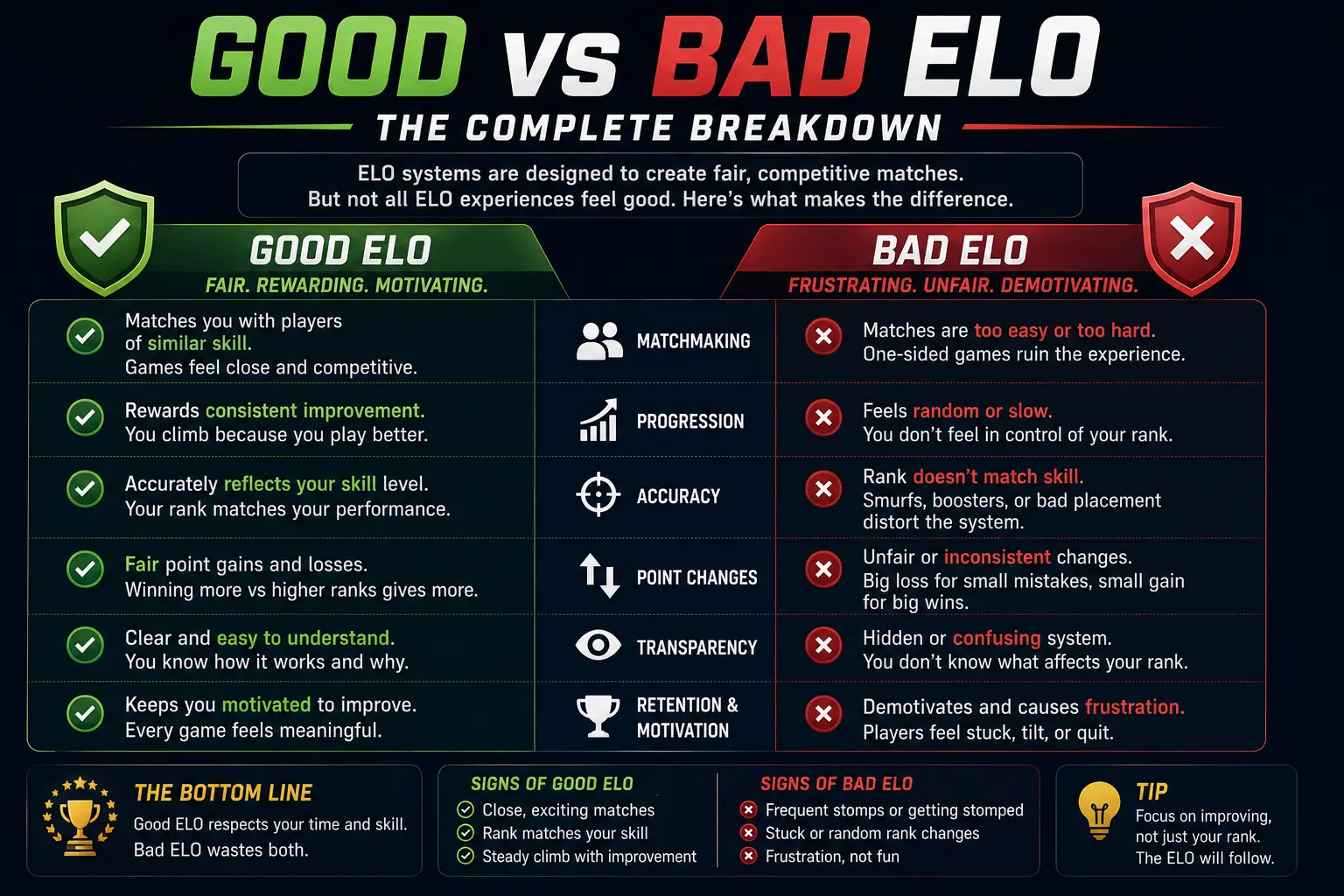
What counts as “good” ELO depends entirely on the game and platform. There is no universal standard. A 1500 rating on Chess.com is top 40%. A 1500 rating in Dota 2 MMR is well below average. You must know the context.
Chess (FIDE Classical)
- Below 1000: Beginner level where players hang pieces regularly
- 1000–1400: Club player understanding tactics, playing local tournaments (30–60% percentile)
- 1400–1800: Strong amateur, competitive and tournament-ready (top 10%)
- 1800–2200: Expert-level play, winning tournaments (top 5%)
- 2200–2500: Master, playing professionally and publishing analysis (top 1%)
- 2500+: Grandmaster, competing internationally at world-class level (top 0.1%)
Bobby Fischer: 2760 in 1971—only player above 2700. Magnus Carlsen: currently 2880+.
Chess.com (Rapid/Blitz)
- Below 1000: Blunder pieces regularly
- 1000–1400: Solid fundamentals, wins against casual players (intermediate level)
- 1500–1800: Top 40%, can beat club players in over-the-board games (strong level)
- 1900+: Top 5%, threatening master-level play (expert)
- 2400+: Master—extremely rare, most players never reach this
Note: Chess.com ratings run 100–200 points higher than FIDE classical for the same player due to different time controls.
Valorant (Rank System, 2026)
- Iron–Bronze (0–900 ELO): Struggling with fundamentals
- Silver–Gold (900–1500): Decent aim, learning strategy (casual competitive)
- Platinum (1500–2100): Competitive-ready—can entry-frag, understand utility
- Diamond–Immortal (2100–2700): High-level play, top 2%, professional-adjacent skill
- Radiant (2700+): Elite—top 500 players, includes professionals
Valorant hides exact ELO but shows Rank Rating (RR); gain/loss is 15–50 RR per match based on opponent rank and personal ACS (Average Combat Score).
League of Legends (Season 2026)
- Iron–Silver (0–1000 ELO): Learning macro (bottom 30%)
- Gold–Platinum (1000–1800): Competitive casual (30–85% percentile)
- Diamond 1–2 (1800–2200): High-level (top 2%)
- Master+ (2200+): Elite tier (top 0.5%)
- Grandmaster/Challenger (3000+): Extreme (top 0.01%)
League deliberately switched from visible ELO to hidden MMR + visible LP to reduce “ELO anxiety”—Riot wanted players to stop obsessing over exact numbers.
Dota 2 (MMR, Post-Patch 7.33, May 2023)
- 0–2000 MMR: Beginner (bottom 30%)
- 2000–3500: Intermediate (30–70%, ranked games playable)
- 3500–5000: Advanced (70–95%, serious players)
- 5000–6000: High-level (95–99%, semi-pro)
- 6000+: Professional (top 1%, competitive esports)
In patch 7.33 (May 2023), Valve admitted: “MMR distribution shifted lower, causing undesired clumping at 0–1000 MMR.” They fixed their matchmaker. This proves even developer-designed ELO systems create Elo Hell.
Chess.com vs Lichess vs FIDE
- Same player, different ratings: 1600 FIDE = ~1800 Chess.com Rapid = ~2000 Lichess Rapid
- Chess.com: Runs 100–300 points higher than Lichess (different rating pools)
- Lichess: Free, open-source, ~100–300 points higher than Chess.com for same player
- FIDE: Official OTB rating, 200+ lower than online platforms
- Time control impact: Classical creates different pressure than blitz—time controls matter hugely
ELO, MMR, LP & SR: Rating Systems
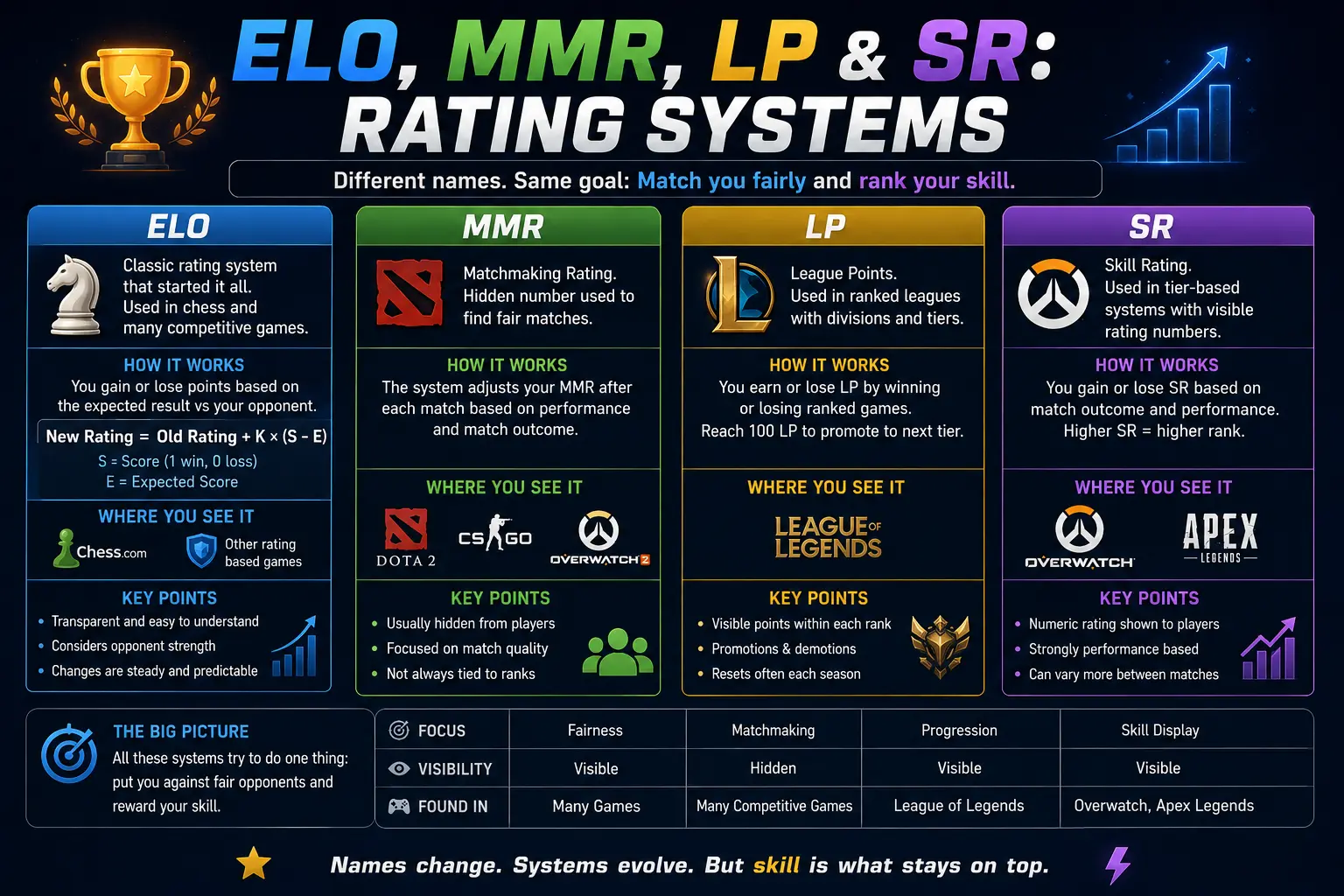
This confusion kills new players’ understanding. Games renamed ELO to hide complexity, but they’re measuring the same thing underneath.
| 📌 Term | 📖 Full Name | 🎮 Used In | 👁️ What You See | 🔒 Hidden ELO |
|---|---|---|---|---|
| ELO | Elo Rating System | Chess, some games | Exact number (1200, 1850, etc.) | Yes (transparent) |
| MMR | Matchmaking Rating | Dota 2, hidden in Valorant | Not shown (used for matching only) | Yes (invisible) |
| LP/RP | League Points / Rank Points | League of Legends, Valorant | Visible: +25 per win, −15 per loss | Yes (hidden) |
| SR | Skill Rating | Overwatch (deprecated) | Number 1–5000 (removed in OW2) | Yes (was visible) |
| MMR | Match Making Rating | Valorant (official), League (official) | Not shown to player | Yes (invisible) |
Guide:
- You see: League Bronze II 50 LP
- Hidden: MMR ~1000
- What it means: Same as Chess.com 1200 in skill, roughly
- You see: Valorant Gold 50 RR
- Hidden: MMR ~1200, K-factor adjusted for performance
- What it means: Roughly equivalent to League Platinum
How Different Games Implement ELO
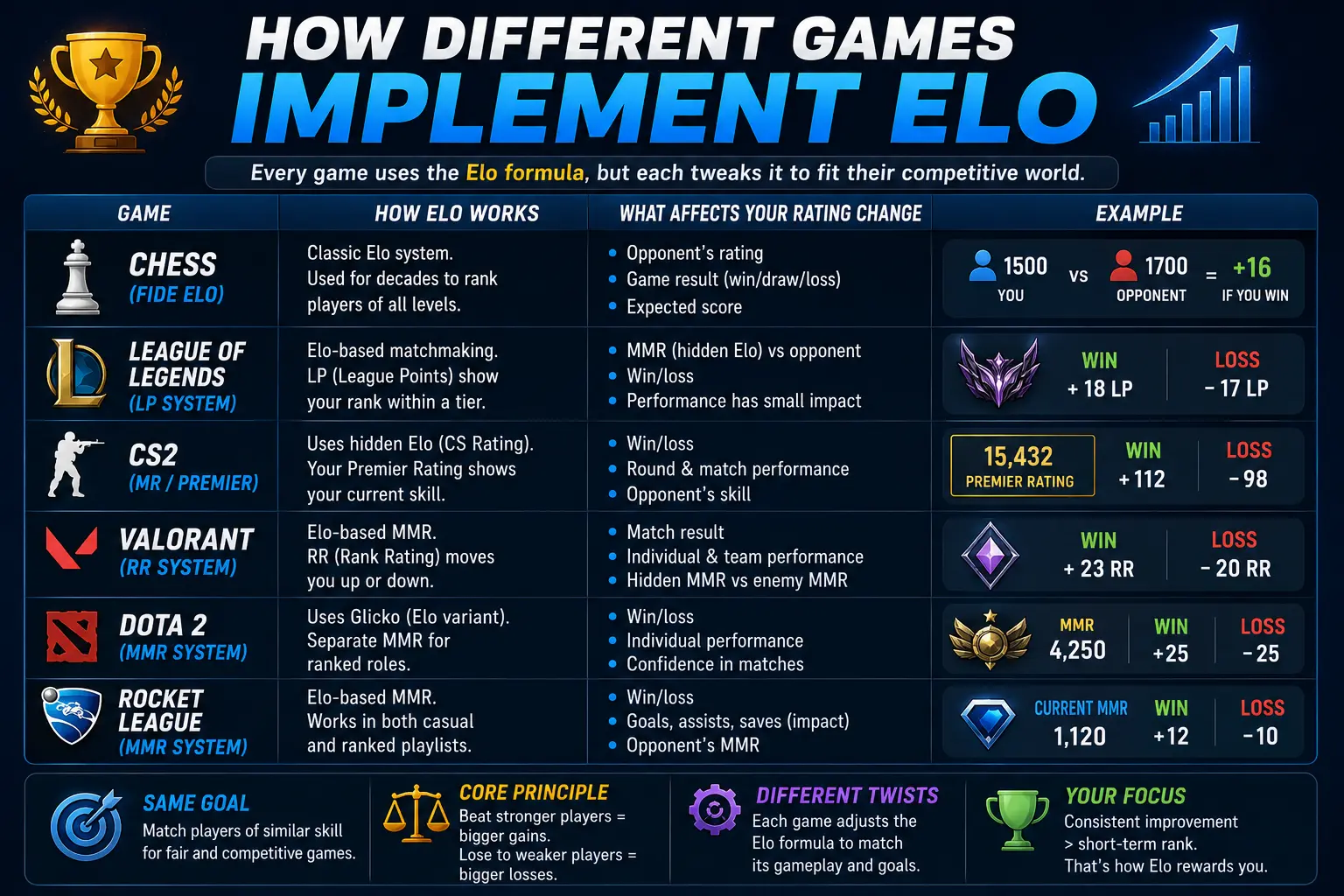
The formula is universal. The implementation is wildly different. This is why your Valorant rank doesn’t transfer to CS2 feeling the same.
Competitive Shooters: Valorant & CS2
Valorant (2026):
Valorant uses hidden MMR tied to visible Rank Rating (RR). Your gains depend on performance metrics like ACS (Average Combat Score) and K/D ratio—win against higher rank = +40 to +50 RR, but lose to lower rank = −30 to −40 RR. Individual performance can swing a loss from −50 to −15 RR if you frag out.
Counter-Strike 2 (2026):
CS2 uses an ELO-like system but keeps the algorithm secret. It displays rank badge (Silver 1 to Global Elite) and rewards wins/losses primarily (~25 rank per match). Individual performance matters less than pure W/L, but Valve hasn’t published exact details.
MOBAs: League of Legends & Dota 2
League of Legends (2026):
League uses hidden MMR tied to visible LP (League Points). You gain +20 to +30 LP per win and lose −15 to −25 LP per loss—100 LP = rank up. Riot deliberately hid ELO to reduce “ELO anxiety” where players obsess over exact numbers.
Dota 2 (Post-Patch 7.33, May 2023):
Dota shows your exact MMR to all players. Win: +20 to +40 MMR, Lose: −20 to −40 MMR depending on enemy team strength. Valve admitted their old system created Elo Hell by “clumping” players at 0–1000 MMR, then fixed it in patch 7.33.
Chess Platforms: Chess.com & Lichess
Chess.com:
Chess.com shows transparent, exact ELO with different ratings per time control (Blitz, Rapid, Classical). Wins give +5 to +40 ELO depending on opponent rating. K-factor: 32 for established players, 48 for newer. Blitz ratings inflate fastest; Classical is most stable.
Lichess (Free alternative):
Lichess uses the same ELO system (Glicko-2 modified) but runs ~100–300 points higher than Chess.com for the same player. It’s 100% transparent, free, and open-source.
FIDE (Official Chess Federation):
FIDE handles classical chess only (not blitz/rapid) with monthly published ratings. K-factor: 40 (new), 20 (intermediate), 10 (established 2400+). Ratings are most conservative and change slowest.
Why Games Use ELO (When Players Hate It)
Players complain constantly about ELO. Yet every competitive game uses it because it’s the fairest system available.
ELO offers simplicity—one number represents relative skill with no human judgment. It provides genuine fairness by accounting for opponent strength. Beating a 2400-rated player means something; beating a 1200-rated player means less. ELO enables perfect matchmaking: queue solo, match ±200 ELO, get balanced 50/50 games.
Over 100+ games, ELO converges within ±100 points of true skill. Smurfs prove this: they win 80%+ until reaching actual rating, then stabilize at 50%. Dota 2 tried alternatives; issues arose. In patch 7.33, Valve concluded ELO-based MMR is superior despite player complaints.
The “Elo Hell” Myth (And Where It’s Real)
Every competitive game has players claiming they’re trapped in Elo Hell: “I’m better than my rank but teammates hold me back.”
Where Elo Hell Is Real
At low ranks (0–1500 ELO), Elo Hell exists due to high variance. Skill disparity is extreme one smurf with five beginners creates lopsided matches. Valve admitted this in Dota 2 patch 7.33, citing “clumping at low MMR” as the cause.
League players report Elo Hell between 1300–1500 (Bronze/Silver). Escaping requires 200+ games if you’re only slightly better. Real testimonial: “I’m stuck with Valorant Gold. Top damage every game, but lose 50% because the team throws. Tried 200 games, still Gold.” You need a 300+ point advantage (99th percentile) to climb reliably.
Where Elo Hell Is Myth
At mid-to-high ranks (1500+ ELO), Elo Hell is a myth. Individual skill dominates. Professional players climb from any Elo to true level in 50–100 games. A Diamond Valorant player climbed from Gold (1200 MMR) back to Diamond (2500 MMR) in 40 games at 85% win rate. They did it, so it’s possible.
Common Mistakes Players Make About ELO
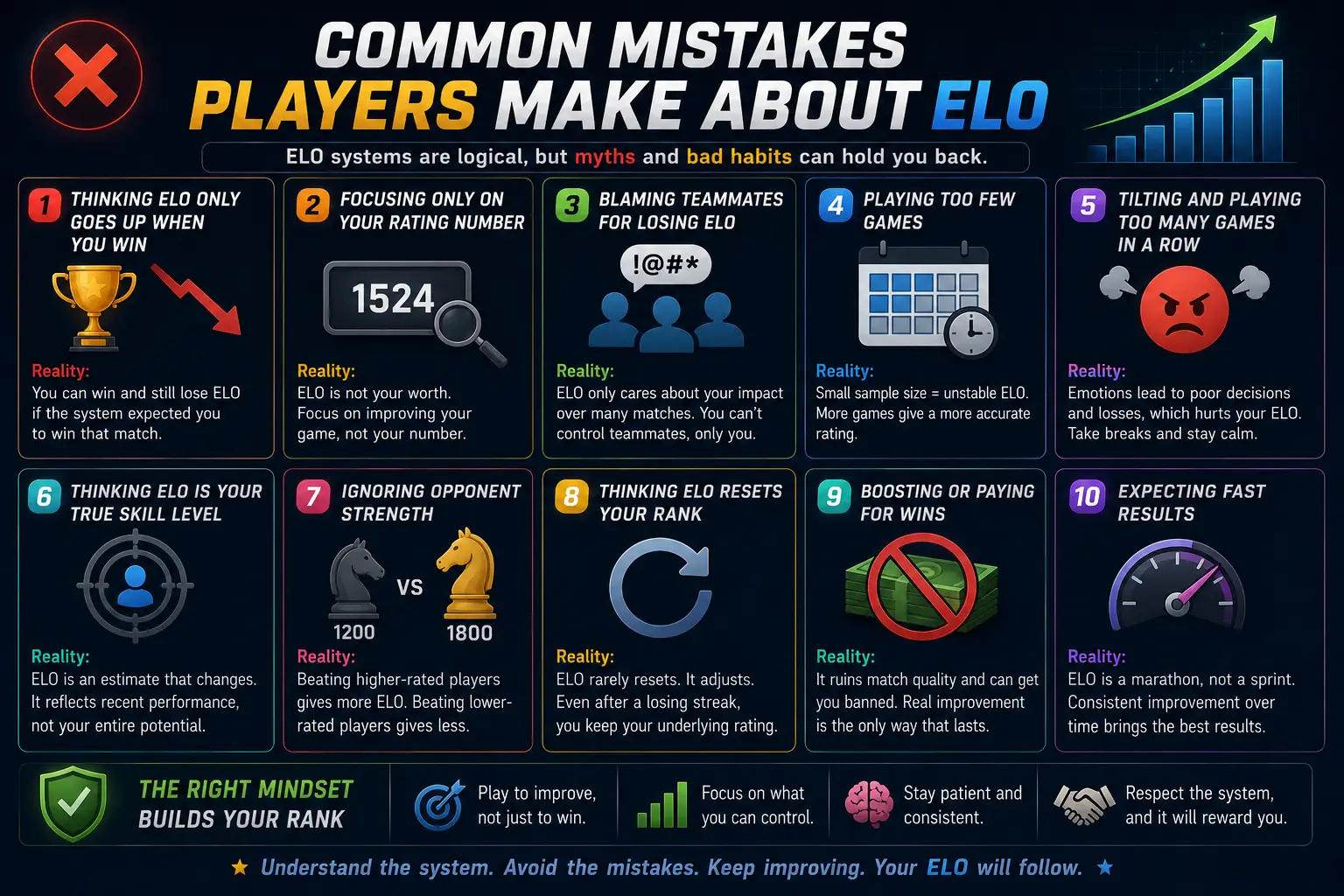
“My ELO Doesn’t Reflect My Skill”
ELO reflects your skill against your current opponents. If you’re hardstuck Gold in League, you’re a Gold-level player—accept this. Smurfs climbing fast from lower ratings prove ELO works correctly.
“I Lost ELO for a Win, the System Is Broken”
You gained LP but your hidden MMR didn’t improve. Riot uses performance adjustment intentionally. It’s not broken, just opaque.
“High Ping/Lag Explains My Low ELO”
High ping hurts your play quality, not ELO calculations. If you’re playing with 100ms latency, you deserve that ELO rating. Upgrade your connection first, then your ELO improves.
“ELO Inflation Over Time Means Nothing”
Chess ratings stayed stable since the 1970s. Dota 2 MMR inflated, but Valve fixed it in patch 7.33. Don’t obsess over inflation, but don’t ignore it either.
“Performance Stats Should Replace ELO”
Many games tried this (Overwatch, League). Players game performance metrics by padding stats without winning. ELO tied to wins is harder to cheat.
“Smurfing Ruins ELO Accuracy”
Smurfing proves ELO works—accounts climb from 1200 to 2400 MMR in 50 games at 85% win rate. The system rapidly separates high-skill from low-skill players.
“I Should Be Rank X Based on Mechanics”
Rank is based on wins and losses, not mechanics. A player with great aim but poor game sense climbs slower than a player with average aim and perfect macro. ELO captures everything: decision-making, mechanics, team play, consistency.
ELO Decay & Seasonal Resets
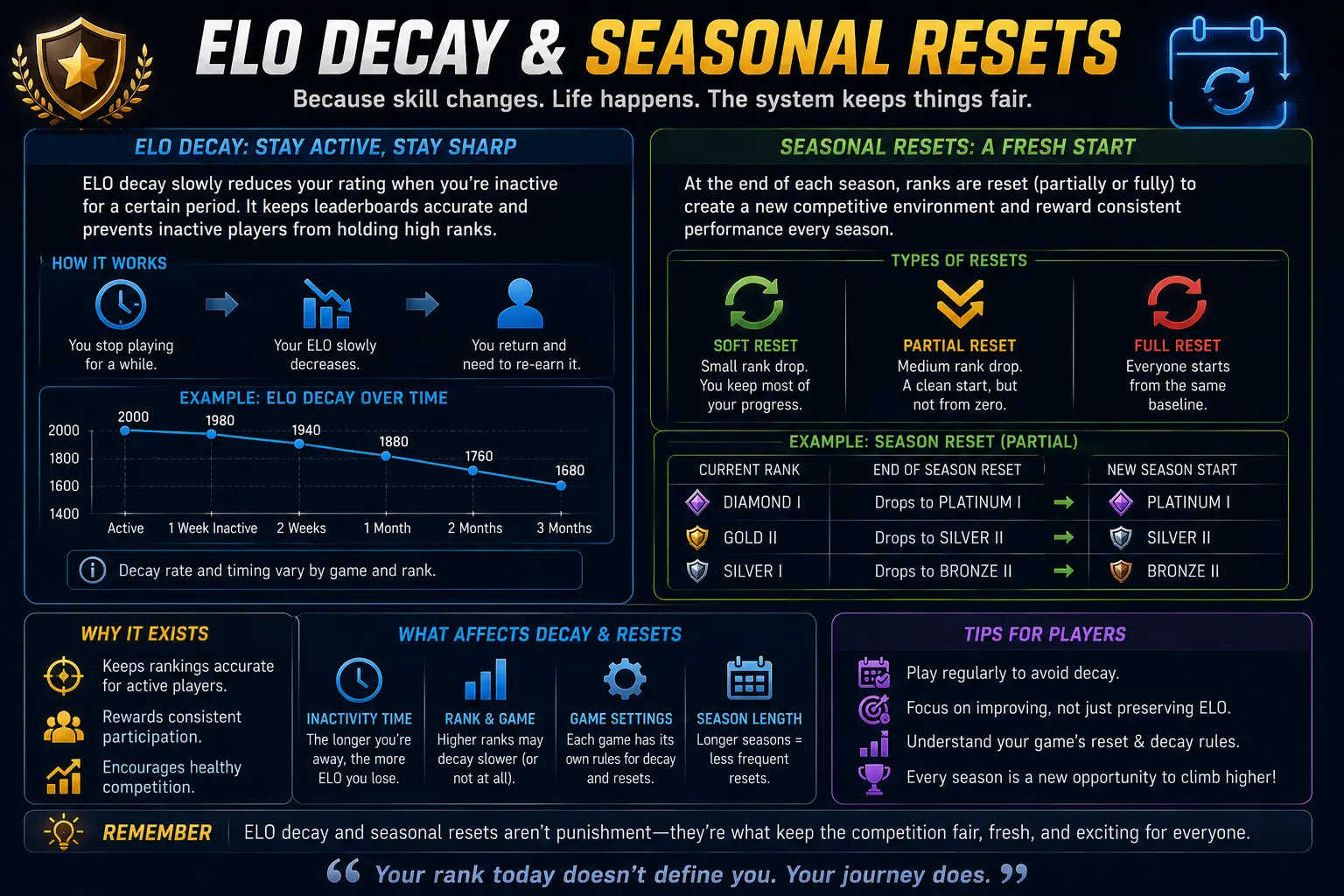
Some games reset your ELO each season. Some decay it if you’re inactive. Understanding these mechanics prevents surprise demotions.
Seasonal Soft Resets
Most games use “soft reset”: drop 100–200 from peak, keep the rest. League drops ~50 LP per tier. Valorant resets rank yearly. Dota 2 recalibrates matchmaker (no reset). Chess.com and FIDE maintain continuous ratings.
Inactivity Decay
Dota 2: −50 MMR/month after 10 days (top 500). League: −75 LP/week after 10 days (Master+). Overwatch: SR decay (OW1 only). Chess.com: No decay.
A 3000 Dota MMR player inactive for 3 months loses ~150 MMR. They rebuild via recalibration after returning.
Ping vs ELO: Key Difference
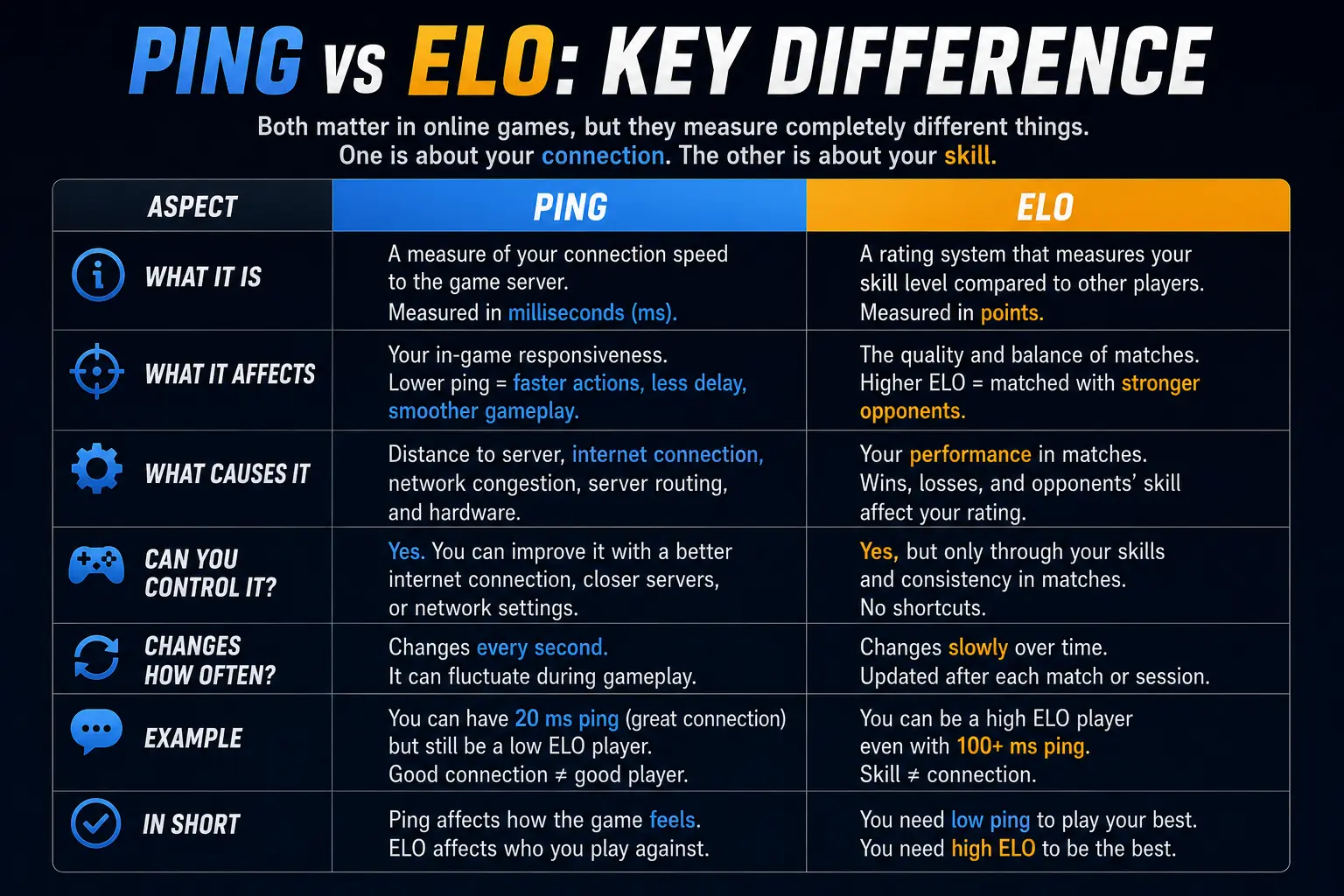
Competitive shooters have a quirk: sometimes high-ping players win fights they shouldn’t.
What Is Peeker’s Advantage?
Imagine two players in Valorant peeking a corner:
Low-Ping Player (20ms):
- Peeks corner, sees enemy
- Information reaches server in 20ms
- Sees enemy location after ~40ms total delay
- Reaction time: 200ms
- Total: 240ms to shoot
High-Ping Player (100ms):
- Peeks corner, sees enemy on screen
- Information reaches server in 100ms
- But defender sees the peek 100ms after it happened
- By the time defender sees the peek, high-ping player already fired
- Total: 140ms to shoot
Result: High-ping player wins a duel they shouldn’t have.
How Games Try to Fix It
Modern games use lag compensation to address the peeker’s advantage. Some games favor the shooter Valorant and Overwatch trust your client first. Others favor the defender—CS2 and Rainbow Six check the defender’s position before confirming a hit. Street Fighter 6 uses rollback netcode, which rewinds the game state to simulate fair conditions; this approach is the most expensive and rarely used in competitive team games.
Over 100 games, these advantages balance out if you’re skilled. Over 5 games, high-ping players do get unfair wins. Professional tournaments enforce sub-50ms ping requirements to ensure fairness across all players.
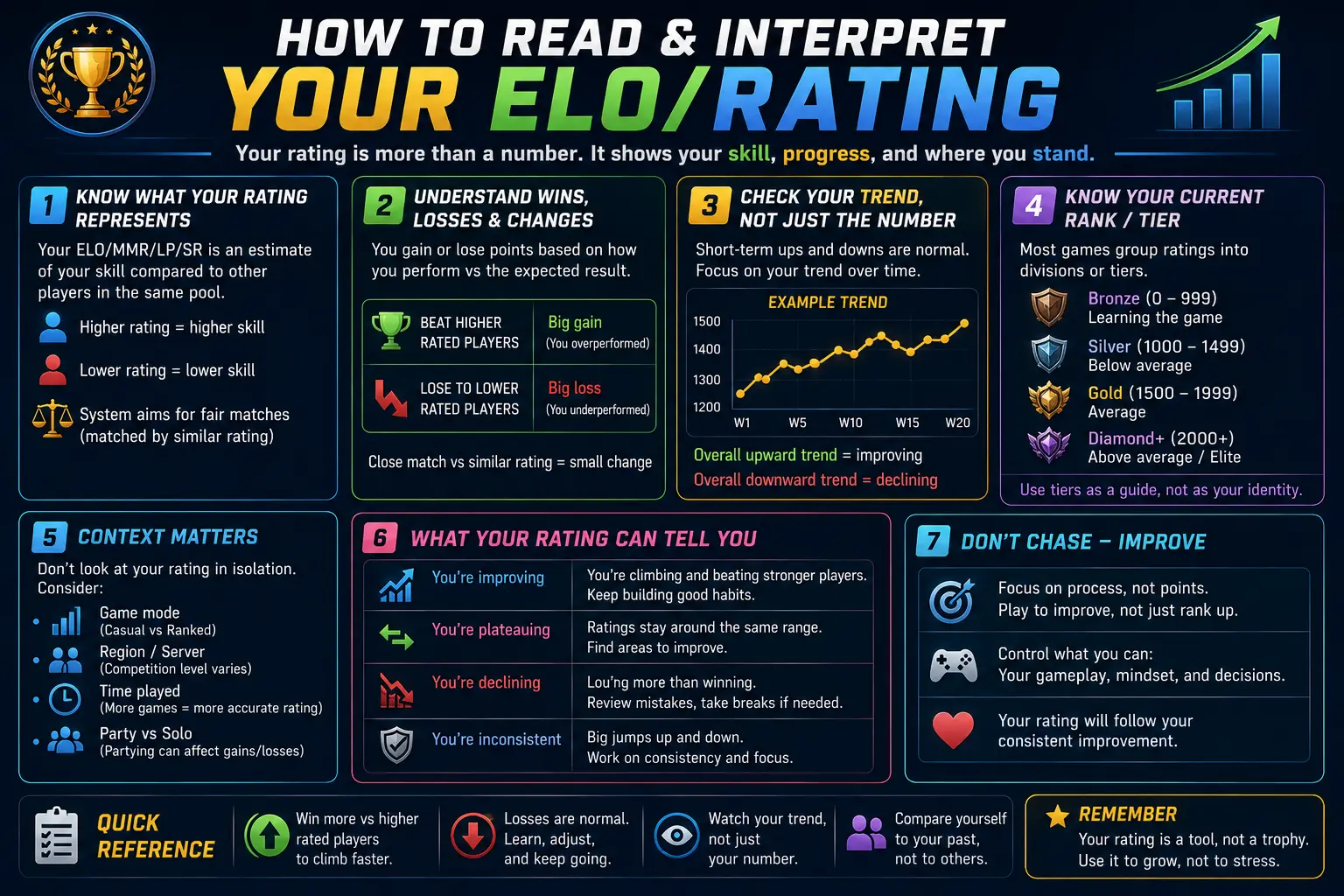
How to Read & Interpret Your ELO/Rating
On PC
Valorant shows Rank and RR in the top-right corner. League requires you to click your profile to see LP and tier. Dota 2 displays Rank medal and exact MMR in the sidebar. Chess.com shows separate ELO for each game type (Blitz: 1600, Rapid: 1800).
On Console
PS5/Xbox: Usually shows connection bars, not exact rating (exception: some Call of Duty titles show exact rank)
What to Actually Watch
Ignore 5-game win streaks (variance), monthly stats (too small), and exact LP/RR numbers (arbitrary). Focus on win rate over 50+ games. Watch your rating trend: climbing = improving, stuck = equilibrium. Climbing while facing stronger opponents = excellent sign. Players who compete in team-based games can also use LFG systems to find teammates with compatible skill levels, roles, and playstyles.
Limitations of the ELO System
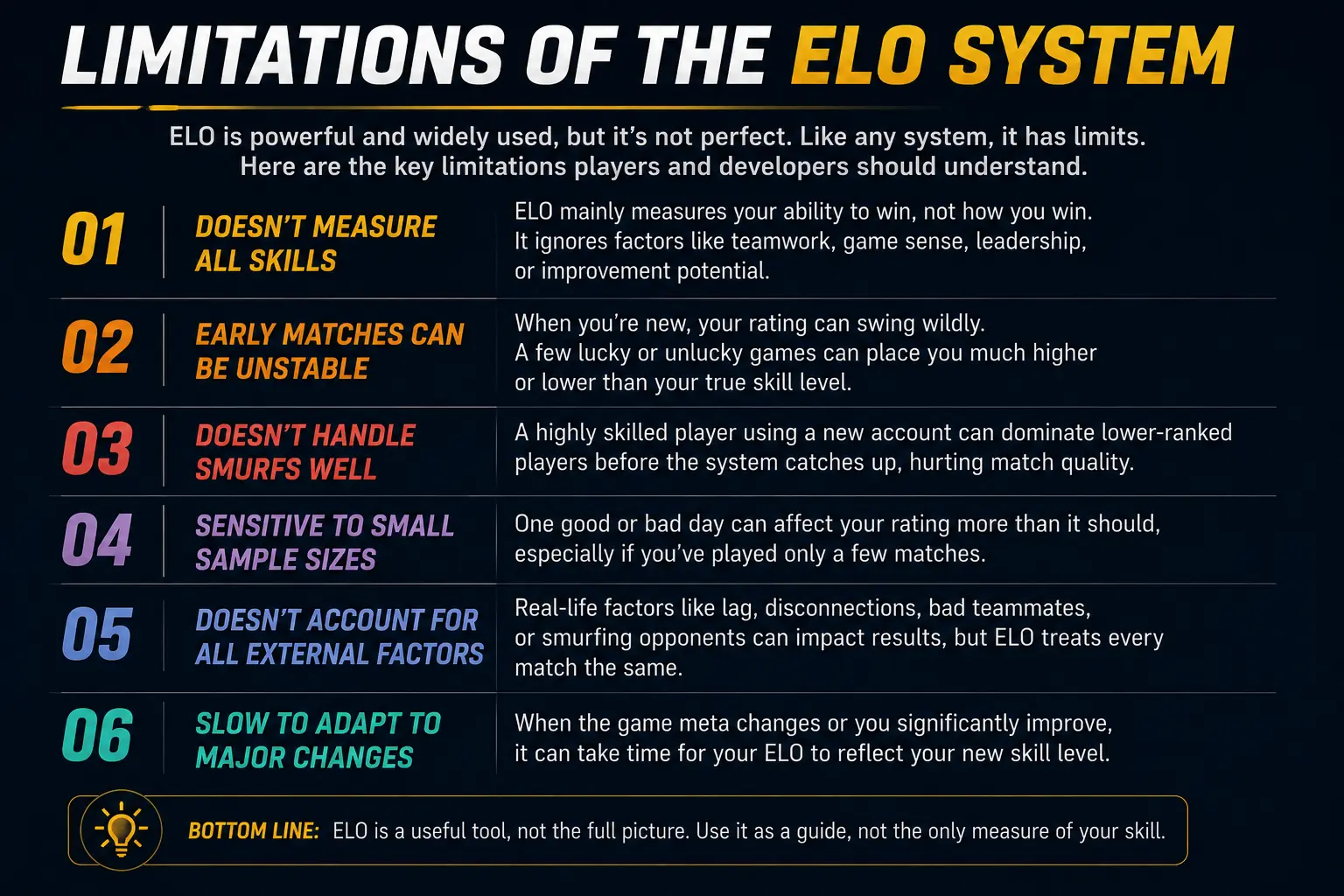
No rating system is perfect, and ELO has known weaknesses worth understanding.
- Rating inflation. As more new players join a game, average ratings can drift upward without a true increase in skill level across the board.
- Team-based distortion. Team-based distortion. In 5v5 or squad games, your individual performance is only one piece of the result. ELO cannot fully separate your skill from your teammates’ skill, and a teammate going AFK mid-match can tank your rating through no fault of your own. Learn more in our What Is AFK in Gaming? guide.
- Smurfing and boosting. Experienced players creating new accounts, or paying someone to raise their rank, distort matchmaking accuracy for everyone else in that rating range.
- Slow initial accuracy. Early placement matches are volatile. It usually takes dozens of games before your rating reflects your true skill level.
Acknowledging these limits does not make ELO useless. It just means the number is a strong estimate, not a perfect measurement.
Frequently Asked Questions
Conclusion
ELO started as a chess solution in 1960. Today it powers matchmaking in every competitive game. Understanding how it works changes how you think about ranked play.
First, ELO measures skill relative to opponents, not skill in absolute terms. A 2000 rating means you’re better than 98% of players, not that you play well objectively. Context is everything. Second, each game implements ELO differently. Chess and CS2 use pure wins. Valorant adds wins plus individual performance. League hides MMR behind visible LP currency. The math is the same; the presentation is different.
Elo Hell is genuinely real at low ranks due to team variance, but it disappears completely at high ranks where individual skill dominates. Skilled players always climb; stuck players need to genuinely improve. Your ELO over 100+ games is accurate. Stop blaming the system, teammates, or ping (unless you actually have high ping creating a disadvantage). Your rating is correct, and your skill level matches it.
Understanding what is elo in gaming helps you set realistic goals. Climbs take time. One rank promotion per 50 games is normal progress if you’re improving consistently. Faster climbs mean you’re significantly better than your current rating. Professional players obsess over ELO because it’s the universal proof of skill. Chess grandmasters rate 2700+. Valorant top players are Radiant. League pros are Challenger. Dota professionals measure 6000+ MMR. You can verify every professional player’s rating through public databases. It’s not politics or subjective opinion. Rating doesn’t lie.
The next time you think you’re stuck in Elo Hell, check your actual rating progression over 50 games. Check your true win rate against opponents rated ±200 points from you. If it’s hovering around 50%, you’re at your true skill level. That’s not a failure—that’s ELO doing its job correctly.