Is 1 Gig Internet Good for Gaming? (Everything You Need to Know)
Is 1 Gig internet good for gaming? Yes, a 1 Gbps connection is exceptional for gaming, providing more than enough bandwidth for multiple simultaneous players, massive live streams, and lightning-fast downloads. Because these plans are usually backed by fiber-optic infrastructure, they offer the lowest latency and most stable ping available.
However, an online match requires less than 2 Mbps to run smoothly. If you’re upgrading purely to stop in-game lag, download speed might not be the fix you need. Let’s break down the honest truth about gigabit gaming performance, compare it to lower speed tiers, and see when 1 Gig is actually worth the investment.
Most people assume gaming needs a fast connection to work well. It does not. Online gaming uses very little bandwidth. What it needs is low latency and a stable signal. A 1 Gbps connection gives you both of those, plus enough room for every other device in the house. Whether 1gbps gaming is worth the cost for your specific setup is a different question. This guide answers that honestly.
What Is 1 Gig Internet?
One gigabit internet is a broadband connection with a download speed of 1,000 megabits per second. This is the same tier covered in our guide on is 1000 Mbps good for gaming, since both terms describe identical speeds. Some providers also offer symmetric gigabit plans, meaning upload speeds match download speeds at 1,000 Mbps. Others offer asymmetric plans where upload speeds are lower, typically 50 to 500 Mbps.
To put that in context: the Federal Communications Commission updated its minimum broadband standard in 2024 to 100 Mbps download and 20 Mbps upload. One gigabit is ten times that minimum. It is available almost exclusively through fiber optic providers, though some cable ISPs offer it as a premium tier.
How Much Internet Speed Does Gaming Actually Need?
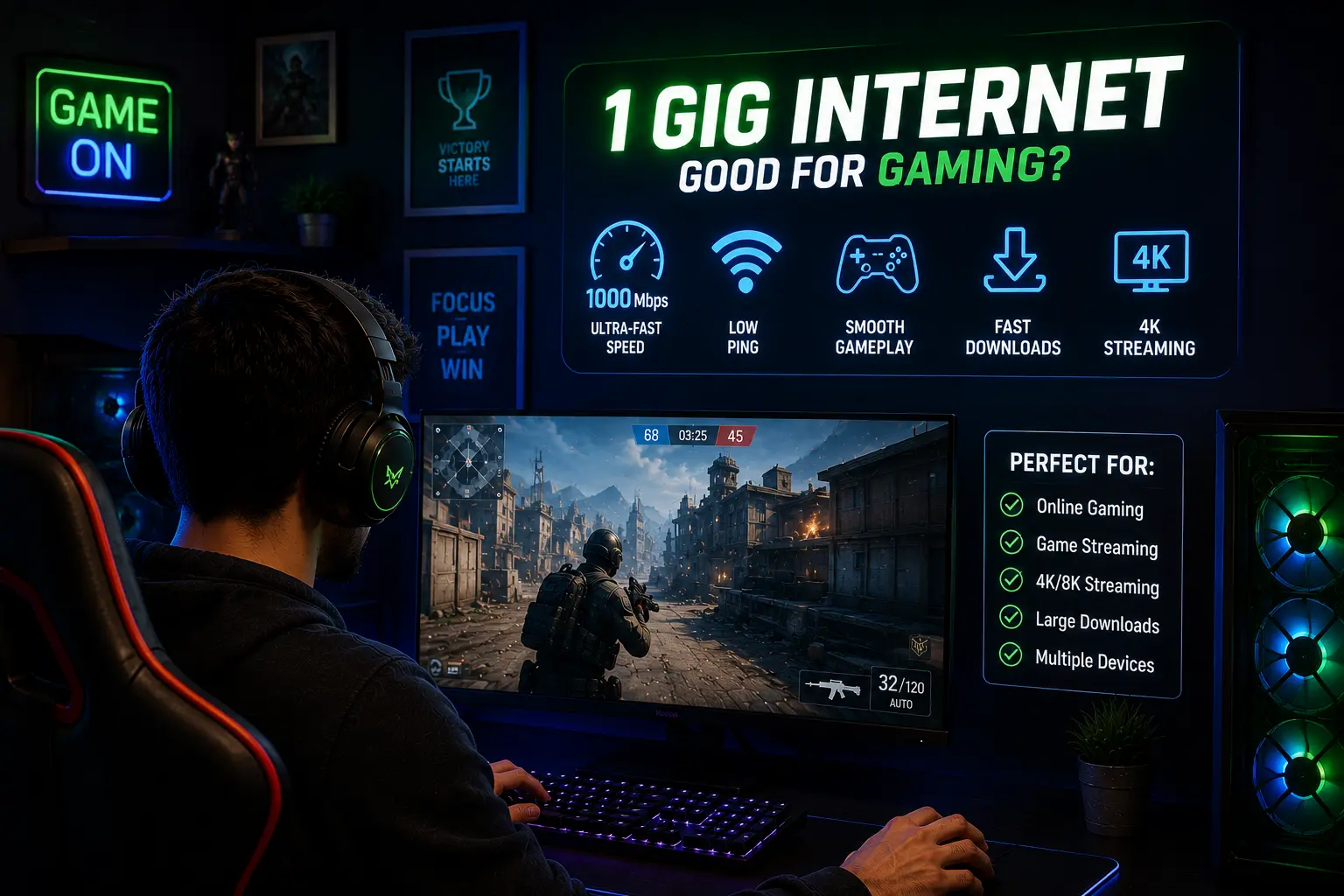
This is the part most people get wrong. Raw download speed is rarely the bottleneck for online gaming. Most games require only 3 to 10 Mbps. What matters for gaming performance is latency (ping under 30ms), jitter (consistency of latency), and upload speed (1 to 5 Mbps for most titles).
That means a 25 Mbps connection is technically enough to play online games. So why does gigabit matter at all? Because gaming does not happen in isolation.
While you are in a match, other things share your connection. A family member streams 4K video. Someone downloads a game update. Your console pulls a background patch. Your smart TV auto-plays a trailer. The real data drain usually comes from game downloads, patches, and updates, which can reach tens of gigabytes each. Those downloads compete directly with your active gaming session and spike your ping at the worst moments.
A gigabit connection eliminates that problem entirely. Everyone in the house gets what they need, and your gaming session stays untouched.
How Much Data Do Games Actually Use Per Hour?
Games like Fortnite and Overwatch 2 use anywhere from 100MB to 150MB per hour. League of Legends uses about 45MB per hour. Call of Duty: Warzone uses up to 160MB per hour. MMORPGs like World of Warcraft use around 40MB per hour.
To convert that into Mbps: 150MB per hour equals roughly 0.33 Mbps of sustained usage. You could run a competitive gaming session on a dial-up connection and not notice the bandwidth limit. What you would notice is the latency. That is what fiber and gigabit solve.
| Game | Data Per Hour | Bandwidth Required |
|---|---|---|
| Fortnite | 100 to 150 MB | Under 1 Mbps |
| Warzone / CoD | 150 to 250 MB | 1 to 2 Mbps |
| Valorant | 100 to 280 MB | Under 2 Mbps |
| League of Legends | 45 to 60 MB | Under 0.5 Mbps |
| World of Warcraft | 40 MB | Under 0.5 Mbps |
| Minecraft (multiplayer) | 40 MB | Under 0.5 Mbps |
What 1 Gig Internet Actually Gives You for Gaming
1. Extremely Low and Consistent Latency
Fiber is the gold standard for gaming. It delivers the lowest and most consistent latency, not just faster download speeds. Gigabit plans almost always run on fiber infrastructure. Fiber does not share capacity with neighbors the way cable does. During peak evening hours when cable connections slow down and ping spikes, fiber stays stable. That stability is what competitive gamers pay for.
2. Fast Game Downloads and Updates
A 50 GB game update on a 100 Mbps connection takes about 67 minutes. On a 1 Gbps connection, the same download takes under 7 minutes. You spend less time waiting and more time playing. Over a year of regular patches, firmware updates, and new game installs, that difference adds up to hours.
3. Room for Everyone in the House
For households with multiple gamers or simultaneous streamers, 100 to 500 Mbps keeps everyone connected without a drop in performance. At 1 Gbps, you have ten times that capacity. Two people gaming, two people streaming 4K, one on a video call, and several smart devices can all run simultaneously without any of them affecting the others.
4. No Bandwidth Throttling Conflicts
Some ISPs throttle connections during peak hours when usage climbs on their network. A gigabit plan on fiber typically does not experience the same congestion that cable connections do at 7pm on a Friday night. For competitive players, consistent ping matters more than peak speed. Fiber at 1 Gbps delivers both.
When 1 Gig Internet Is Worth It for Gaming
You have multiple gamers in the house. Two or three people playing different online games at the same time barely dent a gigabit plan. On a 100 Mbps plan, their combined traffic plus streaming and background apps can start creating congestion.
You stream while you play. Streaming to Twitch or YouTube at 1080p 60fps requires around 6 Mbps of upload speed. Combined with your gaming session, downloading updates, and voice chat, upload bandwidth on slower plans fills up fast. A symmetric gigabit fiber plan removes that ceiling completely.
You download large games regularly. Modern AAA titles regularly exceed 100 GB. Call of Duty: Warzone has surpassed 200 GB including updates. On a 1 Gbps connection, a 100 GB download completes in about 13 minutes. On a 100 Mbps connection, the same file takes over two hours.
You want game updates to not interrupt play. On a slower plan, a background update can spike your ping mid-match. On gigabit, updates download so fast they finish before they have time to cause noticeable interference.
When 1 Gig Internet Is Not Worth It
You live alone and only game. One person gaming, occasionally streaming a movie, and browsing the web will never come close to needing 1 Gbps. A 200 to 300 Mbps plan on fiber delivers the same gaming performance for less money. If you’re deciding between mid-range and gigabit internet, our Is 500 Mbps Good for Gaming? guide explains when a 500 Mbps plan is the better value for most gaming households.
You are on a tight budget. Gigabit plans cost significantly more than mid-tier plans in most markets. If your current connection already delivers under 30ms ping and stable speeds, upgrading purely for gaming is unlikely to improve your gameplay.
You use Wi-Fi for gaming. A gigabit plan paired with a Wi-Fi connection is like putting premium fuel in a car with a clogged engine. Your router becomes the bottleneck. To get true benefit from 1gbps gaming performance, you need a wired ethernet connection. The speed reaching your router means nothing if Wi-Fi introduces its own interference and inconsistency between the router and your device.
1 Gig vs Lower Speed Plans for Gaming
| Scenario | 100 Mbps | 500 Mbps | 1 Gbps |
|---|---|---|---|
| Solo gamer, no other devices | More than enough | Overkill | Overkill |
| 2 to 3 gamers simultaneously | Fine with headroom | Comfortable | Plenty |
| Gaming plus 4K streaming | Can cause spikes | Comfortable | No conflict |
| Large game downloads (100GB+) | 2+ hours | Under 30 min | Under 15 min |
| Peak hour congestion (cable) | Common issue | Moderate | Rare on fiber |
| Streaming to Twitch while gaming | Upload bottleneck | Better | Best |
The Honest Verdict on 1 Gig Internet for Gaming
1gbps gaming delivers a genuinely better experience, but not because of speed. It delivers better gaming because gigabit plans almost always mean fiber infrastructure, which means lower latency, more consistent ping, and no congestion during peak hours.
If you are a serious competitive player, a streamer, or part of a household where multiple people game and stream simultaneously, the upgrade makes sense. If you game alone on an already stable fiber or cable connection with sub-30ms ping, a gigabit plan adds very little to your actual in-game performance.
The number that matters most for gaming is not download speed. It is ping. Fix your ping first with a wired ethernet connection and the right server region. If you have already done that and your connection still feels unstable, then upgrading to 1gbps gaming on fiber is the next logical move.
Frequently Asked Questions
Conclusion
A gigabit connection is excellent for gaming. It removes bandwidth as a variable entirely and usually comes with fiber infrastructure that keeps your ping low and consistent even during peak hours. For a household with multiple users and devices, it is a practical upgrade. For a solo gamer on an already stable connection, the performance gain in actual gameplay is minimal.
Plug in a cable, pick the right server region, and check your ping. If both are already solid, you are already gaming well. If they are not, a gigabit fiber plan is one of the cleanest ways to fix both at once.